Heroes of the Soviet Union
The Second World War provided a great shock to the history, development and psychology of the peoples of the Soviet Union.
Kyrgyz contingents played a part in defending the motherland – of a population of just over one and a half million, some 363,000 went to fight – and 160,000 were killed. That’s 45% of those who went to war and 11% of the total population. The population of the Khirghiz SSR was literally decimated.
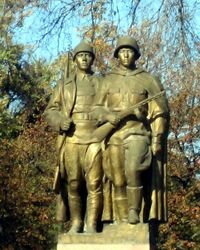
Kyrgyz soldiers served in a number of combat theatres – including the battle for Kursk, the road from Stalingrad to Latvia and the final push for Berlin in 1945. In the Frunze Museum, in Bishkek there is a small exhibition on the third floor outlining their role in the battle. It is sometimes said that these contingents served as “canon fodder” – but there is no doubt of the bravery exhibited by some of their number. Some 73, (one source says 76), of the combatants were honoured as “Heroes of the Soviet Union” and many more received other honours. Some of them have museums and memorials dedicated to them and schools, roads, and even villages named in their honour.
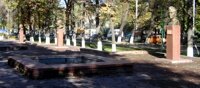
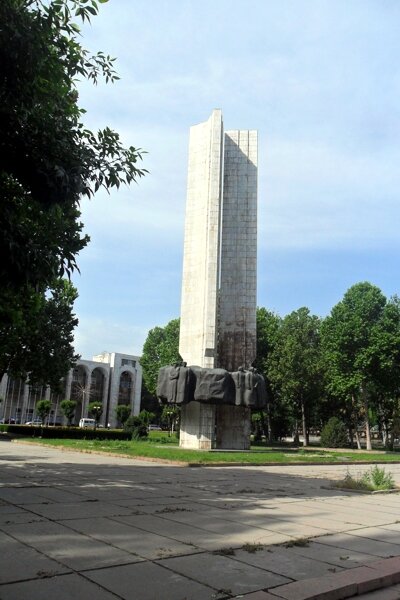
Perhaps the most famous of all exploits of soldiers from Central Asia was that of the 28 “defenders of Moscow” under General Ivan Panfilov. On November 16th, 1941, an Almaty infantry unit was wiped out fighting off Nazi tanks in a village outside Moscow. In Almaty there is a striking war memorial including individual plinths, each with the name of one of the 28. In Bishkek, as well as the statue of Panfilov, outside the White house – on the plinth of the statue, there are some reliefs of soldiers in battle – three of the Kyrgyz members of the unit are also honoured with busts in Alley of Heroes (located in the central reservation in Molodaya Gvardia – “Avenue of the Young Guards” – where it crosses Prospect Chui) They are:
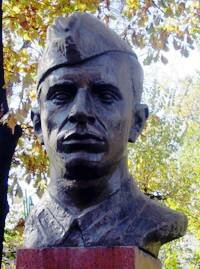
Nikolai Ananyev – born in a village on the northern shore of Lake Issyk Kul. The village has been renamed in his honour;
Dushenkul Shopokov – born in 1915 in the village of Shalta, to the West of Bishkek in Chui province, and before the war he worked as a tractor driver on a collective farm. The village has been renamed in his honour, as have schools in Tash Kumyr, the Sokoluk and Uzgen regions.
Gregoriy Konkin – born in the village of Kyzyl Suu, near Jety Orguz at the Eastern end of Lake Issyk Kul.
Other members of the Panfilotsvy not commemorated here were: Gregoriy Shemyakin, Ivan Moskalenko, Gregoriy Petrenko and Ivan Dobrobabin.
The other three heroes in the “Alley” are:
Moskalenko – born in 1912 in Grigorievka, just over the border in Kazakhstan. In 1941, he was in an infantry unit which destroyed some 18 enemy tanks.
Petnenko – born in 1909 in Russia – and a member of the same unit as Moskalenko. He also had a ship named in his honour.
Tuleberdiev – born in 1912 in a small village called Chimkent in the Talas oblast. He was serving on the Don River in 1943 and part of a unit assigned to a particular task. A pill-box containing a machine gun emplacement threatened to wipe out the unit – and Tuleberdiev tried to destroy it with a grenade. When the grenade failed to explode he used his own body to block the machine gun so that his comrades could, thanks to his self sacrifice, escape the fire and continue on to succeed in their mission.
Amongst the other heroes honoured for their deeds were:
Dimitriev – The first Kyrgyz soldier to be awarded the title, for his actions in the battle for Borisovo (in modern-day Belorussia) when he, single handed destroyed two enemy tanks in July, 1941 -less than a month after three million German forces stormed across the border in Operation Barbarosa.
Asanov – In four battles in 1943 he personally destroyed eight German tanks, six armoured cars and accounted for 40 enemy machine gunners. In one of these battle he continued the fight alone, all of his compatriots having been killed – and succeeded in destroying two tanks. He survived the war and continued his military career, establishing the military academy in Bishkek and becoming the military commissioner for the Lenin District of the capital and, in 2007, he published a book about military theory.
Kaikira – born in 1910 in a village near Tyup, he served in a cavalry decision and in 1945, in Belarus, he sacrificed his life destroying a tank with a hand grenade so that his squadron could pass on to complete it’s mission. There is a bust of him in Tyup – where there is also a park named in his honour.
Pasco – a pilot who flew 780 night missions, dropping over 90 tons of bombs on many strategic target.
Zharkinabaev – born in 1911 in the village of Tashtak on the northern shore of Lake Issyk Kul – the next village to the East of Ananyevo. In 1944, he was a “gun-layer”, an observer, and he single-handedly killed half an enemy platoon with his machine gun, on the Ukrainian front, saving a vital bridgehead. He survived the war and eventually died in 1969 – and the village was renamed in his honour.
We don’t have the names and stories of all the “Heroes”, but amongst their numbers are: Alinazarov, Asanaliev, Azimov, Begaldinov, Belyandr, Capodznikov, Chimenko, Chorthekova, Kalashnikov, Krikun, Kurochkin , Mazkov, Otorbaev, Pichugin, Suhkin, Taranchiev, Teshebaev, Tichonov, Tsarenko, Usenbekov, and Yakubov.
Amongst the other notable acts of heroism were:
Furtzev – one of the defenders of the “Hero Fortress” of Brest, (in modern-day Belorussia), in the opening days of the war. The garrison of some 7-8000 soviet defenders, (including some Kyrgyz soldiers amongst the 30-odd nationalities represented), held out against the invaders for almost six weeks, fighting off some 6 or 7 attacks each day.
Sadyrbaev – In a campaign in the Caucasus, he caught and threw back to the enemy a total of 16 grenades. It was only as he held the seventeenth in his hand, ready to throw back to the enemy, that it exploded killing him.



 Bishkek