Kyrgyzstan and the Second World War
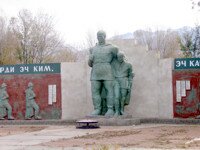
In Western Europe the Second World War is usually considered to have lasted six years from 1939 to 1945, however, hostilities probably really began with the Japanese invasion of Manchuria in 1933. Different combatants entered the war at different times: for the Americans the war began with the bombing of Pearl Harbour on December 7th, 1941 and for the Soviet Union it commenced with the German invasion on June 22nd, 1941.
In the Soviet Union, the War was referred to as “The Great Patriotic War” – it provided a great shock to the history, development and psychology of the peoples of the Soviet Union.
In the remaining months of 1941, following the invasion, the advancing German forces seized virtually all of the European part of the Soviet Union. Although far from the front, Kyrgyzstan was not to escape the effects of the conflict.
From every town and village, people joined the military. Out of a population of just over one and a half million, some 363,000 went to fight – and 160,000 were killed. That’s 45% of those who went to war and 11% of the total population. The population of the Khirghiz SSR was literally decimated.
Kyrgyz soldiers saw action from the first engagements of Operation Barbarosa (the codename for the German invasion of the Soviet Union) to the assault on Berlin. They served in a number of combat theatres – in all branches of the armed services – including the battle for Moscow, the Battle of Kursk, on the road from Stalingrad to Latvia, in Belorussia, in Moldovia, in the Ukraine, in the Caucasus, on the Dneiper, the relief of Leningrad, in Poland and the final push for Berlin in 1945.
Operation Barbarossa, began at 03:15 on 22nd June, 1941, when an army of three million German soldiers, launched a three pronged attack into Soviet territory. They were joined in the next few weeks by troops from Italy, Romania Hungary and other allies of the Nazi regime. Advances were swift, with German Panzer divisions encircling huge numbers of Soviet troops in isolated pockets which the infantry then advanced upon.
One of the first actions of the campaign was against the town of Brest, (in modern-day Belorussia), but the garrison of some 7-8000 soviet defenders, (including some Kyrgyz soldiers amongst the 30-odd nationalities represented), held out against the invaders for almost six weeks, fighting off some 6 or 7 attacks each day. Their gallant defence earned the Brest Fortress the name “Hero Fortress”.
Back in Kyrgyzstan, the response to the invasion was quick. A rifle division under Major General Panfilov was established, and recruits attracted from both sides of the Kyrgyz-Kazakh border. Twenty eight soldiers of the division, including the General, were to die in the November at the height of the Battle for Moscow, as they faced and halted a German Tank advance. Detailed accounts of the engagement differ, but the infantry men faced between 30 and 50 tanks, or even 80. Their sacrifice earned them the honorific title “The Defenders of Moscow” and they also became known as “The Panfilotsy”. Amongst their number, from Kyrgyzstan were: Dushenkul Shopokov, Nikolai Ananev, Gregoriy Shemyakin, Gregoriy Konkin, Ivan Moskalenko, Gregoriy Petrenko and Ivan Dobrobabin. They were honoured as Heroes of the Soviet Union and several had villages named in their honour, such as Ananyevo and Shopokov.
They were not first Kyrgyz soldiers to be declared Heroes of the Soviet Union. This distinction goes to NM Dimitriev. He was awarded the title for his actions in the battle for Borisovo (also in Belorussia) when he, single handed destroyed two enemy tanks in July.
Neither were they the last … in all some 73 (one source says 76) combatants were awarded this honour. Many thousands were awarded other medals – sometimes, apparently, in the chaos of war they didn’t know about it until many years later.
There was also the “battle” on the “Home Front”. Back in Kyrgyzstan there were many changes underway.
One of the most dramatic was the influx of different nationalities as whole populations were transported East, away from the Front, and the advancing German armies. In particular this included large numbers of ethnic Germans. One of the reasons for this was the fear that they would associate with the invaders and form a “fifth column” of sympathisers and collaborators. In Central Asia they would be isolated and easier to monitor and control. Other groups that were transported included Koreans, and prisoners of war – both German (who were employed in building the railway from Bishkek to Balykchi) and Japanese (who were encamped at Tamga on the southern shore of Lake Issyk Kul – where they were employed in the construction of the Sanatoria).
Manufacturing industry in Kyrgyzstan was turned over to the supply of war materials – not just arms and machinery, but also such things as clothing and food products.
Many important industries were also evacuated away from the encroaching front line to the relative safety of Central Asia. In all some 64 major enterprises were completely relocated … from areas as diverse as the Donetzskoy oblast, Kiev, Kursk, Odessa and Rostov. Amongst the factories, Engineering and Technical workshops evacuated, there were also shoe factories and leather works, distilleries and sugar factories. Most of them relocated in the Chui valley, although some were redirected to Osh, Djalal Abad and Issyk Kul. In many cases they were transported complete with their equipment and workforces.
It was also during the war years that Kyrgyzstan got its own film studio – the last of the Central Asian Republics to do so. As with many other industries, the studios of Moscow, Leningrad, and Kiev were evacuated from the path of the advancing German armies and were transplanted to the safety of the Soviet Union’s vast interior. As a result, for example, Eisenstein’s classic “Ivan the Terrible” was shot in Alma-Ata, (Almaty). After the war, when the western Russian studios returned to their original bases, they left much of their equipment behind in their temporary homes, further-boosting Central Asian filmmaking in terms of facilities.
Another “benefit” that the war brought to Kyrgyzstan was that in 1943 a branch of the All Union Academy of Siences, which was at that time based in Moscow, was established in Frunze (now Bishkek), and some of the departments were transferred to Kyrgyzstan, away from the front. This was to form the kernel of the republican Academy of Sciences which was formally established in 1954.
In addition to the enterprises evacuated to Kyrgyzstan, during the war years another 36 new enterprises were established.
In all, during the first six months following the outbreak of hostilities, over 60,000 evacuees arrived in the Republic, and by the end of 1943 this had more than doubled, to about 140,000. The local authorities were mobilised to offer assistance to those uprooted .
Although the war years led to an increase in industrial production, the Khirghiz SSR was at the time, (as now), a major agricultural center in the USSR. Life changed considerably “down on the farm” as well as in the more industrial urban centres. With the majority of the male population involved in the war effort, much of the responsibility in agriculture fell onto the shoulders of women.
There were remarkable improvements in agricultural production. For example, the Kyzyl Asker collective farm in Sokoluk harvested more than three times the amount of sugar than called for in the annual plan – and, although this represents the “outstanding performance”, it was no means unusual. The production of cotton, a vital component for the war effort, was also exceptional.
The population donated many things to help the armies at the front … not just in terms of money, (for example, by foregoing a part of their salary), but also valuables such as gold and silver jewellery, everyday objects such as clothes and food. It has been claimed that the citizens of Kyrgyzstan contributed sufficient to pay for the construction of almost 100 tanks, or nearly 200 warplanes. Over 100 wagons of food was sent for the relief of Leningrad. (During 2006 there was an appeal by some politicians to revise this spirit in order to raise funds in order to pay off part, or all, of Kyrgyzstan’s national debt.)


 Bishkek