Behind the wheel
Have you ever noticed how something happens to people whenever they get behind the steering wheel of car?
It’s as if the body of the car becomes a shell and the driver takes on a new persona. They become aggressive, selfish, thoughtless, inconsiderate to other road users – pedestrians as well as other drivers – and possessive – of the road and their place an it as much as of the vehicle itself – as if they own it.
It happens the world over – and Kyrgyzstan is no different from other places in this respect. A friend of mine, John, who was as a consultant on a year long project with one of the donor agencies, used to get really worked up about it. He hated travelling in taxis and when we sitting on patio outside a cafe, the conversation would often be punctuated with outbursts of “Look at the idiot! He almost ran that woman over”, as he pointed to some vehicle swerving round a corner.
As I said, it happens the world over, and even though I would point out that he has lived in other places where the drivers were as bad, if not worse, (including London), he simply said that he couldn’t get accustomed to the fact.
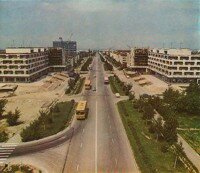
It doesn’t help that there is now so much traffic on the streets of Bishkek. When I first came here there were very few cars. We joke that it was possible to cross the street without looking – because you could hear any vehicle approaching. One of my favourite photographs of Bishkek is in an old guidebook, (from 1978), and shows a view of a long straight street stretching into the distance flanked by apartment blocks and is captioned “One of the city’s main streets“. If you look at it closely you can see some buses and two cars travelling the asphalt – with another two parked at the side. (I often wonder what a photograph of “one of the city’s main streets” in a 1978 guide book of London would have shown.)
The only place I have been where I saw fewer cars was in Albania – there were lots of minibuses, and motor scooters, but I saw only one car – a luxury limousine carrying some high ranking government official in the capital, Tirana. That was a few years ago and I expect it is quite different now.
It is certainly quite different, nowadays, here in Kyrgyzstan. There are many more vehicles and you have to be careful crossing the street.
The “Kerb Drill” that I learned as a child, (“Look right, look left, look right again and if all is clear – cross”), needs a minor adaptation because they drive on the right here – but it stands me in good stead.
In fact, the number of vehicles on the roads is one of the major changes that I have seen in my time here in Kyrgyzstan – along with the rise in the number of cafes and restaurants, and the amount of new building that is taking place. It’s not just the number of cars, but also the type. If before the majority of vehicles were old old Soviet models, over the years the number of imports has increased exponentially. At first they were second hand cars purchased in Germany and driven back here. In fact there was a quite a business in doing this and I know several people who used to earn their living this way. After a while, as the Germans became more strict about issuing visas, the cars were being bought in the Baltic countries - and even from Japan.
Now, there are a lot of new vehicles – not second hand and used vehicles. Also a lot of them are “jeeps” – here, that means Four Wheel Drive, (4WD), and elsewhere might be referred to as SUVs, (Sports Utility Vehicles), or People Carriers. They are not cheap – so there does appear to be some “money” here in Kyrgyzstan – or, at least, here in Bishkek.
A car is an important status symbol here – as I suppose it is around the world.
It also provides a source of income for many people. As people find themselves out of work they look for alternative ways of raising cash – and many see the car as the way to do this … they become taxi drivers.
When I first came here, people would stand on almost every street corner, with their arm held out and the hand waving up and down. They were hailing “taxis” – but in those days a taxi would be any vehicle with a spare seat. People would simply stop and ask where you wanted to go, and if it was in the right direction – they were going that way anyway – then they would say “hop in”. If it seems like “hitch hiking” or “thumbing a lift”, there was a subtle difference. You were expected to pay for the lift – to help cover the cost of petrol.
Soon, cars were touring the streets looking for potential customers – then the drivers found that they could stop at a road junction and so save on petrol whilst they were cruising the streets. Drivers who earned their living this way would put little lamps on the roof of their vehicles – sometimes it was simply a torch bulb with an up-turned plastic cup, painted with different coloured squares placed over it. Then someone brought in and started selling rooftop lights that displayed the word “Taxi” – or TAKSI or Такси ion Cyrillic. Eventually, a number of Taxi Firms started up and offered a variety of services – including being able to telephone and book a car – a “door to door” service with a driver from a recognised source and who could be traced again if, for example, you left something in the car.
Here, there is no form of licensing for taxi drivers – there is for other forms of public transport, buses and minibuses, but not for taxis. It has been suggested to introduce such a scheme, but has not been enacted, so far. When the authorities want to crack down on the rise of informal taxis, then they either use the tax inspection to check to see if the drivers have registered and purchased a “patent”, or the traffic police carry out spot checks on “Tech Passports” – the certificate of road worthiness for the vehicle – neither of which is a particularly effective method of control. What’s more, although there are plans to introduce it, there is no requirement for the driver to have any insurance cover.
It always amazes me that people seem to think – “I have a car, I have a driving license – so I can be a taxi driver”. Sometimes, I have had people come to me looking for work and they describe themselves as a “Professional Driver“. I usually ask them what that means, and in most cases it seems to mean that they have driven as a taxi driver for some time. When I point out that there used to be, (and, incidentally, still is), an official job classification as a “Professional Driver” which involved special training and a lot more than just passing a simple driving test – the applicant normally looks at me with a blank face of astonishment.
So, perhaps it is not so surprising that many drivers are thoughtless, selfish, and inconsiderate of other road users – pedestrians or other drivers.
It’s not just when they are driving – but also when they park. Some of them seem to spot a space and grab it – regardless of the fact that it blocks in other vehicles – or is across a driveway.
Parking is becoming a big issue in the city. Almost any new building project has to include parking provision – and underground garages are now becoming widespread. In the city center there are some areas designated as parking lots and a fee is levied for their use, whilst there are several “stoi-ankas” scattered around the city for people to leave their vehicles overnight – again, for a fee.
It seems funny to me that the authorities have adopted several things from the West to try and help alleviate and control traffic and traffic flow, such as speed radar guns, the breathalyzer, (which is rarely used by the way), and video surveillance (which is still in it’s infancy here). They have the GAI, (traffic police), stand at the roadside and stop vehicles – exacting fines for all sorts of offences – real or supposed – but they haven’t taken up the idea of Parking Meters, Parking Bays, or Traffic Wardens.
Maybe, however, that is something that is still in the pipeline.
For the record – in case you are wondering … yes, I can drive – but I don’t.
Although, I though about applying for a driving license when I was old enough to do so, I didn’t get round to it until I was in my thirties. I didn’t have a car – and didn’t see the need for a license. When I did come to learn how to drive it was a bit of an ordeal – and as a result I would recommend that everyone learns earlier rather than later.
When I came here, I took out an International Drivers’ License which meant that I could drive here. After a while, however, I had to apply for a local license. I had to attend classes and sit the Driving test all over again. That was “fun” … I was really glad when the GAI finally handed me my document. Unfortunately, I kept it in my wallet and one day – you guessed it – I lost my wallet.
Back in the UK, it is “no big deal” to get a replacement – it is, or at least was, a simple clerical procedure. Not here. I had to go through the whole Driving Test again. I said “Never again!” and when I lost my wallet a second time … I know, I know – how careless of me! Lady Faversham would not be impressed … I kept to my word.
As it happens, it’s not a big handicap … Bishkek is quite small and I can easily walk to most places in the city center, and I have drivers I can ask to take me places if I am in a hurry or need to go further afield … and there are nearly always Taxis available – I don’t share John’s dislike of them.


 Bishkek