Manas Airport
Something unusual happened on August 20th, 1922, that was going to play an important part in the history and development of Kyrgyzstan – the first airplane arrived in Pishpek – as Bishkek was then called.
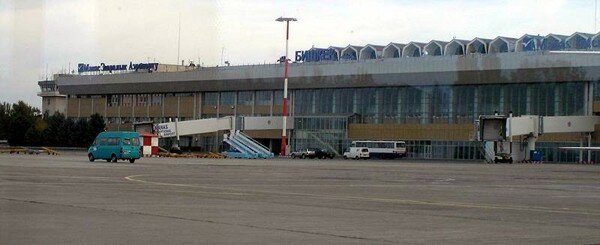
Manas Airport
It didn’t arrive at Manas airport, though … that was not built until some fifty years later. The first airfield was to the South of the city center, just past Ahunbaeva Street – between the city center and the mountains. The old building still stands and the Ak-Keme hotel was built on the grounds, and has since been joined by a host of other new buildings.
The runways ran North-West to South-East and actually crossed what is today Prospect Mira.
The new airport was named Manas after the legendary hero of the Kyrgyz – following a suggestion by the famous Kyrgyz author turned diplomat, Chinghiz Aitmatov. It was built in 1974 to cater for the growing city and the larger, more modern aircraft of the 1970’s, and the 13800 foot runway – over 3000 meters,was suitable for some of the Soviet Union’s bombers – and was to prove an important point when it came to serving the large American transport planes used in Operation Enduring Freedom.
The first plane carrying the then Soviet Premier, Alexei Kosygin, arrived in October 1974, and the first scheduled flight (between Fruze and Dromodedova airport in Moscow) began in May the following year.
The airport continued operating and underwent a programme of modernization in 1988, making it one of, if not the, most up-to-date airports in the Central Asian region.
When Kyrgyzstan declared Independence, in 1991, the airport passed to new management – becoming a part of the national airline in 1992, (Kyrgyzstan aba Zholdoru), which had been formed on the basis of the staff and equipment of the Soviet National Airline, Aeroflot that remained in the country following the break up of the USSR.
It offered scheduled services to to about fifty destinations throughout the countries of the CIS, (Confederation of Independent States), as well as charter services to China, Turkey and Saudi Arabia. In 1994, the first truly International flight began with the scheduled flight to Istanbul operated by Turkish Airlines. Over a period of time, however, the number and range of flights was reduced … partly as a result of a shortage of jet fuel, and Almaty in Kazakhstan, just four hours away by car and a wider range of destinations served, became the gateway favoured by many travelers.
A lack of investment during the 1990’s, however, meant that the airport went into a state of decline. The apron at the Eastern end of the airport became a parking lot for aged and derelict aircraft – helicopters, small planes and large airliners.
Shortly after the turn of the Millennium, however, international funding was found and used to upgrade the county’s two main international airports – Manas and Osh.
Then, came the events of 9/11 – when planes hijacked by operatives of Al Queda crashed into the Twin Towers of New York’s World Trade Center, the Pentagon in Washington and a field in Pennsylvania – the passengers having fought to regain control of the plane that was intended for the White House. The American Military were tasked with finding and planning an operation for the apprehension of those responsible. In late November, General Tommy Franks of CENTCOMMAND announced that American planes would be stationed in Central Asia and Manas proved to be new home for an American base used for support of the operations in Afghanistan. Troop deployments to the base named Ganci after the New York Fire Chief who lost his life trying to save people in the wake of the terrorist attacks, began in December.
It wasn’t just the Americans that used the base – planes and personnel from Denmark, France, the Netherlands, Norway, Spain and South Korea The base is, apparently, not the height of luxury – more of a tent city – but the servicemen in transit to and from Afghanistan only spend a short time there.
Construction of additional facilities took place at the 37 acre site. The derelict aircraft were moved to make room for the construction of a new “semi-permanent” hanger and a new apron for parking larger operational aircraft. Also, some of the fees for using the airport have been ploughed back into the renovation of the facilities – in particular to the passenger terminal.
There were plans for further improvements -
The airport was hived off into a separate company in 2002 and Kyrgyz Airlines moved their headquarters out of the airport. A few years later they ceased operating, but have been replaced by a number of smaller operators.
The base hasn’t been without controversy …
- in 2006, a serviceman on sentry duty shot and killed a local driver who was delivering fuel to the base and two separate investigations were held – one by the Americans and the other by Kyrgyz authorities … there appeared to be serious contradictions between the two and this has helped fuel discontent among a section of the local population.
- An American officer disappeared in central Bishkek and a search was organized to find her … she resurfaced several days later with an account of having been kidnapped but having been able to effect an escape. Before the investigation into her story could be investigated by the Kyrgyz authorities, she was sent back stateside, and this incident left many Kyrgyz slighted and offended that the search for justice was apparently impeded.
- Fuel for the airbase has been a source of considerable controversy. Originally supplied by a firm owned and operated by the son-in-law of President Akaev, following the Tulip Revolution in 2005, the supplier was replaced by a firm said to have been owned and operated by the son of President Bakiev. Both personalities were disliked and have been blamed as being instrumental causes behind Kyrgyzstan’s two revolutions. Some of the fuel, (which had been provided cheap and tax-free by the Russians), was apparently siphoned off and sold on, wither here in Kyrgyzstan or to customers abroad, for example in Tajikistan – at a considerable profit. This was not only unpopular at home, it earned the wrath of Moscow who then threatened to refuse to sell any fuel to Kyrgyzstan
- Whilst on a visit to Moscow in February 2009, President Bakiev announced that the agreement with Americans for the provision of facilities for a base was going to be cancelled … everyone interpreting this as being at the behest of the Kremlin who also made announcements of considerable investments and loans to Kyrgyzstan for major capital projects. Bakiev, however, used the move to extract more fnding from the US in the form of fees and rent, eventually negotiating an extension for the base – which changed its name and, technically, its function … upsettinig, not only the opponents of the base here in Kyrgyzstan, but also earth the ire of Moscow.
- Following the 2010 revolution, President Atambaev has frequently made statements about wanting to see the base closed – about it being a possible target in the event of an international conflict (for example, between the US and Iran) … although he insisted that Kyrgyzstan was still an ally in the global “war on terror” and that it would honour its international commitments. Many people thought that this might be just another bargaining ploy – but Atambaev stood his ground and the Parliament passed a vote calling for the base to be closed at the end of the current lease – in June 2014. Now, everyone – including the Americans – seem convinced that the base will indeed close.
The airport has also, unfortunately, witnessed a number of incidents …
- In October 2002, a transport plane ran off the runway on takeoff and caught fire. There were no passengers and the crew were all rescued and treated in the base hospital.
- In 2006 a Kyrgyz Airlines plane bound for Moscow, collided with a transport plane that had just landed … losing a section of its wing, but was able to take off, turn around and land again with no casualties.
- In 2008, an Iranian plane bound for Tehran experienced “technical problems” shortly after take off and were returning to the airport when it crashed about 3 kilometers short of the airfield – killing sixty eight of the ninety people on board.
- Earlier this year, a transport plane crashed shortly after take off, killing the three service personnel who were crewing the plane.
It is hoped to build on the basis of the experiences and facilities gained as a transit base to transform the airport into a Central Asian Hub … attracting long haul flights and providing cargo facilities for the reception, storage and onward dispatch of cargoes.
Some people are, however, a little skeptical of the prospects of this succeeding pointing to the advantages of other airports in the region. One of the moves that might help to make it successful, however, has been receiving a lot of favourable attention, (but not universal support); the concept of declaring an Open Skies policy … – removing some of the restrictions governing which flights can operate in and out of the airport. Official forecasts point to growing international interest and predict passenger numbers doubling in the near future.
Before Independence, the airport apparently served about 5 commercial flights a day – that has now risen to about 30, (sixty , if you count arrivals and departures separately). In the first six months of the year, the airports run by the company, (that is, including Osh, Karakol and Tamshi – not just Manas alone), .- services over 11,000 flights carrying over a million passengers and a considerable amount of cargo.




 Bishkek