Difficult and worrying times
Standard Hospital sign
I have had some difficult and worrying times recently …
It began one day when one of the kids started complaining of not feeling well … which was a bit odd because he had appeared perfectly happy the previous day … bright, lively and extremely active working on his various projects.
It could, I thought, simply have been a summer cold – an extremely bad case of a summer cold – or perhaps a virus …, There were other factors to consider as well … it’s been extremely hot, uncomfortably hot and I thought it could have been a reaction to the extreme heat – there seem to have been a lot of people having a hard time coping with the high temperatures; all of his friends had disappeared out of town for a while – off to a cycling competition or up to Lake Issyk Kul, so he was more or less at a loose end and so, I thought, his mind and body may simply be reacting to a sudden release of “pressure”; I am not convinced that he eats well – he says he eats a lot, but he’s a fussy eater and I am not convinced he’s getting the right sort of balance of nutrients.
As a result, I didn’t think much of it and let him “sleep it off” … after all, that normally solves the problem and I am a great believer in the power of the human boy to heal itself.
The trouble was … it didn’t seem to do so this time.
Each day he seem to add a new symptom to the growing list: headache, stomach ache, a general feeling of weakness, occasional vomiting, difficulty breathing, fluctuating temperatures – getting quite high at one point, difficulty in sleeping and pains in his side … and when I added those to that the symptoms that he didn’t describe but that I could see emerging (such as disorientation and a lack of an ability to concentrate, an occasional slurring of speech), I began to grow more concerned.
Some of those symptoms made me think of heat stroke or heat exhaustion … it’s been very hot here and so we tried to cool him down, have him rest and lie down, and by giving him lots of liquids.
This didn’t seem to help.
Another possible cause that crossed my mind was concussion, but the symptoms came and went, his eyes seemed fine … and he assured me that he hadn’t been involved in a fight, fallen off his bike or hit his head in way. When I finally tracked down his friends they seemed to back him up on this … so I just kept a “watching brief”.
When, however, after a few days his temperature peaked at a particularly high level, I got more than a little worried and we decided to call a doctor.
As is usual here, the first thing she asked for was a blood test … so that took up a day, and when we got the results, the only problem seemed to be a relatively high level of sugar in the blood. Now, I am no doctor but the results showed three columns – the subject being measured, the “normal” levels and the levels in the sample submitted … and it seemed to me that there were three or four out of the normal range … She, on the other hand, was a doctor with knowledge and experience – she knew what those figures actually meant and what they might imply – so I took her word for it.
She also took his blood pressure – which was, like mine usually is, low … but this was extremely low. ”High temperature – low pressure,” I thought to myself, “what does that signify … ?”, but I couldn’t come up with an answer.
Anyway, the doctor decided on some course of treatment and described some antibiotics and other medicines and we packed the patient off to rest.
Unfortunately, he didn’t respond well to the medicine … nothing like an allergic reaction but when he started coughing and the doctor said “Take him for a chest X-ray”, the penny dropped – “Could it be? … could it possibly be …?”
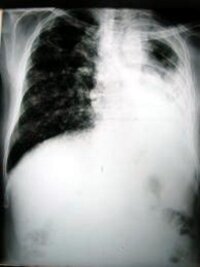
Not his X-ray ... but similar
Sure enough, there on the X-ray there was a shadow … something like like four liters of liquid had amassed in his lungs. The doctor was frank … there was 96% probability of it being Tuberculosis … but a slight change that it was the result of sort of trauma causing a tear in the lungs … only further tests would tell us for sure. The next day we were to go to the Hospital and see about extracting the liquid … maybe an operation would be called for.
For the record: Operations here seem to be routine – especially exploratory operations … so I wasn’t too happy about that … fortunately there are other procedures for removing the liquid which don’t involve invasive surgery, but they still seem to be called “operations” leading to some confusion and much apprehension.
Fortunately, depending on how you look at it … I have a fair amount of experience with Tuberculosis … I have said elsewhere that my mother had the disease when I was born and I have known three other people contract it – each time having to go for chest X-rays and tests myself as a possible contact, (each time being pronounced “clear”). As a result I had done some research and knew a little bit about it … but I can’t say I felt that it helped to cope with the uncertainty.
I don’t think any of us slept particularly well that night. There were lots of questions and I tried to put his mind at ease, these were experienced doctors who, whilst they may not deal with this sort of situation every day, would have met many similar similar cases and knew what to do.
The next day we turned up at the hospital and he underwent further tests … and the doctors decided he was lucky … he was one of the 4% and it wasn’t TB – but the result of some sort of trauma … but I am not sure that this news made him feel any better because he really couldn’t think of anything that could have qualified as such. Despite that, we all breathed a huge sigh of relief.
Anyway, they managed to extract most of the liquid with a syringe pump … which meant that there was no need for invasive surgery … we all breathed another huge sigh of relief.
The liquid fortunately turned out to be just water, mingled with a little blood … and they sent it off to be tested, just in case. Fortunately, it turned out that they were right and it was free of any strains of the relevant micro-bacteria that cause the disease.
That wasn’t the end of the story, however. He was still weak and the doctors said he needed to be admitted to hospital. I had expected him to resist the suggestion … he was already scared stiff … but, to my surprise, he readily agreed. Apparently his restless night had given his pause for thought and he had become accustomed to the idea. Much better for a week in hospital than six months or more which he had been facing if it had indeed been TB.
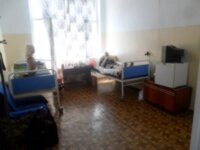
Hospital room
One of the things that struck me as odd in this experience is that, although the hospital provides the basics … there is a lot expected of the patient’s and their families … we were fortunate in that he has many friends and family members who could rally round but, I wondered, what happens if there aren’t any family nearby?
In the case of food, for example, the hospital does provide some – such as kasha (porridge) and soup – but relatives are encouraged to supplement this and bring in more.
You also have to provide your own linen, crockery and cutlery.
Much more importantly, when it came to medicines – the patient and his relatives are expected to buy any necessary medicines. I understand the principle … the basic consultation and some other services are free, paid for by social security, but some things (a lot more than you’d find on the NHS in Britain), have to be paid for.
For the record: Britain’s National Health Service, (NHS), “was born out of a long-held ideal that good healthcare should be available to all, regardless of wealth, a principle that remains at its core. With the exception of some charges, such as prescriptions and optical and dental services, the NHS remains free at the point of use for anyone who is resident in the UK. … It covers everything from antenatal screening and routine treatments for long-term conditions, to transplants, emergency treatment, and end-of-life care.”
Not everything, however, is free. The NHS was founded in 1948 and in 1952, a growing drugs bill prompted the introduction of “prescription charges” – which are paid by patients for drugs or other treatments prescribed for them by a National Health Service medical practitioner. When the plans for their intrdoction were announced a number of Ministers resigned – including the “father of the NHS”, Aneurin Bevan, and the future Prime Minister Harold Wilson.
Harold Wilson’s government abolished the charges in 1965, but was forced to reintroduce them again in 1968 in the face of rapidly increasing drain on available finances as doctors began prescribing more and more low-cost medicines that people had previously purchased for themselves … but they also provided for a system of exemptions.
Treatment in hospitals, however, including medicines used in that treatment are free … and people are not normally charged for medicines they are prescribed during a hospital stay – even if they then take them home to complete the treatment once they are discharged.
OK – here in Kyrgyzstan, opatients pay for their medicines … and for us, in reality that meant walking around the hospital calling at the various Aptecka scattered throughout asking “Do you have this? … or that?”, only to be told “We have some of that … “, but not enough to fill the “prescription”, “but we don’t have this” … so you buy what you can and move on to the next apteka. I even had to leave the hospital to visit a neighbouring apteka on the first night … where, fortunately, they had what we needed.
A few days later however, I was told that we needed a different medicine … and so I trotted off to our local pharmacy … and drew a blank. ”No, we don’t have that.” No-one seemed to have it, so I asked if they could recommend that I try and a couple of phone calls later I got the news … “No, sorry, there’s none in Bishkek.” That led to a frantic phone call, and fortunately the doctor knew where she could obtain some of the elusive medicine – or at least it’s equivalent – and the problem was solved.
I couldn’t help thinking to myself, however, that the hospital should have its own pharmacy, especially where stocks of expensive or the less commonly used medicines can be available … even if the patients have to pay for them.
He is now back home, greatly relieved that his “ordeal” is over. Although there were a lot of injections and “capalnitza“, (drip feeds), to endure, it could have been a lot worse.
In fact, I think that perhaps the worst part of the “ordeal” was the boredom – the room was clean, comfortable and spacious – and we arranged with a TV and refrigerator … but it was very hot and humid in the soaring summer temperatures that we’ve been experiencing … and he didn’t feel like doing much apart from lying back and resting … but, in a way, that’s what it was all about … that’s what he needed.



 Bishkek