The three K’s
I have often noticed that when people speak in different languages, they seem to take on a whole new voice, if not a whole new character/personality.
In a way, it shouldn’t be all that surprising … the phonetics of different languages vary considerably.
The letters of the alphabet are represent different phonemes – sounds associated with them – and although some of them are similar to those used in English, many of them are different. Then there are ones that are not found in English at all.
There are several phonemes in Russian that I find very difficult, (if not impossible), to produce. The classic is the letter “р” which is the Cyrillic letter “r” – but it is a “rolling r” where the tongue vibrates, as in a Scottish “r”, and that is something I have never been able to do. Then there are “Ж“, which is sometimes pronounced as a hard “j” or “dj” and sometimes as “dzh“, or “ы“, which is usually transcribed in English as a “y” but often is pronounced as “ee“. Although it doesn’t cause any problem for locals, I can never tell the difference between “ш“, (which is pronounced “sh“) and “щ“, (which is an elongated “schch“).
That’s not to mention the modulating effects of the hard and soft markers, (“ь” and “ъ“); I have never really got the hang of those. My Russian teacher once tried to coach me in the effect of the merkez znak, (hard sign), by getting me to say the the word “фильм” over and over again, about twenty five times in rapid succession. As far as I can tell, it’s pronounced film, but she insisted that it was more like fil-m, “fill-em” or fill-má. After hearing me say, “film, film, film, film, film … “, she would go “No, no, no, no … fill-em, fill-em, fill-em”, then after the next “O!, Yes, that’s it, you’ve got it!”, only to cry “Nooooooo!!!” after then next iteration.
Other letters look familiar because they resemble a letter in the English alphabet, but they may have a different phoneme associated with then. The letter “c“, for example is not pronounced “see” but as an “s” – “es“.
And it’s not just a difference between the Cyrillic and Latin alphabets, In the British Isles, for example, the dighraph, (the letter combination), “Ll” in Welsh produces a guttural sound. One website actually calls it the “dreaded Ll sound”. In English it is usually pronounced “chl” with the ch being pronounced as in the Scottish word “loch“; not as in “church“. It’s important because it appears in so many place names in Wales, (such as Llanelli), as “Llan” is the Welsh for “the parish of …”.
It’s also not helped by the fact that the same letter can have different sounds associated with it … as, indeed, happens in English. Take the letter “г” as an example – in some cases it is the equivalent of a guttural “g” in English, (as in the word English), but at other times it is pronounced as a “v“. A lot depends on the place of the letter in the particular word and the other letters which either precede of follow it.
Then there are different digraphs – “ay“, for example, is pronounced “ow” which is why many locals see my name written in English and call me Mr. “Slowter“.
More interestingly, if you listen to the same speaking in English and Russian, then they appear to speak in a totally different manner … almost as if they were a different person. I always used to put it down to the fact that they had to concentrate more in the one language than they did in the other, especially as they seemed to speak more slowly and precisely in English.
Now, however, I suspect that it is more a factor of cultural differences. Often, for example, they speak much more loudly and more more forcefully in Russian than they do in English – and I have noticed the same tendency in people who don’t speak another language at all.
I don’t know if I exhibit the same difference when I speak in Russian.
When it comes to Kyrgyz, it is even more complicated because they have three additional letters and not all correspond with either the English or Cyrillic phonemes. Try as I might, I can never tell the difference between the three different “oo” sounds.
All this confusion over pronunciation led to a running joke which, although it has generally run it’s course, still emerges from time to time.
On one particular occasion I was so so het-up and frustrated about the problem I was experiencing, I burst out with something like, “Oh, I don’t get it … I can’t cope … what’s the difference?, Kamaz, Komuz, Kymyz?”, (“камаз, комуз, кымыз?”).
Actually, there is quite a big difference:

A Kamaz Truck - a "people mover"
Kamaz is the name of a truck manufacturer. It’s a portmaneau word which stands for Kama Automobile Zavod, (or Kama Automobile Factory). It opened in 1976 and is now a term used to refer to any heavy duty lorry or truck, such as the ones they specialize in producing. It’s based in Tatarstan, (although there are also also foreign manufacturing facilities in places as far afield as: Afghanistan, Chile, Ethiopia, India, Iran, Kazakhstan, Nicaragua, North Korea, Pakistan, Panama, Poland, Saudi Arabia, Sudan, Turkmenistan, the Ukraine, Venezuela and Vietnam). It is the largest producer of trucks in Russia producing over 260 vehicles a day for haulage companies and even the Russian Army. Their vehicles are very sturdy and some of the tour companies have some of their “people movers” designed to transport army personnel over almost any terrain. Following the collapse of the Soviet Union, the company was privatized and reorganized as an “Open Joint Stock Company” – although the Russian state still maintains a 49% holding in the company.
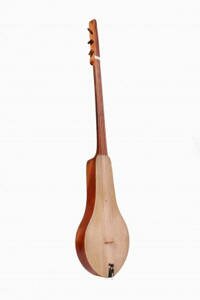
The Komuz - the traditional Kyrgyz instrument
The Komuz is a stringed instrument, made from a single piece of wood (apricot or juniper are the favoured timbers), and plucked like a guitar. While playing it, the three strings are clasped by the left hand to the fingerboard and the right hand is used to pluck the strings in a variety of ways to draw out the sounds. It is a very old instrument – and is mentioned in Chinese Chronicles written over 2000 years ago. There are a number of legends about the origin of the komuz. One tells of a Kyrgyz hunter, Kambarkan, who knew the “language” of many birds and wild animals, so that he could recognise them each by their voice. Once, when he was in the forest, he heard a new and wonderful sound. He decided to investigate and discovered two branches of a tree connected by the dried intestine of a squirrel. The sound seemed to emanate from that “string”. “Perhaps,” he thought to himself, “she had tried jumping from one branch of the tree to another, but cut herself open”. Anyway, he took the string and a piece of wood from the tree and fashioned for himself a musical instrument – the Komuz … and he became known as the Father of Melody. Another legend tells how an old komuzist befriended a nightingale … that was entranced by his playing that she asked him to teach her to sing like the komuz – giving rise to a saying that the instrument taught even the nightingale how to sing.

Milking a mare
Kymyz is the Kyrgyz spelling for Kumyz, (or Khoumis), which is the national drink made of fermented mare’s milk. Once collected, the milk is stored in animal skins (a “chinach”), which has been cleaned and smoked over a fire of pine branches to give the drink a special smell and taste; mixed with a third of the previous day’s supply and the new mixture is allowed to ferment in the warmth of the yurt. It is then churned, beaten with a wooden stick, (a “bishkek” – from which the capital of the Kyrgyz Republic takes its name), and it becomes mildly alcoholic, (about 2% proof), before turning into lactic acid.





 Bishkek