Taking the measure of corruption
 Transparency International, (TI), is famous for its annual survey, the Corruption Perceptions Index, (CPI), which measures the perceived levels of public sector corruption in 176 countries and territories around the world.
A couple of days ago I was sent a link to their latest report – the result of a different survey called the Global Corruption Barometer, (GCB), which they claim to be “the only worldwide public opinion survey on views and experiences of corruption”
I had never heard of this before which is, perhaps, not all that surprising because although the survey has been conducted for 10 years, (since 2003 – although there seems to have been a couple of gaps – in 2008 and 2012, and in 2011 it was simply an addendum to another report), and because the structure of the report changes from year to year.
For example, some of the questions asked in the survey each might change, but also the number of countries in which the survey is held has varied from just 14, (in 2011), to 107, (this year).
Still, the results were fascinating and surprising and, although some care may be needed when comparing results over time, some trends can be seen over the years … data from the seven previous surveys are also available on the website .
Of course, I immediately went to look at the data for Kyrgyzstan – the first time we have been covered – but then went to see what information they had about the UK … and both were full of surprises.
The Global survey interviewed over 114,000 across 107 countries. This is a significant difference between the GCB and the CPI – and their other flagship poll, the Bribe Payers Index, (BPI), in that instead of asking “experts”, (such as “informed observers” or business executives from international corporations); ordinary citizens were polled about the perceptions and experiences – how corruption impacts on their lives. It’s a “grass roots” survey … and may provide a better estimate of public opinion.
However, in another caveat, I suppose that we also have to bear in mind another recent survey from the UK in which Royal Statistical Society and King’s College reported that public opinion is repeatedly “off the mark” on key social issues – public impressions deviating considerably from official statistics.
On the other hand … as this survey went on to ask respondents more direct questions like “Have you paid a bribe to any one of 8 services listed in the past 12 months?”, this may help to give more credence to the overall results.
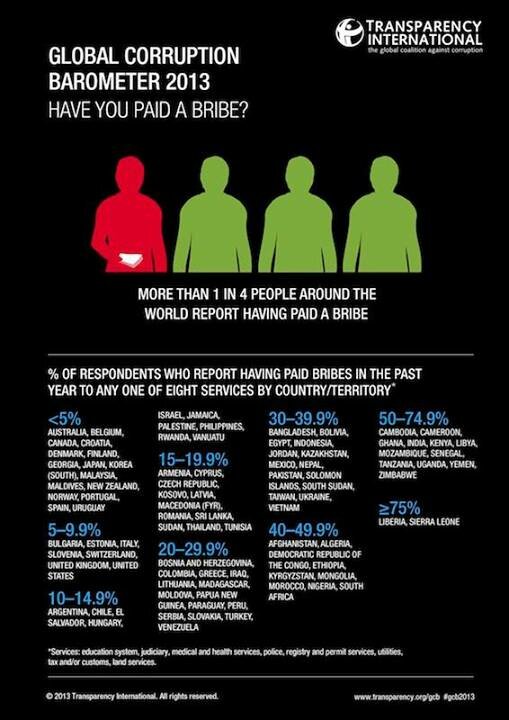
It seems that, according to these results, 25% of the respondents across the globe … and some countries are notably absent from the analysis, admitted to paying a bribe in the last year.
In Kyrgyzstan, 45% of those asked said “Yes“: 48% in Education, 52% to the Judiciary, 38% to Medical and health services; 61% to the Police; 29% with regard to Registration and permits; 6% in connection with Utilities; 26% relating to Tax revenue and/or customs; and 34% related to Land Services.
Incidentally, in answer to another question, 56% said that they had been asked to pay a bribe – so some people refused … or found another way to solve their particular problem. 45% is still a pretty high figure, but an indicator that not everyone accepts corruption as an inevitable fact of life.
Here in Kyrgyzstan, a thousand people were interviewed, which means that the results are likely to be statistically significant and can be relied upon to be reasonable fair and accurate. It’s possible that there will be some variation between the reported results and “reality”, that’s always the case ion any survey, but with 1000 respondents, the diversion from reality is likely to be small.
There’s another slight complication because, it seems, the face to face interviews were apparently conducted in eight urban areas across the country – so there was no data collected from the rural communities. In some countries the survey was conducted online and in others by telephone – what they call “Computer Assisted Telephone Interviewing – or CATI).
In some countries, the members of TI carried out the survey but in other, (including Kyrgyzstan), specialist market research companies were employed. The interviews were held over the winter, (between September and March), and the data then checked and collated. Their website has details of the controls they employed to try and ensure the reliability of the data and hence of the eventual results and conclusions.
Questions were asked about:
- how people perceived the situation regarding corruption in their country in general terms;
- the institutions where it seemed to be particularly prevalent;
- their opinion of the government’s response to the issue and its effectiveness,
and also about:
- their individual experiences in the past year;
- why people paid bribes, (for example: as a gift, or to express gratitude; to get a cheaper service; to speed things up; because it was the only way to obtain a service);
- whether they think individuals can make a difference in the fight against corruption;
- if, and how, they would be prepared to be involved in an anti-corruption campaign, (what action they would be prepared to undertake – for example, reporting it … if so, to whom … and if not, why not).
The reports in the local media seem to have concentrated on one particular aspect of the results: that 68% of the interviewees don’t believe in the effectiveness of counter-corruption measures adopted by the government, (curiously interpreting the 15% who responded that the measures were “neither effective nor ineffective” as “not being able to answer the question”), and that 62% said that ordinary people are unable to do anything to change the situation … although 42% of those surveyed were ready to report an incident.
The full report and country specific charts are available for download from their website along with some examples of the situations faced by ordinary people.
The results for Kyrgyzstan can be found here; and for the United Kingdom, here. (As I said, I found surprises in both sets of data!)
It’s well worth a look! …
… as is this graphic:
Incidentally, on today’s BBC website, there’s an interesting piece on euphemisms that are used around the world for paying bribes.







 Bishkek