Toktogul Satylganov
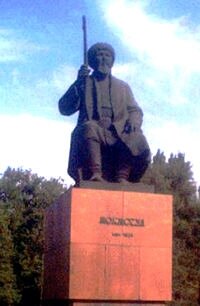
Toktogul Statue
Toktogul Satylganov uulu, (25th October, 1864-17th February, 1933), was a Kyrgyz poet – regarded as a democrat, a thinker, an outstanding komuzist (a performer of komuz music and improviser).
He was born into a poor family in the village of Kysha in the Ketmen Tubin valley, near to where the Toktogul reservoir now lies.
Although his mother, Burma, was a good singer, (a professional composer of laments - koshokchi), and who knew many folk tales and legends, he received no formal education but was sent to become a shepherd.
Encouraged by his parents, however, he began singing at the age of eight and he was soon making a name for himself as a spontaneous topical composer-singer (akyn) by the time he was eighteen, when he turned “professional” after winning am aytish, a traditional competition in which two contestants made up derogatory verses about each other.
As a shepherd, he made up songs about the hardships of his life – a theme recurrent throughout all his life. He remained poor throughout his life – even losing his beloved to a richer man – and he always performed at gatherings of poor people – not for the rich, about whom he composed derogatory verses describing how they exploited the masses.
He seems to have had a knack for this sort of composition. The manaps, (the local aristocracy – who were the target of his barbs), however, were unhappy about this and he was accused of participating in an uprising against the Russians – and sentenced to exile in Siberia. He escaped once – but was recaptured – and a second attempt was also unsuccessful.
On a third attempt, in 1910, he was successful, aided by rum ours spread by his friends that he had drowned. His later songs have many references to his Russian friends – Semen and Hariton – who helped him escape from his penal servitude. At first, praised by the Soviets as a socialist – it is said that democratic ideas in Kyrgyz history began with him, and that Kyrgyz poetry dates from 1919 when he sang a eulogy of Lenin for the local Commissar – he later fell into disfavour with the authorities.
His life and work are usually divided into four periods: the first “Before Siberia” period is characterized by traditional folk songs and lyrical love songs; the second by songs of advice and admonition; the third marks his return from Siberia and the before the Soviet Union – and includes the tragic song, “I have no son” – composed as a lamentation for his son, Topchybay, who died whilst Toktogul was in Siberia; the final period is known as the “Soviet” period when he composed songs such as “Long live Soviet Power” and “What a mother could give birth to such a son as Lenin”.
For the record: Whilst the Soviet interpretation of Toktogul’s “Tsarist-era” trouble-making songs depict him as a hero of class struggle, there are more recent ‘revisionist’ interpretations which suggest that it was more a reflection of Kyrgyz clan rivalries and that they were used by the authorities as political propaganda.
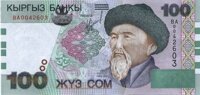
100 som note
Even after the fall of the Soviet Union Toktogul’s songs remain popular among Kyrgyz performers and many streets, parks, schools, and even his home town are named after him.
For example, in Bishkek:
- one of the main streets named after him;
- there is a statue of him which stands outside the Theater of Opera and Ballet, (the Komuz shown in his hand is modeled on one exhibited in the museum opposite);
- the house in which he lived in Bishkek is now a museum dedicated to him;
- the Philharmonia is named in his honour and
- his bust is one of those of famous manaschis which stand in the courtyard.
Also, the Toktogul Reservior and Hydroelectric Power Station were also named in his honour and one of the highest artistic awards is the Toktogul Award.
Toktogul’s portrait appears on the 100 som banknote. On the reverse, are drawings of the Toktogul Reservoir and Dam or, (on later issues), of Khan Tengri and the Enilchek Glacier.




 Bishkek