Eating out … dining in Kyrgyzstan
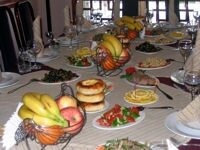
Table set for a "banquet"
Food is one of the most important things to concern visitors when they are traveling abroad.
There are numerous sayings associated with food. One has it that “the way to a man’s heart is through his stomach”. This may be good advice for the budding romantic, but does it explain why so many visitors take Kyrgyzstan to their heart and want to stay longer or to return?
There are a wide variety of dishes available in Kyrgyzstan, consisting of traditional Kyrgyz cuisine, Central Asian delicacies, European and Oriental style dishes.
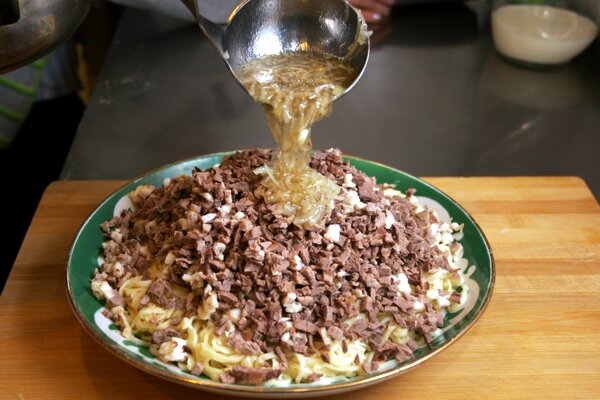
Perhaps the classic and most typical of all traditional Kyrgyz dishes is Beshbarmak. It is meant to be eaten with the hands, not with a knife and fork! (In Kyrgyz, “Besh” means five, and “barmak” means finger.) The dish consists of noodles, which are mixed with boiled lamb which has been cut into tiny pieces and served with a medium spicy sauce and bouillon is then poured over the mixture. Beshbarmak is served when guests arrive and at almost any festive gathering. In fact, in Kyrgyz culture many dishes used to have a special, ritual importance, and are connected with particular celebrations, festivals and holidays.
One of the most essential features of Kyrgyz cuisine is that dishes should preserve their taste and appearance. For example, there are almost no dishes comprising puree, minced, or chopped meat, (although there are a few exceptions). Kyrgyz dishes tend to have a plain taste; sauces and spices are used in only small amounts, although spices are used more often in the South. Sauces are intended only to bring out the taste of the dish – not to change it.
Meat is central to Kyrgyz cooking – the nomadic way of life did not allow for the growing of fruit and vegetables – which means that vegetarian visitors may find it difficult to find dishes that meet their needs.
However, traditional Kyrgyz dishes represent only one type of cuisine available.
Kyrgyzstan stood on the crossroads of the Silk Road, and the caravan routes which crossed the territory carried not only goods for trade, but also brought examples of various cultures: Turkish, Persian, Arabian, Indian, Chinese, Russian, and European and these mingled with the culture and traditions of Central Asia. As a result Kyrgyz cuisine has absorbed elements from all of the cultures with which it came into contact and many of the dishes that visitors will encounter in Kyrgyzstan are common throughout Central Asia, (such as manti, samsa, ploff, shashlik and laghman).
It is said that the food in Central Asia falls into three different types: the subsistence diet of the once nomadic peoples such as the Kyrgyz (mainly meat, milk products and bread); the diet of settled Turkish peoples (such as the Uzbeks and Uighurs) including pilaffs, kebabs, noodles and pasta, stews and elaborate pastries and breads; and dishes which come from the South (Iran, India, Pakistan and China) with more seasoning and herbs.
Modern Kyrgyzstan is home to over 80 different nationalities – each with their own traditions, customs and cuisine, many of which have been assimilated and can be found throughout the country.
In many areas, such as Bishkek, Russian dishes, (such as such as Shchi or Borsh), are common, and the all embracing term “European” is often used to describe a variety of styles of cuisine. It is now also possible to find examples of dishes from all over the world, including Indian, Korean, Turkish and Chinese. Outside the cities local dishes, (such as Kyrgyz, Uzbek and Dungan) are more common.
Even if traditional Kyrgyz dishes seem unfamiliar and not to their particular taste, (after all it is a question of taste and as another culinary cliché has it: “one man’s meat is another man’s poison”), visitors will not feel that they are in a culinary wasteland. Indeed, there is something for everyone.
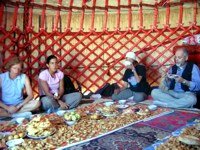
Traditional Kyrgyz hospitality - gathering round a dastorkan in a yurt
Basically, on a tour we plan on three meals a day: Breakfast, Lunch and Evening Meal.
Breakfast normally comes as part of the accommodation package. Lunch can be in a cafe or restaurant, or a picnic (lunchbox), depending on the itinerary and the local possibilities. (For example: … in Issyk Kul, lunch is often included as part of the package – because many visitors stay in one resort for several days). Evening Meal is often provided as part of the accommodation – sometimes there is little choice (especially when staying in a yurt with a shepherd family in a mountain jailoo …).
On a trek, or horse riding tour, we are able to provide cooks as part of the support team.
Tourists sometimes ask if it is possible to organize accommodation on a basis of self-catering, (no meals), Bed and Breakfast (B+B) leaving them free to chose their own options for lunch and evening meal, or “half-board” (breakfast and evening meal) leaving them free to choose for themselves when and where to eat lunch. We can advise where this is possible but there are a few points to consider …
- although there are a few places where this is not the case, breakfast normally comes as part of the accommodation;
- in some places – particularly in Issyk Kul, accommodation often includes three meals a day as part of the package;
-
when traveling on the road, it may difficult to find somewhere to eat,
- for that reason reason we sometimes arrange a picnic lunch;
- in Bishkek there are plenty of cafes and restaurants – and although we can organize meals if requested, we find that many clients prefer to chose for themselves and only want from us recommendations;
- in some towns and villages – or in a jailoo – there may be no choice apart from eating with your hosts;
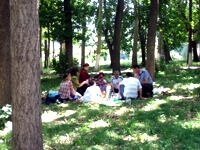
A Picnic
For those who want an element of “self catering” … it is possible to find something similar to “pot noodles” in Bishkek, but (especially for the Brits), not Marmite or Branston Sweet Pickle … (I mention it because, in the past, we have been asked for it).
We need to know if anyone requires a Vegetarian or other specialist diet (for example: a kosher diet, or an allergy to, say, nuts …) so that we can make the necessary arrangements and inform the hosts.
In the lead up to Independence – and just after – there were a very limited number of restaurants in Bishkek … according to one source, just nine in the whole city. Things have changed and nowadays, there is a wide range of cafes, restaurants and bars – something to suit almost any taste, (although vegetarians might have a bit of difficulty finding suitable dishes) and pocket. Of course, new establishments are opening all the time, some change management, so a comprehensive list of “recommended” places to eat is difficult to maintain.
(Indeed, of the seven postcards I have written about places for “places to eat” in Bishkek, one has changed its name although it’s under the same management, another has changed hands, and two have closed – five remain more or less as I wrote about them.)
A note about “Street Food” – It is possible to find at many places throughout the city street vendors selling local dishes, plof, samsy, piroshki … but like “street food” anywhere – you should only really decide to try it if you are sure of your stomach.


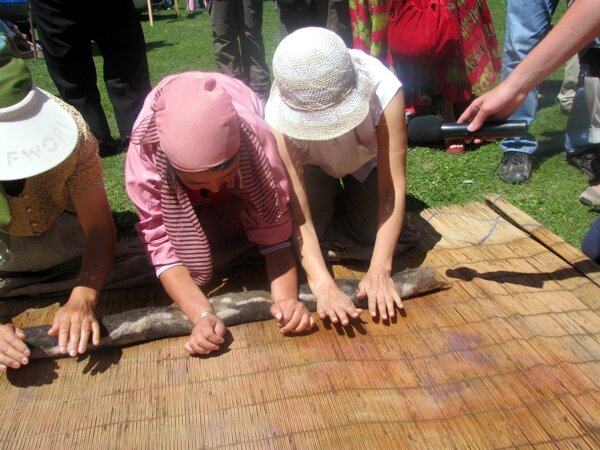



 Bishkek