Traditional Kyrgyz costume – Men

Blue Jeans
There seems to be a universal fascination with celebrating anniversaries … and no less so here than in the West. All the same, I was somewhat surprised the other day to see a reference to today as the “Birthday of Blue Jeans“.
What started out as heavy duty work clothes have also served as a sign of rebellion and a fashion statement … but are now a ubiquitous item of clothing … for people of all ages and classes.
The first patented jeans were made in America by Levi Strauss in 1850 and sold for the princely sum of 1 dollar 46 cents per pair – that’s probably the equivalent of about USD45 in today raking inflation into account … but as we are talking about two totally different worlds, then and now, such comparisons are probably meaningless.
These “jeans” were heavy, long “pants” made out of canvas, with seams, reinforced double stitching … and lots of pockets. They proved to be popular in California gold miners and the first batch quickly sold out. Strauss then set up a company, the legendary Levi Strauss & Co to make such “working clothes”. Then, on 20th May 1873, the company was granted a patent for the exclusive right to manufacture such pants with rivets on the pockets … and that’s why this say is considered the “official birthday of jeans”.
As an aside: the famous leather label – a trademark of the firm – first appeared in 1886. In 1926, there were jeans with a zipper “fly”. In 1981 Levi’s first produced jeans especially designed for women. In 1995, “stretch” jeans appeared … and others using new technologies: jeans washed with pumice stones, soaked in acid, bleached … produced in different colors and patterns and using different fabrics.
Consumers, (ordinary :working people”), quickly came to appreciate both, the durability and the practicality of these new trousers. Shortly after they started production, the company switched from gray canvas to a “new” blue fabric; an attractive and durable material called denim. This is derived from French de Nimes - which means “from Nimes” – after the French city where it is supposed to have originated.
The Levi’s brand maintained a leading position in the market until the middle of the Twentieth Century, when new brands emerged to challenge their dominance of the market, (such as: Lee, Wrangler and Cooper. They were to be subsequently followed by firms such as Calvin Klein, Diesel, Gap, Guess, Mustang, Polo, Tommy Hilfinger, and Zara).
Levi’s didn’t have it all their own way, however, and apart from trading on their name, Levi’s jeans were known for their quality and were recognized as a “top end” product – made from natural ingredients and, as a result, were relatively expensive. As early as in 1878 the German chemist Adolf von Baeyer, invented a synthetic substitute for indigo, which greatly reduced the cost of jeans.
Today, Jeans are as popular in Kyrgyzstan as in the West … but, what would the “well dressed” Kyrgyz have worn before … ?
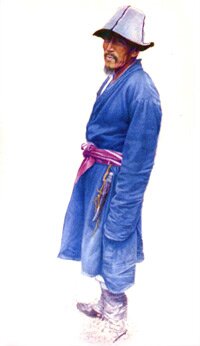
An aksakal in traditional costume
Loose shirts and wide trousers – covered with a “dressing gown” – were the typical forms of dress for Kyrgyz males.
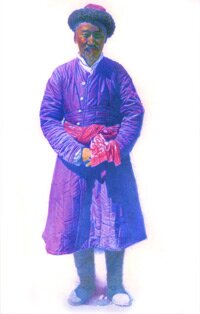
Kyrgyz in traditional costume
Northern cattle-breeders used to wear a felt cloak, (a “kementai”), and later on the Kyrgyz from the southern part of the Osh region also wore them.
A shirt with a cut collar, (measuring some 30-35cm, in a triangular shape – called an “uzun jaka“), became popular amongst the Kyrgyz, and other peoples of the Ferghana valley, in the twentieth century. This shirt was shorter, reaching down only to the thigh, rather than to below the knees. At the same time shirts with similar cuts, but with collars fastened with buttons, also became popular.
A “compulsory component” of the costume was a belt, which was fastened over overcoat. The most popular of them was called “kushak” or “belboo”. In southern areas scarves were used for this purpose. Rich people, on the other hand, had wide leather belts trimmed by silver ornaments, with a massive buckle, reminiscent of ancient Turkic belts.




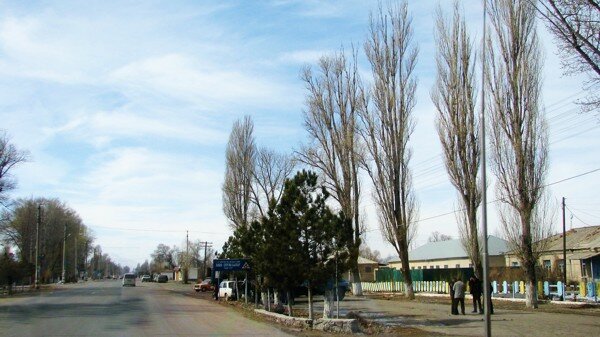
 Bishkek