A nativity play
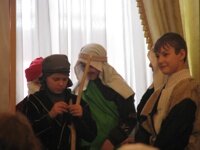
Christmas has come and finally come … and gone.
It’s has always been a hectic time of the year and, especially in my time as a school teacher, I was all too familiar with the traditional build up to Christmas – and the round of special events to mark the occasion.
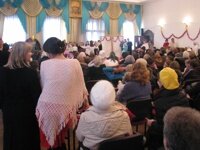
There was always the business of putting up decorations, writing and distributing Christmas Cards and doing the rounds of the shops to buy Christmas Presents. which seemed to creep earlier and earlier each year. It used to be the tradition of decorating the house on Christmas Eve and then taking them down again on twelfth Night, (January 6th), but these days the decorations can go up as September, and when I lived in North London there was one shop nearby which sold Christmas decorations all year round.
Cards were always a problem as the Post Office always advised, “Post early for Christmas” … and you had to time things carefully, especially if you had to post cards to different parts of the world … you may have to stagger your posting at different times depending upon the destination to make sure that your “Seasons Greetings” didn’t arrive too early … or too late.
Presents were also a headache … who to include and and what to get them. To be honest, I went through a stage of looking to buy big presents, until I realized that a present doesn’t have to be big – it is not necessarily a measure of esteem but rather a token, a sign of “attention”, that says “I thought about you”.
Then there were the special events.
As a schoolboy back in the 1960′s, for example, we always held a traditional Carol Service … the full package of nine lessons and carols – just as the one which would have been put on by the Choir of Kings’ College, Cambridge. It was a very popular event and was always packed out.
The Church, of course, always held special services – although, as a Methodist Church we didn’t go in things like “Midnight Mass”, although the Catholic Church just up the road from my parent’s home was always packed out for this “joyous occasion”.
Primary schools and church Sunday Schools would put on a performance of a traditional Nativity play, telling the story of the birth of Jesus, melding together the accounts in the Gospels of Matthew and Luke.
There would be Christmas Parties for the youngest children, complete with a visit from Santa Clause … and I am embarrassed to point out one year that I didn’t recognize him, when I really ought to have done … it was my own father dressed up in the bright red suit and donning a full flowing white beard … my excuse is simply that I was very young at the time!
The secondary school where I taught also ran Christmas Parties for Senior Citizens or Old Age Pensioners from the local community … the Middle School had adopted a neighbouring Old Peoples’ Home, and the traditional party was originally held for the residents of the home, but was later widened to include other retired people from the local community.
Each year, on the last day of the term, the staff would also put on a Pantomime for the children. It was always meant to be a surprise, but it was probably worst kept secret in the school – except for the very first occasion it was done, that is, when it caught everyone by surprise. In subsequent years the staff would all deny that there would be a performance that year and I, for one, never felt completely at ease about that – lying to the children – but they didn’t believe us and the main thing was to keep the details of the performance secret: What was the plot this year – Cinderella or A Christmas Carol?, who was starring in the main roles and, of course, what was to be the “big number” in the finale.
Here in Kyrgyzstan, Christmas tends to be a rather low-key festival. The big events, (as in Scotland), are the New Year Celebrations. Oddly enough, however, Christmas is an official Public Holiday. This is a bit surprising given the atheistic Communist heritage of the former Soviet Union, when Christmas was discouraged, if not actually banned; the fact that most of the Kyrgyz are, at least nominally, Muslim and that the Constitution declares that the Kyrgyz Republic is a secular state.
It was also a bit confusing at first, and took some getting used to – as Christmas in Kyrgyzstan doesn’t fall on December 25th, but on January 7th. Russia and the Orthodox Church continued to use the old Julian Calendar until after the Bolshevik Revolution, long after most of the world had adopted the Gregorian Calendar. The two week difference between the different Christmas Days represents the anomalies built in the former which were corrected in the latter.
I sometimes joke that I get two Christmases a year … and although, technically, it is my first Christmas of 2010, I consider it my second Christmas this year
Whereas most Westerners, even here, celebrate Christmas on December 25th, and many locals take the trouble to “congratulate” us on the holiday, it tends to be a private affair. Back in Britain, after the excesses of the holiday itself, there’s always Boxing Day to relax … and, apparently, December 29th is “the guiltiest day of the year”, when we feel guilty about all our indulgencies throughout the previous year, brought on by our recent excesses over the festive season.
Then, as in the West, we go through the New Year celebrations … and just as the Christmas decorations would be coming down in Britain, we are suddenly thrust into the full cycle of Christmas events once again as the country, (or at least the Russian community), gears up to celebrate the birth of Jesus all over again.
Once again this year, as I have for the last few years, I was been invited to the Nativity play put on by the Sunday School at the local Orthodox Cathedral. Even for those who don’t understand the Russian, it would all seem very familiar – well, the Christmas Story is the same … and although some of the carols sung by the choir are new, there are others, like Silent Night, sounds so familiar and makes you feel you want to sing along with the choir. Mind you, they don’t seem to know the Descant to “Oh come all ye faithful”.
One thing I have always found a little unnerving, however, is the very relaxed, easy going, approach to the whole affair … people in the audience stand up and move around, talk in quite loud voices so that it can be hard to hear the children performing. Many of the Children are “dressed up to the nines” in their “Sunday Best”, (this year one boy sported of bright white suit), others in makeshift costumes, and yet others in quite casual attire.
After the play is over, any children who want to perform their favourite “party piece” are invited one by one onto the stage. One of the most interesting of these impromptu acts was a pair of Russian boys dressed in traditional Kyrgyz Kalpaks performing from the Kyrgyz epic, Manas … in Kyrgyz. Quite what it had to do with Christmas is anyone’s guess … but they did very well, and I just wish I had taken a video camera with me so that I could have recorded the performance.
After the concert, there is a quiz … a Bible quiz … for the children. Who can name the ten commandments?, Who was carried off to heaven in a Chariot?, What was the bird that brought back evidence to Noah in the Ark that the Flood was over and the waters receding? … and so on. Each correct answer is rewarded by a small prize: a bar of chocolate, a small icon, some crayons or a pen …
Finally, it’s all off to one of the dining rooms for a helping of plov – a sort of risotto, a mix of rice and meat.






 Bishkek