Mini Sagas

The Daily Telegraph Header
In 1982, the Daily Telegraph launched the first of a new type of competition – the Mini Saga.
They invited their readers to submit a short story – very short, in fact; just 50 words … exactly 50 words, although another 15 words could be used as a title, although very people made use of this generous allowance.
The idea of the Mini Saga was invented, (and actually patented), by the author Brian Aldiss, (who is particularly noted for his science fiction books), who found the task of creating the stories a light relief and antidote to constructing novels.
They are also used in an exercise on literary courses and in business as a useful tool in exercising creativity, teaching conciseness, (determine the essential elements of a story – character, setting, plot, conflict and theme, and to enhance the necessary discipline in writing), and being entertaining.
Most of them are humourous and many of the entries to the Telegraph competition describe murders … and many of them involve a surprising twist. For example, here is one of my favourites which was one of the winning entries from the 1999 competition:
The Price of Freedom by K C Holt
“I accept,” he whispered.
“Good,” said the General, “then you are reprieved.”
“Executions begin at dawn, your job is to fit the nooses and push the condemned off the scaffold edge.”
“Will I wear a hood?”
“No,” said the General gently, “but your father and your brother will be blindfolded.”
I enjoyed reading these stories and used to to look forward to the next competition.
In a way, that is surprising because I find writing to a word limit is very difficult. Hey, I always have trouble with tweets where messages are limited to 140 characters or keystrokes.
As a schoolboy, we had been given précis exercises that we were given; to summarize a longer passage in our own words in about 150 words, (although there was always a little leeway in that word count – plus of minus 5 words). Shortly afterwards the topic was dropped from the English examination syllabus but was taught more simply as “summarizing” as a tool for testing the student’s ability to comprehension, or understanding, of a text.
After an initial read through, the text is then reread to identify the main themes of the author’s argument or story … highlighting the essentials and creating a map for the final piece. It is important to identify any superfluous material, such as examples or supporting evidence.
I remember when my students were preparing project work for examinations, they always seemed to have difficulty with the “page limit” imposed by the examination board. They had invested so much effort into their work over the previous months and using the outline provided in the marking scheme of what the examiner was going to be looking for – it seems that ten pages were just never enough. As a result, some would use miniscule handwriting, or tiny fonts, and minimal margins. One of the more legitimate techniques employed, however, was to relegate as much as was possible of the illustrative and supporting material, into appendices to the general project report.
When composing these postcards, I tend to have a word limit in my mind of between 1000 and 2000 words … but that’s not a rigid limit – sometimes I make that easily but at other times I struggle and some postcards are only about 500 or 600 words long. When it comes to the Weekly postcard, which is sent out by email on Saturdays, is usually about 3000 words – but that’s because something like 500 words is allocated to establish a theme for the week.
Well, I am now facing an interesting challenge … I have been asked to write a series of vignettes, descriptions, about Kyrgyzstan – each about 100 to 150 words long. At least I haven’t been set the draconian word limit of a Mini Saga – 50 words – but, even so, I am not sure how to sum up many of the topics I have been given in just 100 or 150 words …
Now that is going to be a challenge! … but, then I relish a challenge!
Here’s an example – 140 words on The Burana Tower:
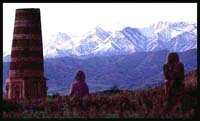
The Burana Tower
Some 10km south of Tokmok, the Burana Tower is all that remains of the ancient city of Balasagun, set at the foot of the Shamshy valley.
The city was established in the 10th century on the site of an older settlement, and was the birthplace of the philosopher and poet Jusup Balasugyn who wrote an epic poem called Katadgu Bilig, (“The knowledge which brings happiness”), which has been translated into several languages.
The tower itself is thought to have been a Minaret and is the site of a museum complex which, in addition to the tower includes reconstructions of mausoleums found on the site; a mound that is all that remains of the palace/citadel; a collection of balbals, (grave markers used by nomadic Turkic peoples who used to roam Central Asia), and petroglyphs, (paintings on stones) and a small museum.
and another – 117 words about Dordoi Bazaar:
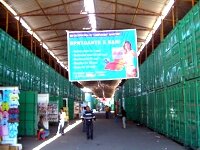
One of the Dordoi alleys ... on a quiet day
Dordoi Bazaar is a large wholesale and retail market in Bishkek, Kyrgyzstan. It is one of Asia’s greatest public market places.
It is not just a major shopping centre for Bishkek and the surrounding area, but it is also one of the main transit points for consumer goods from China to the shops and markets in Kazakhstan, Russia, and Uzbekistan.
Most of the market is built of double-stacked shipping containers. Typically, the lower container is used as a shop, while the upper one is used for additional storage. According to a newspaper reports, there are somewhere between 6,000 and 7,000 containers in the bazaar and about 20,000 people are employed there (as vendors, security and service personnel).
and a third – 118 words about Lake Sary Chelek

Lake Sary Chelek
Lake Sary Chelek, (which means “Yellow Bucket”), in the south west of the country, was formed long ago when a rock fall blocked the course of a river in a mountain valley. It is flanked by steep wooded slopes, topped by snow capped peaks, and fed by many fast flowing mountain streams. This freshwater lake is often thought to be the most beautiful in the country.
The lake, some seven and a half kilometers long, a kilometer and a half wide and 234 meters deep, is the centre of a National Park which was created to protect and research the pristine natural landscape which provides a habitat fpor a diverse range of wildlife and access is strictly controlled.




 Bishkek