Fassol

Beans on toast - a British staple
I have wanted to introduce one item onto the menu at the hotel : Baked Beans on toast.
Baked beans are part of my youth … a quick and easy snack meal – open a tin of baked beans and heat them up and pour them over a piece of toast, or add them as a garnish as part of a “Full English Breakfast” or as a filling for Baked Potatoes. For many years after I first came here, this was one of the few things from home that I could say that I missed. Although you could get beans, they were often red kidney beans or large white Haricot beans … then I discovered that some of the supermarkets now carry lines of Baked Beans in Tomato Sauce, and I quickly bought up a supply … and sit in my cupboard as a handy standby.
Most cans of Baked Beans are made using Haricot Beans and they are coated in a tomato sauce … but, despite their name, they are usually stewed and, unlike the Baked Potatoes, have never seen the inside of an oven … although at one time they were indeed slow baked in a ceramic or cast iron pot.
They originate from the Americas and were introduced to Europe in the sixteenth century. It seems that some of the native American Indians from the North East would made a fire in a stone-lined pit, which was allowed to burn down to hot coals and then a pot with beans would be placed in the ashes, covered over with dirt and left to cook overnight or longer. It soon caught on amongst the European settlers and proved to be a popular accompaniment to almost every meal.
Once the process of canning came along, Beans proved to be an easy and popular convenience food and became part of Army rations during the American Civil War. They made their way across the Atlantic at about the same time and have established themselves as a staple part of the British diet, so much so that as well as well known brand names – supermarket chains also sell their own brand – often at very low prices, perhaps leading to the idea that they are a “down market” food.
Fassol, (beans), are now an important part of Kyrgyz agriculture as a valuable cash crop.
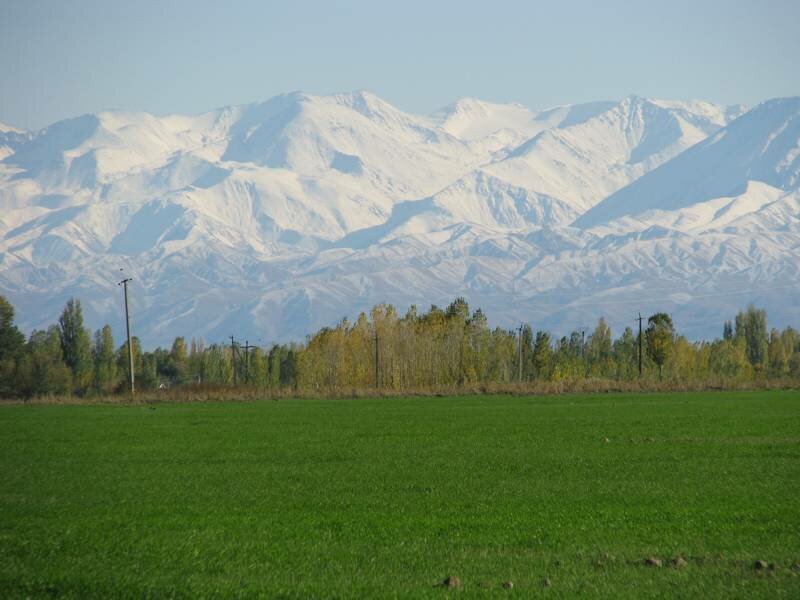
Agriculture is, itself, an important part of the Kyrgyz economy – employing well over half of the population, even though the amount of arable land is somewhat limited as most of Kyrgyzstan is mountainous and about 40% of the land is used as pastures. It seems to be quite common that whole areas are often turned over to a monoculture and beans provide a good example of this.
A few years ago, it appears that interest from Turkey in the possibility of certain areas of Kyrgyzstan to grow beans – in particular the Talas oblast in North Western Kyrgyzstan where the weather conditions are particularly appropriate – warm and equitable throughout the growing period. Delegations of Kyrgyz farmers have visited Turkey to study production methods and marketing. There were mixed feeling expressed about this in the early years as the prices received were not as generous as farmers had thought but, according to recent reports, it now appears that prices have achieved an all time high.
The beans are usually sown in the second half of May, when the soil has warmed up after the long winter and frosts are no longer to be experienced. They are well watered and the ground prepared and crops can be harvested from two to four months after sowing, depending upon the variety – usually in August and September before the autumn tends to usher in more cold weather.
The beans are cleaned and calibrated according to size before being packed in 25 and 50kg bags and shipped to customers. It seems that as well as Turkey, the beans are sold in Russia, Bulgaria, Serbia and perhaps elsewhere in Europe. Apparently, in some of these markets they have even become known as Kyrgyz Beans.
Beans are a good source of protein and essential amino acids. They are rich in fiber, pectin and many minerals. They are said to be used in a number of diets suitable for people with diabetes, hypertension, rheumatism and many other conditions.
They are not without some controversy, however, as processed beans can have high levels of sugar and salt and one of the more infamous side effects of beans is that they can increase the incidence of flatulence – as per Blazing Saddles.






 Bishkek