Siberian air grips Britain
Apparently the United Kingdom is currently undergoing the coldest winter it’s experienced for over a hundred years. I have just listened to a news report that commented that the country is under the grip of “Siberian Air”. Siberia has a reputation for having cold winters, which is probably quite a fair representation as temperatures of minus forty degrees Celsius are not uncommon. Britain, on the other hand, is warmed by the Gulf Stream and as a result experiences a fairly equitable climate where such extreme temperatures are unknown – unless we happen to be going through an IceAge.
The coldest winter weather that I remember back in Britain was that of 1963 – in what is referred to by us Brits as “The Big Freeze”. It was the third coldest winter in Britain since records began in 1659 – only the winters of 1683/4 and 1739/40 had been colder. A cold East wind set in on December 22nd, and snow started falling on Boxing Day, (the 26th), followed by a blizzard a couple of days later. Snowdrifts rose to 20 feet in places, roads and railways were blocked, villages cut off and power lines brought down. In January the temperatures fell to -16 degrees so that rivers froze over, and even the sea froze off Herne Bay in Kent, in the South of the country. The cold temperatures meant that the snow did not melt and then, in February, a blizzard brought gale force winds and more snow. It was only in March that temperatures rose and the snow finally disappeared.
It was such an unusual winter … there were many years when there was just the odd flurry of snow and others when we never saw any snow at all. To me, as a small boy, it was all very exciting – at least vat the beginning. I remember dressing “like an onion” with layer upon layer, to go out and play snowball fights with my brother in the back garden. My mother knitted gloves but they got soaked as I handled the snowballs and hands felt frozen. We didn’t have central heating, few places did in those days, but the coal fires in the living room kept us warm and cozy as we stared out at the white expanse wondering when it would all end.
Although we didn’t experience anything quite as bad again – apparently, that is, until this year, we did see snow from time to time. I remember sitting in school a few years later and watching the snow fall outside and one of the teachers commented how “Canada could see meters of snow fall and they just carry on as normal, but we see a couple of inches and everything stops.” That struck me as a bit unfair … Canada, like Siberia, sees a lot more snow than we did in Britain, and so they are they were used to it and better prepared. Their buildings were designed to cope with the temperatures and their systems established to mitigate the worst effects of extreme temperatures or heavy snowfalls.
In Britain, we were never really prepared for “extremes” in weather. Our preparations seem to be limited to making extra social security payments to pensioners and others if the temperatures fall below zero for several days in a row, and sending out the “gritting lorries” to gather salt or grit on the roads. One winter the snow started falling and we carried on teaching up to the final bell at 3:45, and the children started to trudge their way home, some not completing their usual half hour walk until 8:00pm – some four hours later. Another time we had the first snowfall for several years and the following morning the roads seemed to be littered with car accidents as a whole “generations” of new drivers suddenly found that they had to some to grips with the (at least to them) new and strange weather conditions.
We have a client due to fly in from London later in the week and the forecast does not look good – he has warned us that he may not be able to make it to the airport … and even ifg he does, the airport may still be closed, and the the flight cancelled.
And it is not just snow which throws us. Even the hurricane of 1987 caught everyone by surprise – even the weatherman, Michael Fish, said there wouldn’t be one. but when it arrived overnight it brought down trees (including some of the famous “Seven Oaks” which gave the town in Kent its name and created general havoc.
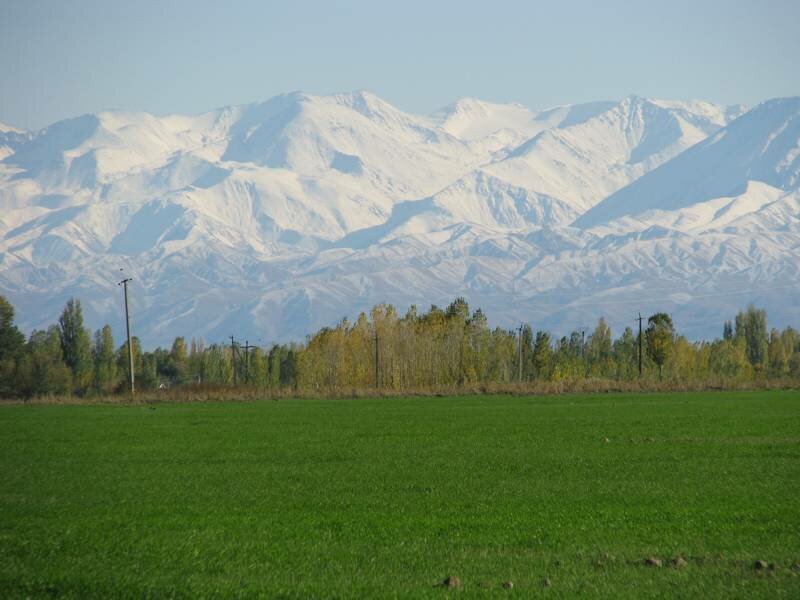
Although there were several occasions since the “Big Freeze” of 1963 when snow fell and it was quite cold, the next time I experienced a really cold winter was when I came here to Kyrgyzstan. Kyrgyzstan has a Continental climate, which hot summers and cold winters. In my first winter here I took a walk to some shops – maybe a couple of kilometers there – and a couple back. It was bitterly cold and the wind was biting. I didn’t worry about it too much, however, until later that night when I was getting undressed for bed. It was then that I realized that on my upper body I had, as in my childhood, been dressed “like an onion” with several layers of clothes too keep me warm. On my legs, however, there was only one layer – my trousers – and I noticed that there was a line across across my thighs where my coat had stopped – above it my skin was its normal colour, but below it my legs were a bright red.
I don’t like the cold – the climate is one of the few things in Kyrgyzstan that I find difficult to cope with – it can be too hot for me in summer and too cold in winter. I quite like the snow – but there was one occasion when I stepped on what I thought was snow on firm ground, and found it as actually soft snow in a hole and my leg sank in it up to my groin. Passers by were very concerned … was I OK?, was I hurt? … in fact, I was fine, and once I got over the surprise, I bust into laughter. I am not sure what they made of that. The ice that forms on the pavements, on the other hand, is another thing … it can very slippery and treacherous, and I have slid over onto my back on several occasions … and I remember on one occasion, lying on my back in some pain, thinking: “I think I have I broken my back”. Fortunately, I was wrong!
That year we had snow in December. That was quite unusual as, although there may be the odd flurry of snow earlier, it doesn’t normally arrive until the middle of January. As it happens, we had a “White Christmas” here in Bishkek. When I got up on Christmas morning it was still dark and so I didn’t notice anything for a couple of hours … then I looked out of the window and saw snow lying on the ground. It was a light covering, not even two inches thick (that’s about five centimeters), but for those Western ex-pats still here in Bishkek, it made our day. Ever since Bing Crosby sang about it, the idea of a “white Christmas” has captivated people in the West. We have some visitors from Australia and the nine year old boy in particular was delighted to be able to scamper around in the snow.
In fact, very few Christmases are “white” in either the US or in Britain. The odds are against it. Apparently, in the time of Charles Dickens, the winters in Britain were generally harsher than they are now, (this year excepted), and snow during December was more likely than it is today. Hence all those Christmas cards with Georgian and Victorian snow scenes with carriages ploughing their way through drifts. Today, in the United Kingdom, bets are placed on the question and the official definition of a white Christmas used to decide if someone has won the bet or not is if there is, apparently, if snow falls on the roof of the Meteorological Office in London.
Here, of course, everyone hopes for a White New Year – Christmas comes on January 7th according to the Orthodox Calendar and, although it is a national holiday, it doesn’t have the same significance that it does back home. Although we had a White Christmas, and more snow is forecast for the Orthodox Christmas, there was no snow for New Year and, in fact, it was quite warm – almost like a Spring day. Everyone is saying that it is a sign of Global Warming.
According to one analysis, a four degree rise in Global temperatures is likely to mean something like a six or seven degree rise here in Central Asia. I am not sure, however, what the effect on weather patterns will be … Kyrgyzstan has a Continental climate, which hot summers and cold winters … will they both be warmer or will the summers be warmer and the winters colder?





 Bishkek