Crossing Torugart
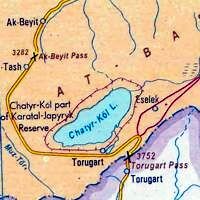
Torugart
At the moment, those people wanting to travel the Silk Road overland, they basically have to travel through Kyrgyzstan.
It’s either up through Pakistan, (over the Khunjerab Pass from the Hunza Valley), or travel travel much further North and East and cross from Kazakhstan over the *** pass, or even further and travel through Mongolia. At the present time there is no crossing into China from Afghanistan or Tajikistan. (The *** pass in Tajikistan is open for commercial goods traffic but not for passenger traffic.)
Kyrgyzstan has two border crossings which are available: Torugart and Irkeshtam. Both connect with the city of Kashgar, famous for its Sunday Market and the antics of Russian and British Consuls resident in the city and vying with each other as players in the Great Game.
I have already written a short postcard about Irkeshtam so I thought I would spend some time considering Torugart.
For the record: The Torugart Pass is a remote mountain border crossing between Kyrgyzstan and China.
In 1905 the British Consul in Kashgar, (George Macartney) discovered that the Russians had built a 27 foot wide road from At Bashi in Kyrgyzstan to Torugart and for about half a mile into China itself. A major player in “The Great Game” between the British and Russian Empires both of which were seeking influence in Central Asia, he reported to his superiors that the road could easily be “made good” and should Russia choose to annex all or part of Xinjiang province, then this was the route along which their troops would come. In 1906, the Chinese government gave in to Russian pressure and agreed to complete the road using a loan from a Russian bank – recouping the money by levying tolls – and Russian merchants were given a monopoly of trade along the route. The Chinese, however, were not happy at this arrangement and set the tolls so high that the road soon fell into disuse and disrepair.
Now it is possible to travel the modern road but, to tell the truth, it is not yet very modern even though it is currently under reconstruction and should be much better once this is completed. Although many sections are not tarmac some of it is – and part of it, near At Bashi, once served as an emergency airstrip.
The Chinese erected an archway on the border itself, but this was removed in 2002 – a pity, because it made a nice photo opportunity.
It is some years since I last crossed the Torugart Pass into or out of China. I remember the anxiety that we felt, having read that is was one of the most difficult border crossings that a traveler would meet. In fact, it was not that bad – there were a few complications, and it was not as straight forward as crossing from, say, Paris to Amsterdam. What’s more, the regulations do change from time to time, but basically, provided one has made the right preparations, the formalities are not as formidable as they might appear at first glance.
Perhaps the most important things to note are that:
- Torugart is remote … some 550km from Bishkek and 200km from the regional center of Naryn and 180km from Kashgar on the Chinese side.
-
- The “standard” trip between Bishkek and Kashgar takes two days with an overnight in somewhere like Tash Rabat or Naryn, (although it is possible to arrange travel between Naryn and Kashgar in just one day), and an early morning start on the day of the actual crossing.
- The distances involved mean that the crossing can be expensive – transport is often one of the most expensive part of of a tour;
- The pass itself is 3752 meters above sea level. Although it is rare, the altitude can cause problems for some travelers;
- The border crossing is classified “for local traffic”, which means for citizens of Kyrgyzstan and China – those from other countries wanting to cross the border here need to obtain special permission and to be accompanied through the border zone. Independent travelers will need the services of a tour company who will be responsible for making the necessary arrangements – and I am not just saying that because I run a tour company;
- The border post is closed at weekends and on public holidays on both sides of the border. The border can also be closed or restricted at other times due to:
-
- weather conditions – it can snow in any month of the year – in July 1999 and August 2000 the border closed for three days because a meter of snow fell and blocked the road; often in Spring and Autumn heavy rains can wash away parts of the road;
- social, political or other conditions on one side of the border or another – for example during the Olympics, and as a result of the Kyrgyz Revolutions; it closed as a result of the SARS outbreak in 2003;
- Even when the post is open, it only operates for restricted hours – it is closed for a three hour lunch break. It is necessary to arrive at he post on one side of the border in the morning, cross to the other side after lunch and arrive at the border post on the other side before it closes. (On the Chinese side, 100km down the valley from the border, they operate on Beijing time which is two hours ahead of local time).
- The border posts are situated some distance from the border itself – about 7km on the Kyrgyz side and 100km on the Chinese – and the area in between is a form of no-mans land. Having passed through the formalities at the border post travelers are taken to the actual borer at the pass where they will be met by their transport (and guide) from the other country who will accompany them to the post on the other side;
Also,
- Cyclists who may want to travel “under their own steam” will still need to be accompanied through the border zone and so will need accompanying transport, at least between Naryn and Kashgar;
- Taking your own transport into China can be difficult to arrange as it requires special permission and can be very expensive and time consuming – allow something like six months to make the arrangements.
The special regulations and the remoteness of the border post can make this one a daunting experience for the unwary independent traveler. Travelers have been turned back for not having the right documents but, on the other hand, some travelers with no documents seem to have breezed through, breaking all the supposedly inflexible regulations on the way. It is highly unpredictable but it is probably wise not to rely on this.
So, although the regulations and the remoteness mean that Torugart is NOT a simple or a cheap border crossing – I think that it is worth it!.



 Bishkek