Saying “Hello”

Hello name sticker - used for "ice breaking" events
The word “Hello” is a salutation, or greeting, in English and comes in many different forms: Hallo, Hello, Hullo, Hollo and, apparently, even Hillo. It seems to be “borrowed” word, taken from Old German, (but there also seems to be a connection with French).
The word has been adopted almost universally in different languages all over the world other day, as a greeting when answering the telephone, (including, for example, in Russian – Allo).
It would be so much easier if the word had transferred as a general purpose greeting rather than just when talking on the telephone. The Russian word for Hello is Zdrastvuite!
For the record: I learned the other day that the use of Hello as a telephone greeting has been credited to Thomas Edison. Apparently, the telephone apparatus invented by Alexander Graham Bell didn’t have a bell or an “off switch” – the “hook” and was continuously connected. The only way you knew if someone was calling you was to pick up the earpiece and listen … which was not very convenient. These two improvements were only added to the design later, by Bell’s erstwhile assistant Thomas Watson … who had been summoned by Bell to come from one room to another in the historic first ever phone call.
In the meantime, Bell used the word “Ahoy“, (as used on ships), to summon the listeners attention, but Edison introduced the word Hello … and the word caught on. By 1889, its use was so universal that telephone exchange operators were known as ‘hello-girls‘ .
Some years ago I met a consultant from the British Midlands, who entertained everyone here with his accent. He had worked in many different countries around the world and always tried to learn a few words and phrases in the local language in order to try and fit in better; so that people would feel more at ease and comfortable when meeting him. He quickly realized, however, that he was not going to get his tongue around those first few consonants, but he did discover that there is a more informal word, Priviet! – the equivalent of “Hi!”. He was sensible enough to understand that, although he could get away with using this less formal approach with most people, there were some occasions when it just wasn’t appropriate – for example, when he met with the Minister. On these occasions he blurted out in his strong distinctive accent: “Hello, my name is *** and this is my interpreter!“, deftly handing over the responsibility for the enunciation of that impressive Scrabble score of a word, to a native Russian speaker.
For the record: I eventually got the hang of it when someone told me to say to myself: “Drasted Wit” – which is pretty close to the Russian.
Now, these days, there is a lot of attention being paid to Kyrgyz. The President and certain other office holders have to be fluent in the language and even sit an examination to prove it. A draft law now proposes that this list should be extended … and that all civil servants should have to speak the language – and even be fined if they are found not to be fluent. All the official documents in the country will have to be in Kyrgyz, and translated, “if necessary” …
This would cause me a certain amount of problems. Like most Brits, I am not particularly good when it comes to learning languages … I feel pretty proud that, for most purposes, I have learned sufficient to “get by” in Russian. Even so, after seventeen years, I have to admit to being pretty poor … speaking a version of Pigeon Russian.
When people ask if I speak Kyrgyz I answer with one of the few words that I do know – Jok, which means No. I then explain that I live in Bishkek. That normally raises a questioning look, so I follow it up with “If I lived in Naryn or Talas, or almost anywhere else, I would probably have been able to learn Kyrgyz … but in Bishkek, everyone speaks Russian … or they want to practice their English. I have little or no opportunity to practice!”
Every now and again, I do pick up one of the textbooks and start trying to get to grips with the language – but something always seems to crop up to distract me, which means that I have a limited and esoteric vocabulary … but little or no grammar. I know a few words and phrases, but can’t connect them together to make a sentence.
To make matters worse, the culture is such that there are different words for different circumstances. Take “Hello”, for example. In Russian there is one word that can simply replace it … a difficult word – but just one word: Zdrastvuite.
In Kyrgyz, how you say “Hello” depends who you are and who you are addressing: your age, gender … and then there are both formal and informal variations as well as regional variations … which goes to make it all very confusing.
Let me give you some examples taken from a page in the textbook I am using at the moment:
A man addressing a woman would greet a woman saying: Salamatsyzby … and in reply she would say: Salamatchylyk, whereas men usually great each other by shaking hands and the younger one saying to the older one, Assalom aleikum, (often followed by the title Aksakal – which means White Beard and is a sign of respect), the elder one replying, Aleikum Assalom.
In the villages in the North of the country, they use shortened versions: Salam aleikum and Alek salam.
In the same way as Aksakal can be used as a sign of respect there are other words than can be added for politeness: eje (sister), apa, (mother) and ata (father) – even if they are not your actual relatives … I said it can be confusing.
Younger people also have their respective terms of address. Chong kyz, which literally means big girl and it the equivalent of Ms. or Miss, and Chong djigit, which literally means Big boy and is the equivalent of Mr. or Sir. These phrases may be used in addressing not only a younger person, but also someone of the same age as the speaker.
A man addressing a much younger woman might use the phrase Karyndash, which literally means younger sister – but is used to mean Miss.
Younger people might address an older person by the term Baike, which literally means Brother but is generally used simply to mean Mr. or Sir.
A more informal greeting would be Jakshysyzby? which means Are you OK?, to which the reply would be Jakshi, Good or OK. So, a younger person addressing an older woman, for example, would say: Jakshysyzby apa?, (to an old woman), or Jakshysyzby eje?, (to an older woman – but not an elderly woman), and the reply would be Jakshi kyzym, (I am good, my daughter), if the younger person was a girl or either Jakshi balam or Jakshi uulum, (I am good, my son), if it was a male. To make matters more confusing, there is also Jakshi ailanaiyn, (I am good, my darling), which can be used to reply either male or female enquirers.
Apparently, you always say Jakshi - although it is expected that you will ask how people are, their health, work, study, family, friends, etc., people never say anything is bad … even if they are facing serious problems, the answer to questions like Den Sooloongoon Kandai, (How is you health), is always Jakshi – “Good”, which can also be taken as “Everything is fine.”
To be fair … it’s more or less the same back home … you’ld do a quick double take if any really bothered to give an absolutely honest answer to the question “How are you?”. There is a difference, however, in that although we tend to have just the one general question, (“How are things?” or “How are you?”), we have more gradations of answer: “I’m in excellent health, thank you”, “Good, Thank you”, “I am fine, Thank you” … and so on.
I have often come unstuck because when someone me how things are, or inquires after my health, I used to take this as a genuine expression of interest, not just as a polite formality. So,m when I started saying things like, “Actually, I have caught a cold”, people stopped and looked at me strangely … I can’t quite get used to answering “Good” every time and nowadays I usually reply. (in Russian – I can’t do it in Kyrgyz – not yet!), Ya eshure zhivou!, (“I am still alive!”).
Fortunately, younger women normally reply with a plain and simple Jakshi! – I’m good!
Then there is Jakshysynaby – which is the plural version used for addressing a group or perhaps as a polite form when answering the telephone.
Well, are you confused? – I know I am … but, to be honest … I, normally, simply resort to the straight forward : Salam !




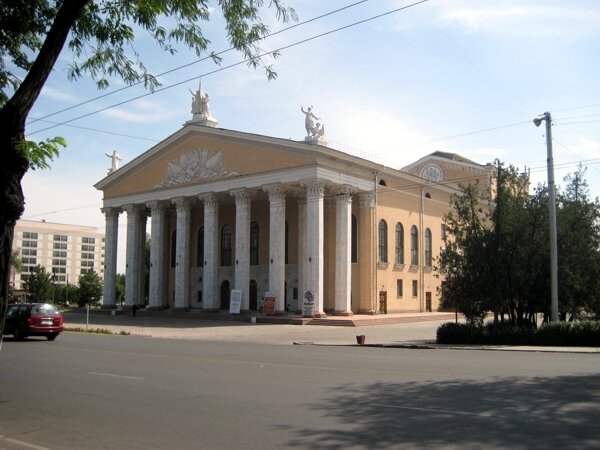


 Bishkek