Some advice from Turkey
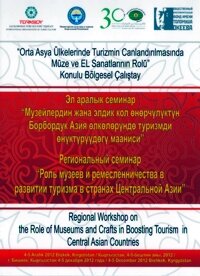
A bit of a mouthful
This week is pretty horrendous … meetings, meetings, meetings!
As if it wasn’t bad enough having the Summit of the Shanghai Cooperation Organization (SCO) in town causing chaos on the streets with traffic jams that make if extremely difficult to move around the centre of town, for some reason everyone seems to have chosen this week to organize conferences.
Last week I received an invitation to a two day conference, (Regional Workshop on the role of museums and crafts in boosting tourism in Central Asian countries), which was being held in our hotel, the Silk Road Lodge on Tuesday and Wednesday, Tuesday and Wednesday, December 4th and 5th. I pointed out that I couldn’t make both days because I already had meetings fixed for Tuesday but I would be happy to attend on the second day if the organizers thought it would be useful. They did, so I agreed.
It’s just as well, because I was the only tour operator present, although the Deputy Minister in charge of the Tourism Department at the Ministry of Culture and Tourism was slated to also appear … and did appear, although he was also obviously under pressure.
I was surprised because, being an Englishman trained in the Anglo Saxon school of philosophy, I looked at the title and saw that it combined a number of elements, (Museums, Crafts, Tourism and the Countries of Central Asia), but the main theme of the workshop was supposed to be about “boosting tourism in Central Asian countries”. It turned out that although the aim was to unite these four elements, the emphasis was as much about the relationships between the various players as in “boosting” tourism.
Apart from the title of the workshop being a bit of a mouthful, I thought it could be a very useful platform and had prepared a few pithy comments about cooperation between those involved in tourism and both Museums and craftsmen and women. They both represent an aspect of the country that we “sell” as part of our “tour products” to visitors … and so we vested interest in each others welfare and prosperity, and should support one another as best we can.
In case we were asked about concrete proposals, I had prepared a list of “the four S’s” … which is actually a cheat because it is it is three s‘s in English and a Ts in Russian.
These days, tourism is about experience … be it lying on a beach and soaking up the sun, horse riding in a mountain wilderness, seeking how Kyrgyz carpets are made, wandering through a museum, (large or small, world famous or simply a local museum), or … whatever. It is no longer a wholly passive activity – lying on a beach soaking up the sun. These days it has an active focus – even if that involves lying on a beach, soaking up the sun. There are some things that help to enhance or detract that experience – and that is where the s’s come in.
Signs … tourists want to understand what it is they are looking at … and so it is important to give them the information. A museum where the signs are only in Russian, (or Kyrgyz), is very frustrating. The visitors are not going to stay long, lingering over exhibits … and are unlikely to return or recommend the experience to others. The Fine Arts Museum in Bishkek, for example, has a very fine collection of handicrafts, but the intricacies of the pieces were lost on me the first time I saw them … and it was only after I went to a demonstration that I began to understand what went into making each piece, the skill, craftsmanship and hard work involved … and the value of the pieces on display. Signs in an international language, (such as English), would help broaden the appeal or, better still, if leaflets were available in a number of languages which would help to explain what was on show.
Smiles … the longest word in the English language … and one of the most valuable and important words in our business. It doesn’t cost anything, (in monetary terms), to smile – but the value of a smile is tremendous. It helps to make the individual feel welcome and wanted, as well as being therapeutic to the smiler. I have been to a number of the museums in Bishkek, (not all of them by any means), and in some cases I and my party have been the only patrons … perhaps the only patrons they have seen that day. These are usually the smaller museums, but it is often noticeable that the staff are glad to see us. They make us welcome. In other museums, (and it is usually the larger ones), the staff appear disinterested and even at times rude. A smile can not only encourage people to feel comfortable, it can lead to a repeat visit and recommendations … and for the craftsman is much more likely to lead to a sale.
Schools … one of the main purposes of a museum is to provide an educational resource and one of the issues addressed by craftsmen is the need to preserve and pass on their their skills to the next generation. Museums and craftsmen need to work with the younger generation and that is probably best done by working with their schools. Instead of simply accepting school groups, they should have someone responsible for liaison with schools and invite them in … at a special rate if not free. Parties can be invited on days when there are traditionally fewer other visitors and have special programmes and activities. The museum or workshop will also benefit from a “live place” which will be seen by other visitors when they do appear.
Sena – or Tsena, price – my cheat … don’t charge locals one price and have another absorbent one for foreigners. We’ve had the situation where clients have seen the prices at the entrance to the museum and then refused to go in because they think they are being fleeced … Psychologically it is much, MUCH, better to have a set price – albeit expensive – and then offer concessions to students, pensioners …. and even for local residents. This sort of thing happens all over the world and is more easily accepted … even though it is effectively the same.
The high point of the day, even though his presentation was entirely in Turkish and I had to rely on the Russian translation, came with a presentation by a Professor at the local Kyrgyz-Turkish Manas University. It was more notable for the fact that it wasn’t on the programme and he was told by his boss, (the Rector), only the previous day that his services had been volunteered. He was Turkish and a specialist in what is known as “cultural tourism“.
Now, to be honest, whenever the example of Turkey is mentioned in connection with the development of tourism in Kyrgyzstan, I start to tremble with trepidation. Turkey is a completely different country, much closer to European markets, capable of supporting tourism all year round, prices are much cheaper, there are many more tourists than we get – and are ever likely to get and not only does it receive considerable incomes from tourism, it is a much richer country generally – and not just in financial terms … it has a wide range of historical and natural attractions to add to the Mediterranean beaches that attract tourists like … well, the analogy I was thinking of is not a nice one so I wont complete it here. More to the point, the industry is subject to much greater government control than tourism here … and such references to Turkey are usually associated with calls for similar controls here in Kyrgyzstan.
On this occasion, however, I found myself agreeing with most of what he had to say.
His presentation began as usual, with a review of Turkey and the tourism industry in Turkey – including a lot of statistics. One interesting statistic was not just how many tourists had visited the country each year and how much the country had received from them, he went on to point out that the average spend per person over a twenty year period ranged from USD630 to USD810. Unfortunately he didn’t have a figure to show what represented per day … but he was confident enough in his presentation that I felt that if I asked him, he could have given me the figure – or at least could have found it for me.
He then went on to make more general points and there were two in particular that I want to share:
Firstly, that the government of Turkey made a definite decision to recognize the fact that if the local population did not value its own culture, then cultural tourism could not develop in that environment. Therefore they adopted measures to try and encourage their citizens to recognize and value aspects of their own history and culture …
Secondly, he expressed the importance of experience. We have five senses so why should museums concentrate on just one, (those are my words, not his – but that’s how I understood what he said). If the museum has a display of fine crafts, then give the visitor the chance to see, and participate (!), in the process … then they will understand and value the product much more.
It’s not entirely appropriate, but I couldn’t help but recall the old Chinese proverb:
I hear and I forget,
I see and I remember,
I do and I understand
He finished with a number of practical suggestions of the “little things” that could be done to help enhance a visit to a museum: having a shop and a café available, with replicas of what is on display; decent toilets (again!) and giving visitors the chance to participate.
I hpe and trust that these find their way into the final report of the workshop.



 Bishkek