The Goitered Gazelle
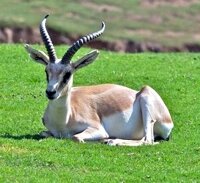
Gazella Subgutturosa (Photo from the Tree of Life website)
Although I knew that there was a Gazelle listed in the Red Data Book of Kyrgyzstan, (which lists the endangered species that are found in the country), I was still surprised when I came across an article about it, because I have always associated Gazelles with the Thompson variety that bound across the African plains. That seems a long way from the Mountains of Central Asia.
Of course, there are many different types of Gazelle spread throughout South West and Central Asia as well as the Indian subcontinent.
The particular species of Gazelle that is found in Central Asia is called the Persian or Goitered Gazelle, (or more formally: Gazella subgutturosa).
The name “Gazelle” comes from an Arabic word which was adopted in French and then entered the English language sometime around 1600. In Arabic tradition, the Gazelle is associated with female grace and beauty.
“Goitered”, (which means “full below the throat”), refers to the enlarged neck and throat of the males during the mating season.
In a way, my initial surprise was understandable as, like most of its relatives, Gazella subgutturosa is fleet of foot and more at home on the steppes of Kazakhstan and ranges over a wide area from South eastern Turkey, Northern Azerbaijan, parts of Iran, South western Pakistan, Uzbekistan and into the Gobi Desert. They are also, apparently, to be found in Kyrgyzstan – but not in high numbers – hence their entry in the “Red Book”.
In fact, when I looked the animal up in Joost van der Ven’s book, Looking at Mammals in Kyrgyzia, I discovered that he points out that they are “extremely rare in this country” … indeed, he says that the species has been found in only two places: In Western Issyk Kul and the foothills of the Turkestan range, in the Leilak region of Batken oblast.
Whereas in Kazakhstan there are estimated to be less than 25000 animals, there are far fewer in Kyrgyzstan. Apparently, some 29 specimens were found in Issyk Kul during a wildlife census conducted in the 1960′s. In the middle of the decade, this population had shrunk to just eight individuals … and towards the end of the decade there were only trails sighted … no animals. In the middle of the 1970′s however, a small herd of half a dozen animals were spotted near the Orto Tokoi reservoir in the Naryn oblast.
On a global stage, the species is recognized as being in vulnerable - the least of the three levels of “threatened status”.
Gazelles are small antelopes, measuring between about 60 and 110 cm in height at the shoulder.
Usually they are coloured a sandy-brown which white under parts, although in winter these colours may be lighter; greyer with a hint of ginger. The black tail gives a distinct change to the beige of the body and is raised when running.
Gazelles have horns, although on the females these are quite short, perhaps just 8 centimetres long, but on the males they can be 25 to 30 centimetres long, and although they smooth at the ends, along the rest of their length sport ring like swellings.
Like most antelopes of the Gazelle family it is normally found in open spaces such as sandy and gravel plains and semi desserts. and also on limestone plateaus, where it can make use of the great that its long slender legs grant it. Some gazelles have been clocked at bursts of up to 60 miles an hour (almost a hundred kilometres an hour), but the Goitered Gazelle does not leap in the same way that is characteristic of many other of its relatives.
Although they are a migratory species and can cover large distances in their territory, (anywhere between 10 and 30 kilometres a day in the winter, although they tend to travel just a couple of kilometres a day in summer when food is plentiful), they are much more settled than other species. Often, they congregate close to a water supply, (either “sweet” or “salty” water as they can tolerate either), especially during the height of summer … when the females may be nursing. The males can go without water for a reasonably sustained length of time.
During the heat of a summer’s day they are likely to be found resting under the shade of bushes, becoming active and emerging as dusk falls.
They tend to live in herds, although not ones. In the winter a herd may number into the hundreds, but during the rest of the year, the large herd will into smaller ones which graze separately.
Their diet consists of easily digestible plants and herbs. During the winter, these can be hard to come by and this is one of the reasons for their status as “vulnerable”.
The mating season starts in October/November with the males marking out their territory and jealously protecting their females; fighting their rivals which is basically any male over two and a half years old. The females start reproducing from as young as just one and a half years old.
The offspring, usually twins, are born in the Spring, typically in May. For the first two weeks they are extremely vulnerable, lying on the ground where their colouring affords them excellent camouflage, with their mothers grazing some distance off in order to draw attention of any potential predators away from them.
Later, the young will follow their mothers who will suckle them it the autumn by which time they will have learned which plants are the most succulent and nutritious.
Although she may be able to handle the threats posed by some predators, such as foxes, she will run away in the face of more serious ones such as wolves, in an attempt to lure them away from her offspring.


 Bishkek