The Celestial Horses
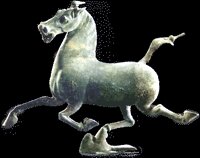
A famous image of the Celestial Horses
An Arab poet once said, “The West was still covered in ice when, in the East, they were already producing music”. It was also in the East that horses first domesticated and historical sources suggest that Central Asia was an ancient centre for horse-breeding.
The horse played a very big role in the life of the nations of the region: it was a religious animal and white horses were sacrificed to the Sun God. It was amongst these peoples horse-breeding seem to have originated and later spread to the Middle East, Mediterranean, and North Africa.
Slim, light-legged, horses can be seen in ancient papyrus and Assyrian bas-reliefs, and it is known that the breeding and training of warhorses was well developed amongst the Hittites, Assyrians, and Egyptians. In the seventh and sixth centuries B.C., ancient Persia became a potent power and an opponent of both Greece and Rome. From that time historians and poets started to refer to horses from Central Asia, (popularly called Nisean), as the best in the world, surpassing all others with their height, strength, speed and beauty. It is possible that the name “Nisea” is connected to the ancient capital of Parthia, Nisoi, the ruins of which are located under the modern city of Ashkhabad.
Herodotus, for example, wrote: “In Medea there is a wide plain called Nisea, where there are majestic horses.”
In the descriptions of Alexander the Great’s expedition into Central Asia there is a reference to the Nisean horses: that “there are no such horses anywhere in the world; they’re passionate, very fast and enduring, of white and rainbow colour, and the colour of morning dusk”.
These famous Nisean horses marched in the processions of Persian, Parthian and Bactrian kings. It is also recorded that Sycthian riders won competitions on them against previously undefeated Persian warriors. At the same time, Central Asian racers were also appearing in the east, under the saddles of the chieftains of tribal associations of the Altai (Pazyryk) and Tuva regions. Images of them were struck in the sacred places of Yenisei and Fergana.
According to ancient commentators, Bactria “with golden horses” produced “wonderful horses of an excellent breed. There are no horses similar to them anywhere in the world. They are very fast and hardy, of white and iridescent colour, and also the colour of the morning dawn”.
The earliest Chinese expeditions into Central Asia, (in the second century BC), came looking for both allies and horses led by the general Chang Ch’en. It was not an easy journey and after a trip lasting thirteen years he returned with a solitary survivor from the 100 men that had originally left with him.
His mission was a failure in that he failed to find allies for the Chinese court, but he brought back with him something, perhaps, much more valuable – information about the geography, the peoples and culture of the lands to West – information about some 36 separate kingdoms.
Of particular interest to the Imperial court was his description of the short, strong, sturdy horses that sweated blood and which were superior to any in China at that time and could match, and surpass, those of the nomadic Xiongnu and so a return journey was undertaken to arrange for the purchase of a stock of these Celestial Horses. The new emperor Wu-ti sent him back (this time with three hundred warriors), and after a lifetime of travel and danger his health gave out and he died after his return from this second trip. Wu-ti then sent another, far larger, expedition which after a four year campaign returned with some 3000 of the Celestial Horses.
These horses were famous for “sweating blood” – something noted by Silk Road travellers right up until the 19th and 20th centuries. The reason for this phenomenon remained a secret right up until the twentieth century when it was discovered that it was due to parasite infections. The parasite burrowed under the skin in the region of the shoulder and back and produced little swellings which burst and bled. Not only were these horses highly prized by the Chinese army and served in many campaigns, (and later by the nomadic tribes which inhabited the region, they were traded for silk – much of which found its way to Europe – and served as models for sculptures across China.
Perhaps the closest descendant of the Celestial Horses is the Ahaltekin horse. The appearance of this breed is exotic in that it completely contradicts the common idea about how a horse should look whilst at the same time amazes with its unusual and unearthly beauty fashioned over the centuries.
The name given to the Ahalteke breed comes from the Akhal oasis and the Turkmen Teke tribe, which bred them. At the beginning of the twentieth century Teke horses from Ahal were called ahal-teke. The Tekinese would keep one or two horses in the yard or near their yurt. A foal would grow up as a family member, lavished with attention and love – the Ahaltekinese differ from other breeds in their devotion to their owner and suspicion of strangers, reacting keenly to a change of riders. A Turkmen was not simply raising for himself a working horse, but a “horse-friend”, that wouldn’t let him down either in a fight, in racing, or on a long journey crossing through desert sands. Often the life of a warrior depended on such a horse. “These beautiful animals stand all the efforts spent on them … Indeed, they are amazing creatures, valued by the sons of the desert more than wives, children, and even their own lives” said the traveler Vamberi about Turkmen horses.



 Bishkek