Kyrgyz Cinema
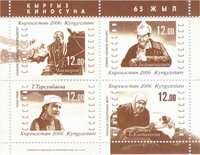
Kyrgyzstan may not spring to mind whenever there is discussion about the Cinema and the film industry. This is understandable as very few films made in Kyrgyzstan reach the West, and those that do are normally restricted to various specialist festivals. There is, however, a film industry and, even though they don’t produce high-budget “blockbusters”, the Kyrgyz Film Institute has long had a reputation in the countries of the former Soviet Union for producing interesting and challenging films. That reputation is being maintained by a new generation of producers in the newly independent country, despite facing many problems – such as the lack of finance.
The first film to be shown, rather than filmed, in Central Asia was screened in Tashkent as early as 1897. No-one is certain when the first film was shown in Kyrgyzstan but the Soviet Union built a number of cinemas in the main cities, and Social Clubs in many of the villages where films were shown … and they also developed the Kyrgyz Nomadic Cinema as a propaganda weapon, to take films to remote communities in the country’s rugged mountain regions by horse. According to Finnish director, Arto Halonen, whose film “The Star’s Caravan” tells of two modern day projectionists trying to keep the system alive: “In Kyrgyzstan 80% of the films came from the Soviet Union and 20% from the other Eastern European countries. Generally, the whole propaganda system was very well built and very well controlled. The old Soviet films were done in a very skillful way as manipulated films because they were using emotions to tell the story.”
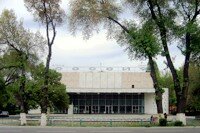
There are, now, a number of cinemas in Bishkek which show a wide variety of films from all over the world – usually dubbed into either Russian or Kyrgyz. Gennady Bazarov, a prominent Kyrgyz director who has not made any films since 1989 comments: “There are people who want to see Kyrgyz films, but many problems exist. First, the cinemas are very old. Second, those that work show Hollywood films, action and pornography. Third, many people are so poor, they can’t go to the cinema at all. A new law has just been signed by the president about a little aid to cinema; it is small but symbolically significant to help people understand that art is important.”
The attitudes of the Kyrgyz towards their film industry, and of those within the industry itself, are markedly different from those found in the West. Although local audiences are now more familiar with Hollywood blockbusters than with the products of their domestic industry, there is a pride in the achievements of the Kyrgyz film industry.
Kyrgyzstan got its own film studio in 1942. It was the last of the Central Asian republics to do so.
- The first in the region was established had been established in Uzbekistan as early as 1924, (called “Buchkino”, as it was based in Bukhara). Technically, it was a subsidiary of Leningrad’s Sewsapkino studio – and in 1925 the “Star of the Orient” studio opened in Tashkent.
- Turkmenistan followed in 1926 when the Ashgabat Kinofabrica (“Film Factory”) was established.
- In 1929, a documentary film unit, a subsidiary of Vostokkino, was set up in Almaty, (the unit established it’s own studio in 1934).
- Tajikkino (later Tajikfilm) was founded in 1930 as Tajikistan’s documentary and newsreel-studio,
As in the case of Kazakhstan and Tajikistan, at first, the studio in Kyrgyzstan made just documentaries and newsreels. It was only in 1955 that the first “feature” to be filmed in the country, “Saltanat”, appeared … once again, Kyrgyzstan was the last of the Central Asian republics to break into new territory. In fact, “Saltanat” was produced by a film company based in Moscow (“Mosfilm”) and the first truly local production, called “My Mistake” appeared two years later, in 1957.
In the early days, most of those involved producing films for the Central Asian studios came from the Western republics of the USSR – Belorussia, Russia, Ukraine, – and were generally the less important characters. One reason why cast and crew were “imported” was the reluctance of the locals to work with film – possibly because of Islamic views about images in various art forms. It was only later that the first local talents finally began to emerge – although that did little to alter the character of the film output – in view of the soviet control of propoganda.
During WWII the film studios in Central Asia were to become the centre of Soviet film production: as with many other industries the studios of Moscow, Leningrad, and Kiev were evacuated from the path of the advancing German armies and were transplanted to the safety of the Soviet Union’s vast interior. As a result, for example, Eisenstein’s classic “Ivan the Terrible” was shot in Alma-Ata. After the war, when the western Russian studios returned to their original bases, they left much of their equipment behind in their temporary homes, further-boosting Central Asian filmmaking in terms of facilities. In terms of subject matter, however, the studios were still subject to the dictat of the Moscow regime.
It was in the 1960’s when cinema in Central Asia began to blossom, A change in attitudes in Moscow (sometimes called the “Soviet Thaw”) initiated by Premier Nikita Khrushchev cleared away the restrictions imposed by the Stalinist regime. In the arts this meant an end to the official monumental style and “freedom of expression” was encouraged. Although the Party did not relinquish all forms of control, a more realistic, more personal, kind of cinema was encouraged. A great deal of money was invested in the film industry and production grew – including the output of the studios in the Central Asian republics.
Amongst the various film makers to their mark during this period were Larissa Shepitko and Andrei Konchalovsky from Kyrgyzstan. They were the first to adapt the works of Chingiz Aitmatov – Shepitko’s Heat, and The First Teacher, were well received as masterpieces.
In fact, Chinghiz Aitmatov was to play a pivotal role in the development of Kyrgyz Cinema. Apart from the fact that he was the head of the Kirghiz Filmmakers’ Union for over twenty years, his novels and screenplays formed the basis for much of the country’s film classics and also served as aesthetic examples – so that even if he wasn’t directly involved in a film’s production, he still exerted a strong and unmistakable artistic influence.
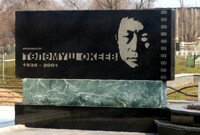
Another major producer from this period was Tolomush Okeev. His first film was in 1965, and his last in 1986. When he died in 2001, (at the age of 66), the national film studio in his honour. He has been described as “one of the greatest outdoor filmmakers who ever lived”, “a somewhat reclusive master of a discreet pantheistic cinema”, “a born poet”, and a “master of the smallest nuances, of the beauty of details”. Okeev tells his stories mainly through their landscapes, within which people were simply one element. His storylines are usually minimal, with few plot twists. He patiently studies the rituals of daily life at decisive moments during the eternal cycles of life – such as hunting or harvesting.
The 1970s and early 1980s were challenging but rather productive. Waking up to a sudden change with Leonid Brezhnev’s “stagnation era” and Soviet filmmakers were forced to express their thoughts in a way that wouldn’t be obvious to censors. As a safe path, many decided to make films about the establishment of Communism in the region. Regardless of the main plot, the viewer could “read between the lines”. Another approach, adopted by many of the Kyrgyz film makers was for films to concentrate on the daily life of locals.
During Perestroika other young filmmakers made their first works and attracted attention on the festival circuits, including directors like Aktan Abdikalikov and Beyzhan Aidkuluev.
However, just as such directors were beginning to obtain a reputation the collapse of the Soviet system a devastated the regional film industries. Suddenly:
- there were no more state subsidies available,
- they were deprived of the services of an agency in Moscow which would promote their work to Western festivals and distributors,
- there were no film schools outside Kazakhstan for any Central Asian directors.
Faced with serious social, economic, social and political problems, the arts were not a high priority for the government and the national film centers (throughout Central Asia) found themselves in severe difficulties. However, most filmmakers stayed in their home countries, although many of them work in other businesses in order to earn a living and creative filmmakers started looking towards the West for finances and recognition. Some films have been produced with financial support from Europe, notably from France and Germany. Films have been submitted to several festivals around the world and have achieved a certain level of success and earning recognition for several individuals, (in particular, Beshkempir and Saratan for their respective directors Abdikalikov and Abdyjaparov).
“We want economic reforms to change our system,” commented Ernest Abdyshaprov, (who worked with Abdikalikov on the short film “Bus Stop”), in 2001. “We understand that we are going through a difficult period. Perhaps one day the attention of the government will turn to us. In the meanwhile, we make videos to survive. In the Soviet era, Kyrgyzstan made three films per year. After perestroika, we made more because directors could find rich sponsors. In 1992, twelve long feature films were produced. But after that, it became more and more difficult. Between 1995-96, no films were made. Since 1996, we have been producing one film in two years, but this year two feature films have been made: Aktan Abdykalykov’s Maimal, produced with French money and Marat Sarulu’s Altyn kyrghol (“The Silk Road).”
Most filmmakers who have work are now producing short video clips for television.
Other recent developments include:
- the renovation of the Kyrgyz film studio – to incorporate a recording studio, a national film museum, and restaurant on the premises;
- attempts to seek governmental support and trying to produce films by young filmmakers including competitions for aspiring new talent to produce scenarios and screenplays;
- independent studios are being established
- one is called “Beshkempir”, headed by Aktan Abdikalikov and named after his successful film
- the film studio Epos has an extensive film library and produces films commissioned by clients
Kyrgyz films tend not to be filled with action. They are more atmospheric and have an artistic flair which mark them out as different from their Western counterparts. In place of action, the directors, actors and film crews call upon their collective experiences. (Some of the films have distinctly autobiographical elements.) Many of the themes explored are expressed through everyday situations – the life and culture of the people. The films are populated with scenes from daily life. Animals and landscape also feature prominently.
For example, when speaking at a press conference about the film “Bus Stop”, one of the writers, Abdyjaparov described how, “most of all we wanted to show our country in the film. Active life – a noisy thoroughfare that is intersected by a highway, while we just stand there and wait for something. … Obviously this is some sort of dead end because the bus doesn’t come after all, and perhaps won’t ever come. But the main thing is – the people who stand there. They are alive, human, and will always live together.”
There is one local project aiming to produce a “Hollywood type” film (to be called “Paranoia”), but generally filmmakers recognize that their industry cannot produce commercial films and compete with Hollywood. They don’t have the finance available … but also, according to Abdyjaparov: “it is not our mentality. We can only make our traditional Kyrgyz cinema and develop intellectual films. We are in the process of finding our lost traditions and parallel to that trying to choose the best tradition to adapt to meet the civilization of the West.”
If there is a tendency for modern Kyrgyz films to reflect the current social conditions and cultural heritage of the people – one thing that is often missing is: politics. Whereas at one time directors sought refuge in making films about how Communism was established in the region … now political issues are not deemed subjects for comment.




 Bishkek