Don’t close doors
I know that I have a penchant for clichés … pet phrases which populate many of my conversations.
One that always seems to raise eyebrows when people hear it for the first time is: “Don’t close doors!”
When someone is young they have a myriad of opportunities open before them … think of them as doors, each leading to a different future. The problem is that over the course of time these doors close, one by one, limiting the options available to them in the future. Some of them close due to reasons beyond our control, but others close as a result of decision that we make.
As a schoolboy, for example, I failed the “11-plus examination” which meant that I went to a secondary modern school, which limited my future career options. Although I was able to study for A-levels, (university entrance examinations), I studied Mathematics, Geography and Religious Education … which was quite an eclectic mix, but the school did not offer a course in Physics, or any of the other sciences. That limited the options available to me at university, and in my later career. I didn’t choose to fail the 11-plus examination, it may have been down to me, my performance, but wasn’t my decision, but the eclectic mix of A-level subjects was. Maybe my life would have turned out quite differently if I had not chosen to stay at school and study these three subjects, but had chosen to leave and go to a college somewhere else where I could have studied Physics.
Who knows how things will turn out in the future … I certainly had no idea when I was at school that I would end up running a hotel and tour business so far away from home in Central Asia. Fortunately, as it happens, much of my experience up until my decision to come to Kyrgyzstan has been useful to me here and, rather than closing doors, (or even just keeping them open), has actually enabled me to open new doors which I had thought were closed to me.
For example, I am not particularly good at learning languages, and yet I have had to learn, and manage to get by reasonably well in, Russian. At school, it took me three attempts to get a pass grade in French … I gave up on New Testament Greek at the earliest opportunity after the sixth month introductory course, on holidays I usually managed to learn only only a few basic phrases in the local languages: Please, Thank You, Two beers …. However, the formal grammar that I had to learned when studying French and a variety of computer languages; the fact that I was already familiar with much of the Cyrillic alphabet and the fact that I had learned another of life’s important lessons, (“Don’t be shy … Seize the opportunity … Have a go!”), have all been helpful in this.
As a result, one of the maxims which I always keep in mind is: “Don’t close doors, but try to keep as many as possible open for as long as possible”.
When I was a teacher back in the UK, we often had to participate in parent-teacher consultation evenings. Most of these involved a discussion about so-and-so’s progress in class … what was going well, what could be improved, and so on.
There were other evenings as well … maybe an evening dedicated to a particular topic in the school curriculum, such as when we were introducing computer awareness courses. One of the regular annual meetings was the careers evening, when we talked to the children and their parents about what plans, what hopes, they had for their future … and started exploring the various possibilities and career paths may be open to them.
Sometimes the conversation on these careers evenings revealed a lack of understanding about the jobs that people do. I remember, for example, the girl who said she wanted to be a barrister and when I asked, “Why do you want top be a barrister?”, I was somewhat taken aback by the response. “Because I am sick and fed up of all these criminals getting away with things and I want to put them away!” So much for for being innocent until proven guilty.
There were other surprises as well. On one particular occasion a family sat in front of me: son sitting in the middle between mother and father. They weren’t sure what subjects he should choose to study the following year … and they faced one big dilemma in particular – whether to choose German or Computing. This had obviously been the subject of much discussion at home, and now they were looking to me for advise. He was a good student and very keen on computing and also, apparently had a particular skill in German. Now, I was Head of Computing and there was a certain amount of tension in the air … they obviously thought I would advise him to opt for Computing. Instead, I gave him a question … what did he think he would be doing in ten years time?, what career plan did he have in mind? I can’t recall his answer, but it was clear that neither German not Computing was essential for him to achieve his ambition. To everyone’s surprise I said that the choice was his, but if I was in his place then I would probably choose German. Neither discipline was essential for him, but both could be useful. He was more likely to maintain an interest in computing in his everyday life than German. Generally, once you give up a language then, (like sport), you don’t take it up again unless there is a specific reason, but computing and information technology is something that he was likely to continue using and learning – but there was no particular reason for him to learn about linked lists and the architecture of a CPU. If, one day, in the unlikely event that it was important for him to learn these things, then it would be in a particular context and easy enough to assimilate what he needed.
The important thing, I said, was “Don’t close doors, but try to keep as many as possible open for as long as possible”.
Sometimes the hopes and ambitions which were exposed during these consultations were realistic and sensible, but all too often, unfortunately, they were optimistic beyond the realms of reality. Now, don’t get me wrong … children all have their strengths and interests as well as their weaknesses and limitations. Who can say what will happen in the future. Although performance in school subjects can be a good indicator of success in university or elsewhere, there is no reason to assume that a child who is not achieving high marks at school cannot develop and “blossom” later in life when they see the direct relevance of learning something or acquiring a new skill. Ambition is a good thing, but children always seem to think that life is easy … it isn’t. Parents obviously want their children to do well and often had over inflated ideas, not only of the talents of their offspring but also of the openings that were available to them.
A similar trend is particularly noticeable here in Kyrgyzstan. Everyone wants a university education for their child and Kyrgyzstan has one of the highest ratios of graduates to the general population in the world. Laudable though that is, it is fraught with problems.
First of all, not everyone is suitable for an academic education … and it seems to me a disservice to push a child into higher education which is unsuitable for them, and in which they may struggle and likely to experience failure. One of the less savoury aspects of Kyrgyz education is the number of students who, apparently, “buy” their grades. It is not only bad for them, but it reflects badly on all the good students who work hard and do achieve good grades by stint of hard work … and that is probably the majority.
Secondly, many of the graduates have difficulty finding employment once they leave higher education. The system here is quite rigid in that although there is a general core curriculum which is supposed to be followed by all students, whatever their discipline, every course also has a specialism which is supposed to fir the student for a particular career. In the days of the planned central command economy of the Soviet Union, it was forecast that the country needed so many economist, so many accountants, so many lawyers, and so forth, and students were shepherded into courses to produce people with these skills and qualifications to meet the anticipated demand. With the advent of the “Free Market Economy” in post independent Kyrgyzstan, such planning is a thing of the past and students have much greater freedom to select their chosen course and career. However, the rest of the system hasn’t adapted to the new environment and courses are, for the most part, still heavily geared towards particular professions. I remember sitting in a conference where a newly qualified graduate complained bitterly that he wasted five years of his life studying for a diploma, (degree), only to be unable to find work “in his specialism” upon completing his course. Recently, a mother came to see me to ask if we had a vacancy for her son. He had graduated in Banking, Credit and Finance and although he had applied to all the local banks couldn’t find a post … so she was asking everywhere she could think of to see if she could find a job … even hotels and tour companies.
I have been interested to see that President Barrack Obama has been advising the youth of America to “aim higher than rap or basketball”. This might seem a bit odd, if not a contradiction, coming from someone whose campaign slogan was “Yes, we can!”, but as usual we have to look “behind the headlines” to get the full story. Apparently, what he told a meeting of the National Association for the Advancement of Coloured People (NAACP): “I want them aspiring to be scientists and engineers, doctors and teachers — not just ballers and rappers. I want them aspiring to be a Supreme Court Justice. I want them aspiring to be the President of the United States of America,” Although he may well have been addressing a meeting of an organization which concentrates on issues related to racial discrimination, but the message is applicable to almost everyone.
America may well be “the land of opportunity”, but how many rap stars and basketball stars can the country sustain?. Even if the children concerned do have talent, will they have the wherewithal to deal with the competition, and the pressures of the lifestyle? The good thing about “the land of opportunity” is that people do have the possibility to achieve their ambitions and “live the dream”, but that doesn’t mean that everyone can, or will, do so.
The important thing is, as I said to that student so long ago: “Don’t close doors, but try to keep as many as possible open for as long as possible”.
I have been using the phrase quite a bit in the last two weeks. It’s September and, like all children of school age, the “baseball kids”, (Maxim, Andrei and Sveta – see the post, A Baseball Match), have stared back to school. Mum decided, however, to change their school, and that has led to a lot of conversations about education and their career plans. She hopes that the new school will be better placed to give them the skills they need in later life.
One of them, Maxim, has long spoken about his ambition to work in films. He is really keen on the cinema and goes to watch all the latest releases. Kyrgyzstan does have a small film industry, but it is one thing to enjoy watching films and another to make them. Also, because it is a small industry, their aren’t that many opportunities, that many openings, available to the would-be director, scriptwriter, cameraman, sound recordist, technician, etc. If he is to achieve his ambition, and I hope he does, then it will take a lot of hard work, aptitude and effort.
The important thing for him, however, is: “Don’t close doors, but try to keep as many as possible open for as long as possible”.






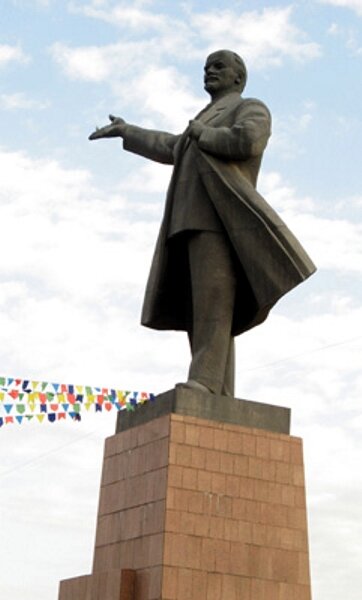

 Bishkek