Who the Dickens …?

Tourism and Sustainable Energy is the theme for adopted for WORLD TOURISM DAY, 2012
When I was a lad one of my favourite schoolboy jokes was: “Who the Dickens wrote Oliver Twist?”
“Who the Dickens … ?”, is, (or was), an exclamation which served as a rhetorical question … an expression of surprise. Sometimes, it would be abbreviated to WTD.
The way that WTD just rolls off the tongue, I can’t help thinking that it to stand for something (… in the same way as WTF or WMD do). Of course, it probably does, to someone … somewhere. For example, WTD could stand for World Tourism Day.
Thinking about it, I was reminded of the old Acronym Game … where you have three columns of words and you chose one from each column and see what you come up with:
|
W |
T |
D |
|
Want |
Table |
Date |
|
Water |
Technology |
Day |
|
Weapons |
The |
Depth |
|
Week |
Tight |
Deuce |
|
What |
Time |
Devil |
|
White |
To |
Dickens |
|
Win |
Tourism |
Die |
|
Working |
Training |
Directive |
|
World |
Do |
|
|
Door |
||
|
… |
… |
… |
Using the table, for example, we can arrive at: What the Dickens, Water Tight Door, Week to Date, Weapons Training Day, Working Time Directive to mention just a few – and, apparently, those are all genuine acronyms. You can also come up with some other humorous suggestion such as What Training Day – a good question.
Every year since 1979, September 27th has been designated by UNWTO, (the United Nations World Tourism Organization) as World Tourism Day. Each year there is a theme and this year’s theme, Tourism and Sustainable Energy, draws on the declaration of 2012 as The United Nations International Year of Sustainable Energy for All.
Tourism is seen as being at the forefront in developing and deploying some of the world’s most ambitious and innovative clean energy solutions, for example, it is claimed that:
- the aviation industry is implementing cutting-edge technologies to make aircraft lighter than ever before;
- commercial flights are beginning to use energy efficient fuels and biofuels;
- increasingly popular carbon offsetting schemes;
- key card systems and energy saving light bulbs are increasingly being implemented in hotel rooms worldwide;
- pioneering innovations renewable energy sources such as solar technologies and wind power;
- simple measures such as opt-in schemes for postponing the laundry of towels and linen and
- tour operators are asking for energy efficiency throughout their supply chains and sustainable procurement policies.
In a way, it was obvious that something like WDT was coming because there have been a whole host of stories about Tourism. Of course, there are always stories about Tourism in the press – and they always attract my attention because I am in the business. For example, there was an interesting iem on the BBC website about “Slum Tourism” … “There is a growing trend for tourists to seek out poverty-blighted neighbourhoods when they go on holiday, to get a sense of real life for the poorest communities there.”
Another one raised the question if “culinary tourism play an important role in helping create sustainable development in some of the countries along the ancient silk road?” … highlighting a new UNWTO report that suggested that could be the case.
There have also been an increasing number of stories about the importance of Tourism in various economies around the world … although, as it happens, they haven’t really focused directly on aspects of this year’s theme.
For example, it has been announced that the first sixth months of the year saw a 5% increase in the number of international tourists, suggesting that the number of international tourists this year is likely to breach the one billion mark.
All this is pretty impressive and research conducted by Oxford Economics published by the World Travel and Tourism Council even suggests that the Tourism industry in China, India and Russia is substantially bigger than more traditional sectors of the economy such as car manufacturing.
In China, they say that Travel and Tourism, at 9% of GDP, is larger than the vehicle manufacturing, (8%), educational services (7%) and communications (5%); providing employment for more people than financial services and almost as many people as the Mining sector. The signs are that growth is likely to be at over 9% for the next ten years.
In Russia, Travel and Tourism accounts for almost 6% of GDP, which is more than auto manufacturing, communications or chemicals. It supports some four millions jobs, (either directly or indirectly), more than in the chemical industry and almost as many as in financial services. Growth over the next ten years is expected to average 4% per annum.
In India, Travel and Tourism provides almost 6.5% of GDP, out performing car manufacturing, education and the mining industry.
This report apparently concentrated on these three countries, but there are signs of positive growth elsewhere as well.
A report issued from the White House in America, for example, highlighted the sharp rise in the number of international tourists visiting the United States – 10% over the figures for the previous year – providing a welcome fillip to the beleaguered economy. Although most of the revenue earned from international tourism apparently comes from just two countries, Canada and Mexico, there have been some interesting and noteworthy developments. The report, for example, links the increase in the number of tourists directly to the changes introduced to the visa application process – which saw an increase of almost 40% in the number of applications made in Brazil – whilst the demand from China increased by 48%.
All of these statistics got me thinking … in Kyrgyzstan, Travel and Tourism is supposed to account for something like 4% of the economy, (GDP), and the number of visitors coming to the country is thought to rise each year,although I must admit that I have my doubts about the reliability of these statistics.
Although these stories are indicative of an industry which is developing, I can’t help thinking that I would have liked to have seen some more based on the theme of sustainable energy: Solar Energy, Wind and Thermal power, energy saving techniques and technologies …
It is not as if there is a deficit of information in this field, for example the World Tourism Organization Network operates an Energy School, which explores various energy solutions, such as: renewable energy sources and various examples of simple but proven technologies, (… back when I was a teenager this approach was a new and exciting trend called “appropriate technologies“), which will not only help reduce greenhouse gas emissions by decreasing its use of fossil fuels but also enable cost reductions and enhanced competitiveness.
To be honest, when we first opened our hotels over a decade ago, we considered the use solar energy, but were dissuaded from this option because of the apparent poor efficiency and lack of support for the technology at that time, as evidenced by the number of previous installations which seemed to lie around damaged and inoperative. I think that it would have been nice to see some discussion of the recent developments in this field.
Kyrgyzstan is, after all, a country where energy is a supposed to be “one of the wings of the economy” - even if we do experience problems over the reliability of electrical supply, Gas, coal and petroleum.
What is more, the pristine environment and ecological issues are major political themes which are used to berate construction projects from the construction of new Hydro electric power stations to operations in the mining industry (the other wing of the Kyrgyz economy) and new hotel developments on Lake Issyk Kul. Concerns over the retreat of glaciers, irrigation and potential desertification arising from global warning, are all issues which seem relevant.
Still, I suppose it is always possible that there will be plenty of coverage on these issues today – on WTD.
For more details about World Tourism Day 2012 and the various activities organized to commemorate the day, see: www.wtd.unwto.org.


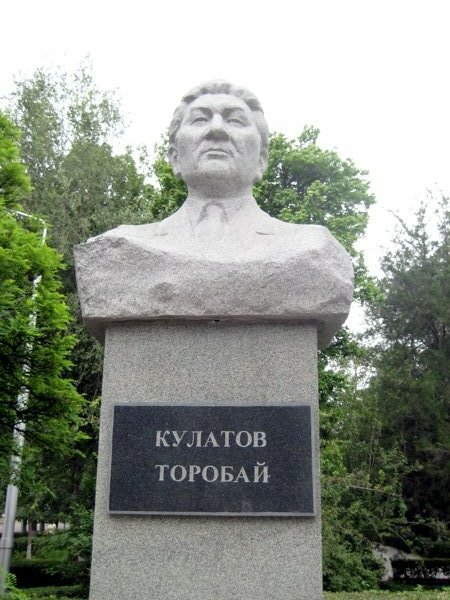
 Bishkek