The truth, the whole truth and …
I don’t often get to look at the Sydney Morning Herald – after all, Sydney is an awful long way from Bishkek, but a tweet on Twitter sent me to an interesting article: “Why would anyone want to go there?” by Ben Groundwater – aka The Backpacker.
It was not only interesting. I found Groundwater’s approach, his use of “glib” humour in the face of a difficult issue, both thought proving and challenging.
The article is about Mexico – another faraway place, but that didn’t put me off. Indeed, it made me think of Thailand – and of Kyrgyzstan.
The article started by highlighting the difficult times that Mexico seems to be experiencing at the moment, (“Drug lords … appear to be killing at will. Innocent bystanders as well as each other, … Much of the Chihuahua state is a no-go zone. The city of Ciudad Juarez is about as enjoyable to stroll around as Baghdad. Police seem to have lost all control. And, to make matters worse, there was also an earthquake in the country’s north quite recently”) and then Groundwater asks, “why in the light of all this would anyone want to go on holiday there”.
A good question and one that I could identify with given what we have been through here in Kyrgyzstan this year: A revolution that cost over eighty lives, several examples of civil disorder, one of which has cost yet more lives and virtually made the Southern regions of the country an almost no-go zone. Months of political instability and uncertainty as the Interim Government seem to flounder from crisis to crisis. Some of this disruption is being attributed to the activities of drug lords protecting their position, influence and business controlling the transit of drugs from troubled Afghanistan into Russia and further. And, to top it all, we are also in a seismically active zone – and earthquake zone. It sounds as if the two countries are facing situations which, if not exactly identical, are similar to one another.
It instilled in me a sense of empathy with the Mexicans in the same way as the stories about trials and tribulations in Bangkok earlier in the Spring had elicited empathy for the Thais when we were experiencing our revolution.
So Groundwater asked, why would anyone want to go on holiday to Mexico at the moment? – or, I thought to myself, to Kyrgyzstan for that matter?
One reason, he points out, that he is still planning to go on holiday is that he’s already paid for his it.
OK, that represents some sort of commitment – but I don’t think it can be as be as important a reason as all that.
Even if he hasn’t bought a package with a refund policy that allows him to cancel his trip – all is not lost if he’s taken out, (as I am sure he has being an experienced traveler and journalist), adequate travel insurance. If the Australian Government were to issue a Travel Warning against travel to Mexico, then he would almost certainly get a refund on the money he had paid if he chose to cancel his trip.
We, for example, always recommend that our clients consider not just basic insurance cover for medical expenses, but a comprehensive policy which contains provision for situations such as the loss of belongings and documents, cancellation and delays.
To be fair, I know, however, that this is not always possible. I’ve recently several days trying to arrange such a policy for a Kyrgyz woman travelling to Australia, and could have got one easily enough if hadn’t been for her age – 66 – the insurance company have an upper limit of 65 for their policy. In the end, we had to settle for a policy that covered just basic health care expenses.
Even so, when it comes to weighing up the cost of the holiday – for example, let’s say, several hundred dollars – with his physical and mental health and well being, then I think the latter would normally win, hands down.
So, as he points out, the economic explanation is basically a somewhat “glib” answer to the question.
I suppose that in addition to the financial expense involved, there is also the question of the time and emotional “expenditure” he has made, (paid), in planning his trip, (the expectation and anticipation of, as he puts it, “ the food, the beaches, the culture, the ancient ruins and the tequila”), but that can always be compensated for by postponing the trip and taking it at a later date when the situation is more settled, rather than cancelling the trip altogether.
It struck me as interesting that, as a journalist himself, he went on to recommend a healthy distrust of the media … that’s my phrase, not his. He says, “in my experience, you never really know just how dangerous a destination is until you set foot there. It’s a case of not believing everything you read”, and continues “After all, the media never run headlines like, “Nice day in Oaxaca.” Or, “Tourist meets friendly local in Guadalajara.” It’s all murdered journalists in Juarez, kidnapped American students in Mexico City and robberies in, well, everywhere, really.”
As it happens, that’s a point of view I can strongly identify with. The journalist’s job is to report something … the more dramatic, striking or spectacular, the better. It stands far more chance of being picked up by the editor and included in the newspaper of TV programme. So, as well as the need to look for dramatic events and trends, there is also a tendency to ignore “Good news” or “no news” (of the “everything is normal” variety) as not meriting a mention. Any such report would simply be squeezed out by other, more “newsworthy” happenings.
Indeed, another of Groundwater’s articles is headlined: “Why bad stories are always good”(!) where he points out that, “… things going wrong are far more interesting than things going right.”
That’s not to say that the risks being reported aren’t real or that the media reports don’t present real concerns. They are, and they do.
On the other hand, they are just that – risks and concerns.
Groundwater goes on to consider the question of how real the risks are in reality?, how real are the concerns? He asks, for example, “what are the chances the next victim is going to be you?” Particularly “if you play it safe and steer clear of the badlands.”
Of course, that moot point won’t be of much comfort if you do happen to end up being the next victim. For example, if, sometimes, it seems as if airplanes seem to fall out the sky at an alarming frequency, that doesn’t stop us flying – or the industry claiming that it is the safest form of travel. Statistically, there may be some justification for that claim, but that knowledge doesn’t help when you’re sitting in the cabin and an engine seems to go wrong and the plane lurches in the air.
So what to do? Cancel a trip to Mexico, (or Thailand, or Kyrgyzstan), and decide to go somewhere else, even if that somewhere else happens to be home where you sit and watch DVDs instead?
That raises a question that is which I would have posed if I was in his place, but he doesn’t – although is implicit in his suggested alternative of sitting at home and watching DVDs, … and, then again, maybe he had a word limit to consider – which I don’t.
If you rule out a trip to Mexico, (or Thailand, or Kyrgyzstan), on safety grounds, then where will you go? After all, there are dangers everywhere in the world.
For example:
- I remember being attacked by a group of skinheads in sleepy little Malvern, and there are parts of London I would want to wander through at any time of the day, yet alone in the early hours of the morning after a night on the town.
- I remember being concerned when hiring a car in Miami at a time when there was a spate of robberies involving car hijackings – rental cars driving to or from the depot near the airport.
- I have had kids attempt to pick my pocket in broad daylight in Rome.
- I remember the argument with a taxi driver trying to get me into a backstreet nightclub even though I had clearly asked to go somewhere else.
- I remember being on a cruise ship which caught fire and which everyone thought was going to sink and another sailing frantically trying to outrun the oncoming approach of Hurricane Andrew.
- I’ve sat on a plane when the pilot aborted take off because a light on his control panel failed to come on – and then decided to have a second attempt because it suddenly started to work.
- Even if you decide to stay at home and watch DVDs – then who’s to say that nothing is going to happen to you?
However, as he points out, not everyone has been put off by press reports about the situation in Mexico, (or Thailand, or Kyrgyzstan). There are tourists in Mexico at the moment, “some of them having the time of their lives, free of violence and concerns.” There are tourists in Thailand. Indeed, we’ve had tourists here in Kyrgyzstan during the summer as well … I don’t know if they would say that they would claim to have had “the time of their lives” but most of them – at least, the ones that I have met – seem to have enjoyed the experience.
Also, on the other hand, although most of us don’t fall into this category, there those who thrive on visiting out of the way places and who treat with “scorn” the potential dangers. It sometimes seems as if some of them see traveling to the world’s trouble spots as obtaining a Merit Badge. We have even had calls asking us if we could arrange tours to Afghanistan immediately after the American led invasion.
Shortly after the fall of the Taliban tourists did start visiting Afghanistan – no, we are not involved in any of those tours. It’s now a few years later, and whilst the situation in some parts of the country is still extremely volatile, others are more settled and peaceful and a couple of weeks ago I had a visit from someone who had just spent several, uneventful but fascinating weeks in the Wakhan Corridor of Afghanistan.
Others, perhaps mountaineers are the classic examples, (after all, mountaineering is a dangerous activity as it is), of people take a “little local difficulty” like a revolution in their stride, treating it simply as an inconvenience requiring some alternative planning.
Planning involves thinking ahead – considering alternatives, assessing risks and making choices which are backed by logical reasoning based on sound information.
The two sources of information that Goundwater highlights, and chooses to treat with a healthy caution, but not disdain, are press reports and government travel warnings. Neither of which are without difficulties. Neither tell the truth, the whole truth and nothing but the truth.
To be fair, both are valuable sources of information – but there are others. The important thing is what we do with that information – the conclusions that we come, the decisions that we make based upon it. After all, we all take responsibility for our own decisions.
So, it seems to me that Groundwater’s article, despite the headline, is not about Mexico at all, (or about Thailand, or about Kyrgyzstan). Mexico is just “the hook” he uses to raise another, deeper, issue … how we gather the information we can trust and on which we can base our decisions. It is summed up in two, (almost “throwaway”), comments:
- “It’s a case of not believing everything you read”, and
- “So who do you believe?”


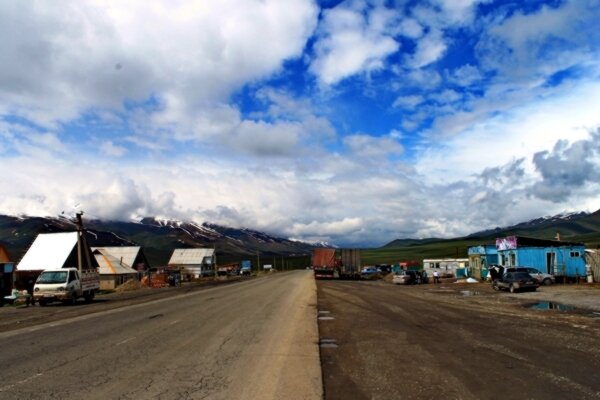

 Bishkek