Prospect Chui
Prospect Chui is the one of the main thoroughfares of the city. It stretches along the entire length of the city from East to West. Entering the city from the West it carries the main road from Tashkent (Uzbekistan), Taraz (formerly Djambul in Kazakhstan) and Kara Balta (Kyrgyzstan – and hence the main road from Osh). After traversing the city centre it eventually ends in a T-junction with Cholpon Atinskaya Street in the Alamdemin microdistricts to the East of the city.
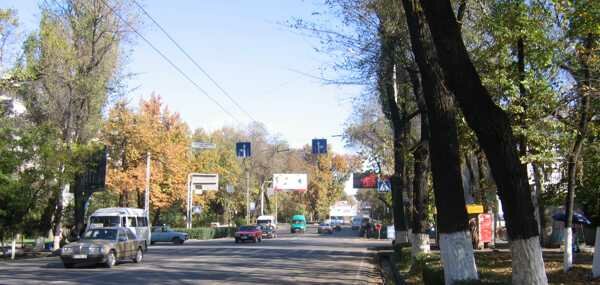
The whole of the street has been designated a site of Historical and Cultural Importance – and is this protected by the state.
Over the years the street has been known by an interesting variety of names:
- Until 1924, it was called Kupecheskoi: Merchant Street;
- In 1924 is was renamed Grazhdanskaya: Civil Street – which seems to give the English phrase “Civvie Street” a whole new meaning;
- It became Joseph Stalin Street in 1938;
- To commemorate the XXII Party congress in 1961, it was rechristened XXII Partciyezda;
- In the summer of 1974 it was divided into two:
- the part from Cholpon Atinskaya in the East, through the city center up to Fuchika Street in the West, (just past Osh Bazaar), was renamed as Lenin Prospect, and
- from this point on to the Western border of the city, the street retained the name of XXII Partciyezda Street; (In 1997, this section of the road was renamed, in honour of the friendly relations with China, after the Chinese leader: Deng Xiaoping)
- After Independence, in 1991, Lenin Prospect was renamed Prospect Chui.
| South – Towards the mountains | West | North – away from the mountains | |||
| The road arrives in Bishkek from Kara Balta, (and hence the main Bishkek Osh Highway), Taraz (in Kazakhstan) and Tashkent (in Uzbekistan). This area is known locally as Shlagbaum – as once a barrier stood here. It is where those who commute to the city from the villages in the West catch the marsheroute minibus service. | |||||
| … to Manas Airport | Fuchika Street | … to Fuchika Park and Moskovskaya | |||
| The road passes over the Ala Archa River | |||||
| Beyenshlieva | |||||
| Osh Bazaar - the building that looks like an oil tanker is called Kiyal | |||||
|
Avenue of the heroes – with busts of the six Heroes of the Soviet Union: Three Panfiletz: Ananyev – born in a village on the northern shore of Lake Issyk Kul. The village has been renamed in his honour; Shopokov – born in a village to the West of Bishkek in Chui province. The village has been renamed in his honour. Konkin – born in the village of Kyzyl Suu, near Jety Orguz at the Eastern end of Lake Issyk Kul. The other three heroes in the “Alley” are: |
Moldaya Gvardia Avenue of the Young Guards A dual carriageway separated by a wide, tree lined central reservation. It marks the course of one of the branches of the Ala Archa River – which was filled in by army engineers who also planted the trees and created the boulevard. |
Monument to the Kosomol Heroes of the 1920’s and 1940’s – erected in 1963. The statue of two soldiers are flanked by plaques, which read “We went to war for Communism” and was constructed by Komsomol – the league of young communists – in the 1960s. | |||
| The island which makes up the central reservation used to be the site of the 19th century Russian Orthodox Serafimovskaya Church – which until the 1950 served as a Children’s Club |
265/7 – buildings of the National Academy of Sciences – built in 1960. The Academy was originally founded as the Kyrgyz branch of the All Union Academy in 1943 - when some of the institutes of the Soviet academy were evacuated here away from the front. The Academy comprises 14 institutes, a publishing house and press, the Botanical Garden, the Archaeological Museum and several research stations. The inscription across the front of the building reads “Glory to Soviet Science”.
The Atom sculpture on the plinth in the courtyard used to stand on the island which makes up the central reservation. |
||||
| Umetalieva (Sverdlovskaya) |
|||||
| Building of the National Bank of The Kyrgyz Republic, facing onto Umetalieva … on the parapet at the front of the Building are the words “GosBank SSR” – State Bank of the Soviet Union. | |||||
| Turusbekova | |||||
|
On the corner of Chui and Turusbekova is the Metro Pub – the original home of the Philharmonia, later converted into a puppet theater before being converted into an American style ‘pub’
168 – The Kyrgyz Promstroi Bank Building – formerly the Ministry of Agriculture and before that the Philharmonia, built in 1958 |
255 – The International University – built in 1956 253 – The Philharmonia concert hall, built in 1981. Concerts include performances of both classical and traditional Kyrgyz music as well as by local popular artists (pop music – Kyrgyz “Estrada”). The building also houses a night club and a restaurant. The Manas Sculptural Complex with statues depicting the legendary Manas in a pose resembling St. George slaying the dragon. He is riding his horse, Akula, with a dragon, (or winged snake), entwined around them. The plinth on which he stands is flanked by statues of his wife, Kanykei, and his friend and advisor, Bakai, and busts of various famous Manaschi (Balykov, Dzapiev, Orozbakov, Karaliev) – erected in 1981 |
||||
| Prospect Manas | |||||
|
The building on the corner housed the Centralniy Gastronom (Central Grocery) store … although it sold other things as well and is now one of the Narodniy chain of supermarkets. On the side of the building – on Prospect Manas, there are three commemorative plaques honouring three of the residents.
160 “Dietsky Mir” (Children’s World) Building – now the United Nations Building, The large marble clad building was originally the store Ai Peri … it has been closed for renovations although some ground floor units have been let to tennants. |
The Okean building flanks Prospect Manas
Demir Bank The parade of shops was once, in the days of the Soviet Union, Bishkek’s Foreign Currency Shop. It then became a Supermarket before becoming a parade of smaller shops. |
||||
| Isanovna | |||||
|
The supermarket “Beta Stores” (pronounced as “Better Store-ez” by the locals) which occupies a building which used to be known as Dom Bita. It is run by a Turkish company, and sells food on the ground floor, with space rented to tenants on the other 3 floors selling a variety of goods: clothes, leather goods, mobile telephones, etc.
It is followed by a series of small shops and cafes and residential buildings. |
The Central Call Office – for making long distance and international calls, sending telegrams, etc.
The small building set back from the footpath used to house the Bishkek Teacher Training College, but is now the The Italian Restaurant Adriatico 219 – Behind the imposing fence are the equally imposing offices of the State Tax Inspection The Santa Maria Restaurant – offering Korean and European Cuisine. |
||||
| Togolok Moldo | |||||
| Residential buildings containing small shops and offices |
The Rossia (Russia) Cinema
Dom Soyuz – Trade Union House – built in 1959 209 – Government House – The White House built in 1984 Monument to the Friendship of Peoples (Druzhba) – erected to commemorate the 100th anniversary of the Assumption of Kyrgyzstan into the Russian Empire – erected in 1978. There are two stories about the origin of the monument. Some say that the square was inaugurated by Kosygin in 1974 to mark the 50th anniversary of the USSR and others that it was to mark the 100th anniversary of the Kyrgyz “voluntarily” joining the Russian Empire. The trees were all planted by dignitaries, including Kosygin and Brezhnev, but the plaques which recoded their names have long since disappeared. |
||||
| Logvinenko | |||||
| The Ilbirs building – behind the marble façade is a clothing factory – with small shops and offices | |||||
| Covered walkway to Kievskaya | Panfilova | ||||
|
The square is surrounded by a magnificent marble edifice – which is exactly just that … when the square was being laid, the marble was placed on the exterior of the existing building - a clothing factory – to make it fit into its new magnificent surroundings.
In the distance the building in the form of an Arch is the Ministry of Agriculture and Water Resources. |
Ala Too Square
Underneath the square is apparently a “secret” complex of rooms connected to the White House by a long underground corridor. Apparently it hasn’t been used since before independence – there are still portraits of members of the politburo of the Soviet Union including Andropov and Brezhnev and apparently a lot of dust everywhere. |
The Official State Flagpole – built in 1998. The guard is changed every day, on the hour, from 07:00 till 18:00. Do not try going into the fenced off area – unless you want to be arrested – the sentries are not there as models for you to pose with for photographs, even if this is common practice elsewhere in the world.
Erkindik – The Kyrgyz Statue of Liberty Unveiled in 1999 to commemorate the eighth year of independence, this represents a Kyrgyz woman holding a flame ringed tynduk. The statue replaced the one of Derzhinsky – founder of the Cheka – the forerunner of the KGB. “Freedom” has replaced Lenin overlooking Ala Too Square, as a symbol of the new times. The large “marble Cube” standing behind the Erkindik Monument is the Historical Museum. |
|||
| Covered walkway to Kievskaya | Orozbekova | ||||
|
Marble clad building containing small shops and offices.
The building on the corner of Prospect Erkindik is the Former Central Telegraph Office – now branch offices of Kyrgyz Telecom |
The two storey domed building is Dom Druzhba (Friendship House). Built by the Czech Interhelpa Group in the 19302, it was the first Government House. There is a story of a nomad visiting the city from his high mountain pastures (Jailoo) who went back and told all his family and acquaintances what a wonderful city it was – with such tall building that if you bent over backwards looking upwards – with the top of your head on the ground behind you – then you still could not see the top of the building – it was this building he was describing. When the second Government house (currently the parliament) was built – this became the Historical Museum. | ||||
|
Prospect Erkindik Freedom Avenue Prospect Erkindik is one of the main thoroughfares in Central Bishkek. A dual carriage, separated by a wide, tree lined central reservation which is a favourite spot for people to simply wander up and down - especially in the heat of the summer, or on balmy summer evenings. “Keep Off The Grass” … No matter how tempting .. it is NOT advisable to walk on the grass in the central reservation – there are some little signs (in Russian) announcing a 500 som fine for those who do. |
Kurmanjan Datka – about 50m off the road in Oak park – at the foot of Prospect Erkindik. In 2004 the current statue of the Queen of the Alia, (who appears on the 50 som banknote) was erected. A large plinth on this site once supported a statue of: Lenin – now in the Old Central Square, behind the history Musem, then … Dzerzhinsky – now behind the National Library, on the corner Tynystanova and Fruze, then … Erkindik (Freedom) - now in the centre of the main Ala Too square. |
||||
|
On the corner is the “Fire and Ice” night club. At the back of this building – up Erkindik – is the Erkin Too building. Erkin Too was the name of the first Kyrgyz language newspaper published – and the government’s official Kyrgyz language gazette is still called Erkin Too. This building used to be called the “House of Printing” and during the Second World War it served as a barracks. 108 – Artists House – Gallery of the Union of Artists, built in 1947. On the Corner of Tynystanova is the building of the Ministry of Economic Regulation |
187 – The Ala Too Cinema, built in 1938. In the 1960 it underwent a refit and was decorated with mosaics depicting heroes of the time, including cosmonauts. | ||||
| Tynystanova Street | |||||
| Revolution Square containing the Monument to the Matyrs of the Revolution – erected in 1978. The main figure is Urkuya Salieva (1910-1934), and early socialist organizer in Southern Kyrgyzstan – apparently murdered by “rich peasants”. Around her are the “awakening” proletariat. The monument was erected in 1978 by Sadykov … and was awarded the All Union Lenin Prize. | |||||
| Sovietskaya | |||||
| The Central Post Office – with Bishkek’s “Big Ben” clock tower. | After some open space, and some street traders, there is TsUM or ZUM Aichurek - one of the main department stores in Bishkek, established in 1956, but moved into the present building in 1974. There are about 700 tenants, offering a wide range of consumer foods and souvenirs on four trading floors, an outdoor market, a business center renting office space, and there plans to develop even more retail space, 4000 square meters of car park space, an entertainment space. The store receives on average 20000 visitors per day. | ||||
| East | |||||


 Bishkek