Ormon Khan
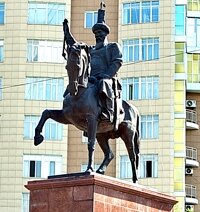
Statue of Ormon Khan outside the Old Airport
Ormon Khan, otherwise known as Orman Niyazbek uulu Khan, he was an influential manap (or tribal leader) in the Kyrgyz tribes in the Chui region.
Born in 1791, he played a major role in the political events of the first half of the nineteenth century eventually organizing a kurultai (or congress) of the northern tribes at which formed a confederation of all the Northern Kyrgyz tribes and he was elected as its Khan.
By some accounts, however, he was hot tempered, despotic and enjoyed battle. It is said that he tested his guns on slaves. When he became the chief manap of the region, he established a gallows on a hilltop, and many are said to have met their end upon it.
It was common at that time for the various tribes to settle their differences, (and there were many), with a war, and hostilities were brought to an end with a wedding. Ormon was the head of the Bagu tribe and their nearest rivals were the Sarybagysh. Ormon had already made allies of most of the northern tribes: the Sayak tribes of Kurmankojo and Kuljygach, the Temir, Bolot and Cherikchy. He then sought to create an alliance with the Sarybagysh by marrying his favourite daughter to Omurzak – the son of Borombai, the head of the Bagu tribe.
In 1842, he called for a Kurultai at Kutmaldy in Issyk Kul. For the three months before the event he sent messengers with invitations to all the Kyrgyz tribes to attend. No-one really knew what to expect … there had not been such a gathering in living memory, although there were stories of such assemblies being held in the time of Genghis Khan. Ormon’s fame and wealth were well established – he had his own flag and fortress, he was recognized by Kokand as paravanchi, the highest rank of subject ruler with the right to collect taxes (zyakat) from the subject tribes of Northern and Central Kyrgyzstan - and so many representatives of the various Kyrgyz tribes descended on Kutmaldy for the celebrations.
The Kurultai lasted for a week. Guests were met with honour; food was served; drinks such as Kumyz, bozo and arak (vodka) flowed; races were held; competitions and games were organized and conversation turned on whether the Kyrgyz really needed the power of Kokand. The Kazakhs already had their own Khan. The zyakat that was paid to Kokand might stay with the Kyrgyz if they had their own Khan. All this time, however, Orman stayed quiet. He let the Kyrgyz talk amongst themselves.
On the Friday, at the end of the kurultai, the nomads placed Ormon on a white felt carpet and put a red hat on his head, electing him as the Khan of of all the Kyrgyz.
Ormon immediately declared independence from Kokand, and sent a band of djigits to burn down the fortress at Kutmaldy – and others were to follow.
And so Ormon had united the Kyrgyz … but perhaps in name only. In reality the Kurultai came to end, the guests left, and although he promulgated a law, (the Ormon Okuu – or Instructions of Ormon), the various manaps continued to rule their own people as they saw fit, not necessarily as Ormon wanted. However, he continued as the Kyrgyz Khan and was keenly interested in social issues: attempting to create a systemized administration, taxes and courts; establishing schools – inviting scholars from Andijan and Namagan to open schools, and he commissioned the first written history of the Kyrgyz people – Zho’op Name.
In the late 1846 he received messengers from the Kazakh Khan, Kenensary, who suggested an alliance to fight the Russians. Kenensary, however, insisted that the alliance should be under a unified command – his. Not just the army, but the entire unified Khanate. Ormon refused led the Kyrgyz against the Kazakhs, defeating them in battle. Apparently he ordered his troops to march creating as much dust as possible, and at nighttime to light many fires … giving the impression of a much larger force – Kenensary was fooled and the strategy worked. In the ensuing battle the Kyrgyz were victorious and Kenensary was captured, and executed, his head being sent to the Russian Governor General of Western Siberia.
The war, however, weakened his position in the confederation and several of the tribes left it, leading to a civil war. He died in battle in one of the expeditions against them in 1854.


 Bishkek