Jamilia
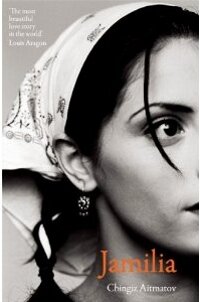
One of the editions of Jamila ...
It’s a long time since I have been back to Britain … but one of the things on my “To Do” whenever I did was to go and visit the bookshops on the Charing Cross Road in Central London.
For many years, one of the problems of life in Bishkek was the fact that it was so difficult to get books in English. Nowadays there are a number of outlets that carry some stock and although the range of titles is constantly growing, the list can be a bit esoteric.
So, a visit to Foyles, of Waterstones was like a visit to “heaven” … with a huge range of books across so many different genres, both old and new titles; classics and the latest of blockbuster best sellers. It wasn’t quite as good as a trip to Central Oxford in my student days, to the vast caverns of the various branches of Blackwells, not to mention the myriad of smaller specialist shops but it was rare if my luggage on the return flight wasn’t overweight with the twenty or so books that I had bought.
Fortunately, in these days of ebooks it is possible to obtain even the latest titles without having to worry about excess baggage fees.
Waterstones is a large British based chain of almost 300 high street bookshops that has gone through several sets of owners and is well known for aggressive marketing – which is often to the detriment of smaller, independent outlets. Their approach features a book club and regular recommendations of publications as the Book of Month. Well, it seems that their selection for August this year will feature Jamilia by Chingiz Aitmatov.
Jamila was the the first of Aimatov’s novels to be published in 1957. He had had some small pieces published before this but the appearance of this novella is generally regarded as being his first real published story.
Told as a continuous narrative, almost a monologue, without chapters it tells a love story as seen through the eyes of a young 15-year old. The central character, however, is Jamilia for whom the story is named. It is during the Second World War when all the able bodied men have left for the front. The collective farm is manned by the elderly, the very young, the women and the invalided. Jamilia is a widow who, in keeping with tradition of Hadath is betrothed to another villager, but who strikes up a relationship with Daniyar, a invalided veteran who arrives to work on the farm.
As in the tradition of Tolstoy’s Anna Karenina, in Jamilia Aitmatiov explores the story a woman stands apart and goes against the traditional mores of the time. It is a moving story which is sympathetically told and gives tremendous insights into the sort of world in which the author grew up. It is said that several characters in his home village of Sheker in Western Talas were easily identified and were often presented to visitors.
It struck me as interesting that Waterstones have chosen to promote Jamila in this way.
For example, I wondered about the availability of copies. Although the novel was originally published in 1958, that was, of course, in Russian and Kyrgyz, (interestingly called Jamilia in Russian and Melody in Kyrgyz), and Waterstones customers would presumably want copies in English. Now, although Aitmatov is probably the most well known Kyrgyz author, whose works have been translated into over 80 different languages, it can sometimes difficult to find any in English. At least, that used to be the case. I remember, for example, visiting Waterstones, (and several other bookshops), back in the 1990′s when I first came to Kyrgyzstan, trying to track down some of his books. The staff had never heard of him and we could only find one title in the encyclopaedic catalogue Books in Print. Fortunately, however, there are new translations of his books appearing including one of Jamilia, by James Riordan, which was published by Telegram Books in 2007.
Then again, I wondered about the choice of such an old book, thinking that they might want to promote some new title from a contemporary author. However, Waterstones’ Managing Director, James Daunt, said: “There were undoubtedly other, newer books we could have chosen, but I think sometimes it is the job of the bookseller to recommend the unexpected. If Waterstones can bring some new readers to this small masterpiece, we will have done our job well.”
Hmmm, “small materpiece”, he said. It is certainly well written and accessible, telling the story whilst at the same time exploring an interesting period and society … and can work on several different levels, For example, unlike some of Aitmatov’s other works, it doesn’t really require any specialist knowledge, for anyone who does know something of the former Soviet Union, especially at this particular period of history, or of traditional nomadic culture and attitudes, then it provides considerable insights and food for thought.
What’s more, as Daunt also said: “It is hard to imagine a more perfect example of the short novel.” It has also been called: “the world’s most beautiful love story”. Now, in both cases, that’s praise.
IMHO, (in my humble opinion), it’s well worth a read, I commend Waterstones for their choice … and I thoroughly recommend the book. Although I think it is likely that it might lead you to try and find and read some more of his books, even if you don’t I think that you will enjoy this particular gem.
For the record: it was also made into a film by MosFilm in 1968.







 Bishkek