Visa Free … finally!
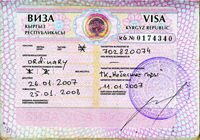
The all important visa
For some time I have had a draft press release sitting on my computer … actually, two press releases … to welcome the fact that Kyrgyzstan has, unilaterally, declared a “visa free regime” for citizens of some 44 different countries. “Visa Free Regime – What it means and what it doesn’t!”
The process has been long and arduous. Personally, I have been involved in tourism here in Kyrgyzstan since 1997 and in all that time we have been discussing the possibilities for introducing a more liberal visa policy, but the question had been raise long before that. Back in the mid 1990’s, the Silk Road Project of the WTO, (that is the World Tourism Organization – now renamed as the UNWTO, the United Nations World Tourism Organization, to avoid confusion with the World Trade Organization), had highlighted the importance of visas for developing this historical trade route as a “tour product”. The suggestions included harmonizing visa policies and even creating a Silk Road Visa which would facilitate ease of transport through several of the fourteen or so countries which straddle it.
Kyrgyzstan had been a part of the Soviet Union and, as such access to the country was strictly controlled. As a result, foreign visitors to Kyrgyzstan were few and far between. It was slightly easier for those living in other Soviet Republics such as Kazakhstan Russia and Uzbekistan to visit Lake Issyk because the borders of the republic at that time were simply administrative boundaries and not international borders with special designated crossing points, immigration and customs control. Some of the most popular trekking routes, for example, involved crossing the Kungey Ala Too between Almaty and Lake Issyk Kul … something which became illegal once the border became a political boundary between sovereign states.
There were already some countries which enjoyed a visa free regime. These were mainly the countries that had once been constituent republics of the former USSR and had now become members of the newly formed Commonwealth of Independent States and socialist countries which had concluded agreements with the Soviet Union for visa free travel for their citizens as the successor states, including Kyrgyzstan, inherited the rights and obligations under these treaties
For a while after Kyrgyzstan became Independent, visas were still issued by Russian embassies around the world, but as the number of Kyrgyz diplomatic missions slowly grew the embassies began to take on that consular role. It was still difficult, however, to get to the country as there were precious few international flights into Manas Airport, about 36 km from downtown Bishkek. There were, however, lots of connections to the capitals of neighbouring Kazakhstan and Uzbekistan. The newly independent states that had once been constituent republics of the world’s largest country, had agreed between themselves that a visa for one of the countries, could be used for up to 3 days for transit through the others. This was known as the 72 hour rule and for some time it worked to Kyrgyzstan’s advantage, as most people flew into neighbouring Almaty and then drove overland the 250 kilometers.
Then, suddenly, Uzbekistan announced that they would no longer operate by this agreement, and shortly afterwards, Kazakhstan followed suit. This meant that use either of their capital cities as a gateway to Central Asia, would necessitate obtain a collection of visas. This cost, and not just in terms of money, but also in terms of time and inconvenience.
The time and inconvenience didn’t just involve a trip to the embassy to submit the application and receive the all important stamp ion the passport. The system inherited from the Soviet Union required that visa applicants had to have an invitation – which had to be issued by a proper authority, (albeit simply a tour company – or even an individual) and also had to be duly registered and approved.
The number of flights to Bishkek’s international airport slowly grew, however, which meant that the additional visas could be avoided – although there were still fewer flights into the Kyrgyz capital than the other airports, from fewer cities around the world, and often the routes were more expensive. All the same, things were improving. In particular, Kyrgyz embassies and consulates were gaining a reputation for being helpful and welcoming – it was just a pity that there were so few of them.
Another international agreement meant that it was possible to obtain a visa to enter Kyrgyzstan in countries where there wasn’t a Kyrgyz embassy, by applying to the Kazakh embassy or consulate – if there was one. Fortunately, this meant that the number of places where a traveler could apply for a visa was more of less or less doubled and covered countries like Australia, France, Italy, Spain and Thailand.
For a moment, back in 1999, those of us working in tourism felt a state of euphoria … as, in September, President Akaev issued a decree saying that Kyrgyzstan should aim to create a visa free regime for citizens of WTO member countries, (World Trade Organization, that is – not the World Tourism Organization! – Oh … if only!!) He gave the Ministry three months, until the end of December, to work out a plan to implement this decision. On December 24th, Christmas Eve – a week before their deadline, they issued their plan: From January 1st citizens of Japan would join the bastions of Socialism and enjoy a visa free regime. From January 1st the following year, so would the citizens of six or seven countries – including the USA and Germany, (the holders of diplomatic passports). The following year, the citizens of another six or seven countries were to be given similar status, (holders of diplomatic passports, that is), and a year later a third tranche, (including citizens of the United Kingdom – holders of diplomatic passports, that is), would join this privileged band. The Ministry of Foreign Affairs had performed the task set before it … without, basically, making much of a difference – except for holders of diplomatic passports, that is.
For the ordinary tourist it was still a headache to navigate all the obstacles in the process … but things were to get better. The Kyrgyz authorities agreed to establish a consular post at Manas airport so that passengers on international flights into Bishkek could obtain a visa on arrival. Then, the authorities decided that citizens of certain countries could apply for a visa, (valid for up to one month), without needing an invitation. That was indeed a very welcome move, removing several hurdles and simplifying the process considerably.
Unfortunately, however, this only affected the citizens of twenty eight countries – and for everyone else, the system either remained the same, or seemed to get worse. Certain countries were designated “countries of risk” and not only did they have to invitations, which had to receive official approval, in order to obtain that a special commission had to consider the application. The process took twice as long as for that for citizens of other countries which were not considered to present a “risk”, or more. In one case, we had a client that waited 72 days for the application to work its way through the process. What’s more, there was no guarantee that approval would be given. That’s quite right, of course, or else there would be no point of having the process in the first place. Having said that, it was always a difficult task to try and explain this to our clients.
Further innovations were proposed by different people at different times. Following the 2005 revolution, there was a proposal to cancel the requirement for a visa, at least for some countries, at least for a period, (say, during the summer season). Personally, I am not sure how that might have worked and I certainly didn’t follow the logic of establishing a three month “visa holiday”, but it was a suggestion which was actually taken seriously in some quarters.
Another suggestion was to make visas available on arrival, at the border. Again, it didn’t have to be for every citizens of every country, and it might not necessarily have required considerable resources to implement, especially as there are just a handful of border crossing posts which would be affected. Several countries already operate such a system, Turkey and Thailand, for example.
To make the system more universally accepted, however, it was suggested to implement a system of electronic visas. Applications could be submitted across the internet, with approval, (or otherwise), also being transmitted the same way. Once again, there are several countries that have experience of such systems, but this would require additional resources at the border posts to be properly implemented.
A suggestion that Kyrgyzstan and Kazakhstan should recognize each other’s visas was partially adopted so that a visa issued for one of the countries could be used to cross the border, and even travel in the neighbouring administrative districts. The agreement, having been signed by the two presidents, however, was not implemented for some time as the two Foreign Ministries negotiated the details of the procedures with each other. In the end they implemented regulations, (different in each of the two countries), which were difficult to interpret yet alone put into operation. Actually, the diplomats have to be congratulated because they do have a system that works, (after a fashion), albeit under strict and narrowly defined conditions.
It wasn’t all good news, however. The European Union was enlarged and several Eastern European countries also joined the Schengen Visa zone. Many of these countries had inherited a visa free status as friends and allies of the former Soviet Union, but as members of the Shengen zone, they were compelled to impose a visa requirement on Kyrgyz citizens so that they couldn’t be used as an open gateway to the rest of Europe. Kyrgyzstan’s response was to impose a tit-for-tat visa requirement on citizens of those countries, (such as Poland and the successor countries of Czechoslovakia and Yugoslavia). Instead of welcoming visitors from these countries, a barrier was placed before them.
All this time, those of us in the tourism industry had continued to argue the case for further relaxation in the visa regime. If we want to portray ourselves as a hospitable and country, eager to welcome visitors, then the first thing we present them with should not be a hurdle that they have to overcome – applying for a visa. The requirement itself says to the potential visitor, “I don’t know that I want you to come to my country … I need to check you!”
To me, that starts to get to the nub of the issue: What is the point of the visa? It is an instrument of control which helps to regulate access to the country – whether, or not, to let someone enter the country. It’s an instrument, one which tells the border officials that based on the results of established checking procedures, the potential visitor can be allowed to pass … but it is just one of a number of such instruments, (such as immigration “black lists”), which can be used to identify potential threats.
A visa free regime simply implies that the potential visitor is not seen as a potential threat.
There were other arguments about the likely effect on the number of tourists, again drawing on the experience of other countries – most notably Georgia and the Ukraine – and the economic benefit that the measure would bring. These arguments were important to the politicians as justification for taking a decision to change the system, but, to be honest, I am not convinced by them … that’s the point behind my draft press releases – or, at least, the one aimed at the local community rather than the international one.
Obviously, there is more than one side in a discussion and, to be fair, not everyone agreed. What I found so frustrating, however, was the fact that people who argued that we should not implement a visa free regime did not seem able to present coherent, logical arguments. Instead, we were met by a “blunderbuss” approach: fire enough small shot at a target and some of it will hit home. The visa fees were important for financing embassies; visa fees are not expensive and do not deter tourists from considering Kyrgyzstan as a tourist destination; the visas were important for the collection of statistics; introducing a visa free regime won’t bring more tourists; there are other issues which are more important such as marketing, prices and the quality of services; introducing a visa free regime should be a mutual agreement between two countries and that Kyrgyzstan should seek similar arrangements from other countries; that introducing a visa free regime will violate security agreements with other countries … and so on. Some of those arguments did have logic and validity, but not all of them were relevant in that they didn’t actually address the question of whether Kyrgyzstan should introduce a visa free regime.
After the 2010 revolution, however, there were signs that headway was being made. People were listening and could see the logic of the case. First of all a Ministry made a suggestion; then the government made a decision to recommend a change in the law; it went out for consultation and there were discussions between ministries and departments; it was sent to the parliament and received its three readings, passing the committee reviews and after some amendments changing some of the conditions; it was finally passed to the President for signature. Now, according to the Press Service of the Presidential Administration; now, the President has signed the document and it will come into force once it is officially published.
The selection of which countries should be included in the list of those to which Kyrgyzstan would grant a visa free status was long and tortuous. As an opening gambit the list comprised those counties for which Kyrgyzstan was willing to issue a visa without requiring an invitation, but soon other countries were added. The Ministry of Economic Development suggested a criteria of those countries with a GDP of USD7000 per capita. The list grew, and shrank. The 34 member countries of the Organization for Economic Cooperation and Development were considered, but eventually the lists was pared. Despite suggestions that citizens of countries like Israel, South Africa, Argentina, Brazil, Chile and Mexico would offer no threat to Kyrgyzstan in terms of security or economic migration, they were excluded from the final list although several other countries were added such as Saudi Arabia, Qatar, and Brunei. Iran, in particular, appears to be smarting by the fact that they have not been included in the list.
At every stage there has been an element of tension … would we win the argument or would the forces of conservative reaction win the day once again. There was even a question as to whether our neighbours, Kazakhstan and Tajikistan, might go ahead and introduce a similar scheme before us. Although Kyrgyzstan has, for a long time, had one of the most liberal visa policies in Central Asia, our neighbours have often followed our lead and there were both discussions and proposals on the subject in both countries.
Now it seems that the long wait is over … with yesterday’s announcement by the Press Service of the Presidential Administration that the Bill had been signed.
This has resulted in a mass of congratulations and eurphoric excitement – some of which I fear may be misplaced, or at least badly expressed. One Press report spoke of countries of South America being included in the list – they are not. One ecstatic tweet blurted out an invitation to all and sundry “Come to Kyrgyzstan now you don’t need a visa”, in fact most people do still need a visa!
This is nothing new … When the bilateral international agreement about the mutual recognition of visas between Kazakhstan and Kyrgyzstan, was signed by the two presidents, many people publicly trumpeted the measure abroad: in the press, over the internet, in letters to all and sundry … only to have to wait whilst the lumbering diplomatic machinery went through the necessary steps to put flesh on what was effectively an agreement in principle. Then, when the details finally emerged into the light of day, we saw that, (just as earlier had been the case with Akaev’s decree), little actually was to change.
As a result, those draft press releases have sat on my computer … as I waited to see how things would eventually unfold. Maybe it is now time to brush them off and issue them … but, all the same, I think I’ll wait for the official publication … just in case.





 Bishkek