Marat
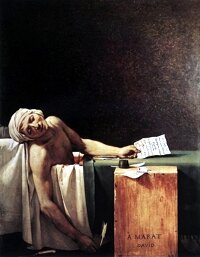
The Death 0f Marat, by David, 1793
I have a number of friends and acquaintances here in Kyrgyzstan called Marat. It can get quite confusing when I am told that someone is calling me, perhaps on the telephone or in calling into the office in person, that: ”It’s Marat …”.
In fact, it gets even more complicated because there is another version of the name, Murat, and the two names are often confused. Murat and Murad, are Muslim name and seems to be popular amongst, for example, the ethnic Turks.
The name is so common that, at first, I thought it was a Kyrgyz name, but I now understand that it was quite common throughout the former Soviet Union.
The reason it is so popular in the Soviet Union is that it was used to honour the French Revolutionary leader Jean-Paul Marat, who died on July 13th July, 1793; assassinated in his bath by Charlotte Corday – which was the inspiration for the classic iconic painting, “The Death of Marat”, painted by Jacques-Louis David later that year.
I wonder how many people who bear the name Marat know after whom they are named?
Not everyone, however, seems to agree that the popularity of the name is tied to the French Revolutionary. I am told that the name Marat has two meanings: one derived from the French for Conqueror and the other from the Arabic meaning “Great Spirit”, or “Good Hearted”, “Generous Hearted”.
In societies all around the world, naming a child is a very significant event. Many parents try to chose names which represent characteristics they would like the children to have. Amongst the Kyrgyz, a child was usually named after one of their relatives, (usually someone who had already died but who had lived a long life), but sometimes special consideration was given to their particular circumstances:
- If there was a history of infant mortality in the family, then a child might be given a name like Toktogul, (meaning “Stop, slave”), or Toktosun, (meaning “let him stay alive”).
- A name indicating strength might be chosen, for example: Tashturghan, (meaning “Standing stone”), Omurbek, (“full of life”), Tashtanbek, (“Strong as stone”), or Bektemir, (“Strong as iron”).
- Sometimes children were given names as if to fool vengeful demons and evil spirits that the child was not really of any significant importance - for example: Asrankul (“Adopted slave”), Bokbasar (“Stepped on dung”), and Tezekchi (“Dung collector”). Likewise, children were sometimes given names to make them unnoticeable amongst everyday, household, items - for example: Tutkuch (“Potholder”), Tuzbay (“Man-Salt”), Kiyizbay (“Man-Felt”), Itybay (“Man-Dog”).
- The character Beshkempir in the film of the same name, received his name because he was adopted – and was allocated to his adoptive family by a committee of “five grandmothers” (“Besh Kempir”). When he learns of this in his adolescence, and confronts his grandmother about it, she denies it and insists that he is “of her blood” and tells him that he was given the name as a charm: “To protect you from the evil eye.”
Many names in Kyrgyz are based on things found in nature. For example, a common girl’s name is Aigul (eye-GOOL), a combination of Ai, meaning “moon,” and gul, meaning “flower.” Here are some other meanings”: Adilet - Justice, Ai - Moon, Almaz - Diamond, Alsu - Rose water, Altin - Gold, Azamat - Very good, Bak - Tree, Bakyt - Happiness, Bek - Male (masculine ending), Cholpon - Venus (morning star), Gul - Flower, Jildiz - Star, Jyrgal - Gladness, Mir - Peace, Nur - Ray of light, Sulu - Beautiful.
Sometimes children were given names which were special constructions. Marlen, for example, is derived from Marx and Lenin, and despite the fact that the the Soviet Union has collapsed and communism is no longer the prevailing political philosophy, it still retains a relative popularity.
Although the choice of such a name might be acceptable here, or in the United Kingdom, (where Princess Anne once caused a stir by naming her daughter Zara – a name which is apparently of Arabic origin but previously unknown in Britain), there are some countries in the world where it would not be accepted. In Portugal, Sweden and Denmark, for example, there are lists of acceptable names that can be used and special permission has to be obtained to name a child as something different. Back in 2008, a judge in New Zealand made global headlines by ruling that a nine year old child should not be named “Talula Does The Hula From Hawaii” … and there have been other names which the courts in New Zealand as unreasonable : such as 4Real and Sex Fruit. Surprisingly, for some reason, the courts have allowed “Number 16 Bus Shelter“.
For the record: Marat was a physician and scientist, but it is as a political theorist and one of the more extreme voices and uncompromising defenders of the French Revolution, that he is best known. As a journalist, the influence of his attacks on “counter revolutionaries” was to extend far beyond the immediate audience for his fiery public speaking.
Born in a French speaking canton in Switzerland, the second of nine children. His father came from Sardinia and his mother was French. At the age of 16 he left the family home in Geneva and traveled through France teaching and studying medicine. He later traveled to England; at first London then to Newcastle, mixing in intellectual circles and gaining a reputation. Although he never actually qualified as a doctor, he did receive an Honorary doctorate from St. Andrew’s University. In 1776, he returned to France and continued to make a name for himself in medicine, (becoming a Court Doctor), a scientist and philosopher.
He had already made contributions to the the debate on slavery and on the eve of the French Revolution wrote and spoke as a “friend of the people” – which was the name of the journal he established. His contributions were, however, controversial, forcing him into hiding and even at one point into exile in London. In 1792, however, he had emerged once again into public life and was elected as a member of the National Convention. In the turmoil the surrounded the execution of Louis XVI, Marat got into trouble once again attacking the Girondins whom he saw as enemies of the newly formed Republic.
Corday was a Girondin sympathizer. She came to Marat’s lodgings claiming to have vital information about the group and despite the fact that he was in the bath, he agreed to an audience. This might be seem surprising, but it appears that he suffered from serious, debilitating and disfiguring skin disease and he spent most of the last three years of his life sitting in the bath in order to ease the condition. David, in his painting, portrayed the skin without a blemish, but he included the bandana around his head which would have been soaked in vinegar as part of the treatment to ease his pain and discomfort.
A board had been placed across the bath to make a writing desk and he wrote down the information that she gave in the course of a 15 minute interview, at the end of which she produced a kitchen knife and plunged it into his chest.
Following his death a grand funeral was arranged, Corday was guillotined and Marat received many honours. Time passes, however, and attitudes change. Within eighteen months the high regard in which he was held was replaced by a more negative image with many of the honors accorded to him revoked.
He was still highly regarded in certain revolutionary circles, however, and in particular in the Soviet Union – with a battleship named after him, and … in the use of his name as a popular imya, (given or first name).


 Bishkek