Okroshka
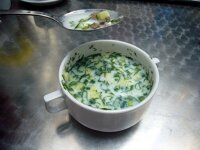
A bowl of Okrashka
One of the first groups of tourists that we had here in Kyrgyzstan was from Austria, and as is often the case, they spent a day in Bishkek before going off around the country – and in this particular case crossing the Torugart6 Pass into China. As part of the “city tour” we took them to many of the main sights, like the White House and main Ala Too Square, vising the Historical and Fine Arts museums, the Orthodox Cathedral, taking a walk though a couple of the city center parks, and a stroll through Osh Bazaar. For Lunch we organized a visit to a city center cafe and, as it was the height of summer, we had ordered a classic Russian cold soup as a starter: Okroshka.
To be honest, at the time I wasn’t sure that it was a good idea. Although the weather was good and it was a hot day, I wasn’t sure how a cold soup would go down with the clients. Apart from Gazpacho in Vichyssouse, I thought of cold soups in the same way as Fruit Salad; as a desert. As it turned out, I needn’t have worried as it to be a great hit … they all wanted copies of the recipe.
It is very popular here, especially in the hot summer months, even though it’s not a Central Asian dish. Basically, its Russian, – although there are also some who claim that it’s from the Ukraine – and during the Soviet period it was found throughout the USSR. This popularity is probably because it can be very refreshing and is relatively easy to prepare. The kids, for example, like it, and make it for themselves.
It’s easy enough to make although not all the ingredients are readily available in the west. I remember, for example, trying to make it once for my mother but couldn’t find Kvass – a traditional Russian fermented drink made from Black Bread, although I was able to replace the Kefir - a sort of fermented milk – with a yoghurt, just as I did when I made Tzatziki, (a Mediterranean dish involving yoghurt and chopped cucumbers).
The name probably comes from the Russian word kroshit, which means “to chop finely” … which basically describes it; what happens to the ingredients.
Those ingredients can vary but usually involve a mix of:
- cucumber;
- radish;
- Spring onions, (also known as green onions, scallions or shallots);
- hard boiled eggs;
- boiled potato;
together, perhaps, with some cooked meat such cooked beef or luncheon or sausage meat – all of which are chopped into pieces about a quarter of an inch cubes. They are then mixed together in a large bowl with
- kefir or plain yoghurt, (in Russia Kvass is often used), and
- cold broth (for example chicken broth) or mineral water.
Finely chopped dill, and mint or parlsey is added and also salt, (to taste).
The mix is then left to stand for at least an hour, (preferably in a refrigerator). Some people actually add ice cubes just before serving.
As I said, it is very simple to make and very refreshing.





 Bishkek