Marmots
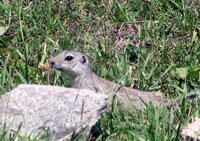
Marmot
July 15th is St. Swithun’s Day – and in Britain there is a tradition that the weather on this day will continue for the next forty days: if it’s dry today then the next forty days will be dry but if it rains then the next forty days will be wet.
To be honest, I don’t know of any such traditions here in Kyrgyzstan - if anyone out there knows better, then please let me know - but this is just one of set of folklore traditions which are said to predict the weather: In France there is Saint Medard, (June 8th), Urban of Langres, and the day of Saint Gervase and Saint Protais (June 19th); in Flanders, St Godelieve (July 6th) and in Germany the Seven Sleepers’ Day (June 27th). In Russia, the weather on the Feast of the Protecting Veil, (October 1st), is popularly believed to indicate the severity of the forthcoming winter. In Italy there are similar: one says, “As St. Quirinus’ Day goes, so will the summer”, (St. Quirinius’ Day being March 30th) … and another that “On St. Paternian’s Day, the dog’s tail wags”, refering to the fact that the winter cold begins on the Saint’s Day, (November 13th or November 23rd – the are actually three St. Paternian days; the third is July 12th).
In America there is February 2nd, Groundhog Day – which achieved worldwide fame with the release of the Bill Murray film in 1993. According to folklore, if it is cloudy when a groundhog emerges from its burrow on this day, then spring will come early. If it is sunny, the groundhog will supposedly see its shadow and retreat back into its burrow, and the winter weather will continue for six more weeks.
The groundhog, also known as a woodchuck, whistle-pig, or in some areas as a land-beaver, is a rodent of the family Sciuridae, belonging to the group of large ground squirrels known as marmots.
Marmots are large “ground squirrels” and there are 15 species. They tend to live in mountainous areas, so Kyrgyzstan provides a suitable, typical habitat. They are found throughout the country although different species occupy different regions.
Marmots typically live in burrows (often within rockpiles), in which they hibernate through the winter. Most marmots are highly social and use loud whistles to communicate with one another, especially when alarmed. Their diet consists mainly of grasses, berries, lichens, mosses, roots and flowers.
It’s been suggested that the story in Herodotus, (the Ancient Greek historian who lived in the fifth century BC), of “gold-digging ants” was based on the golden Himalayan marmot of the Deosai Plateau and the habit of local tribes such as the Minaro to collect the gold dust excavated from their burrows.
Three of the fifteen species of Marmots are found in Kyrgyzstan: The Grey Marmot, the Long Tailed Marmot and the Menzbier Marmot. One of them, (the Menzbier’s marmot), is listed in the Red Data Book as an endangered species.
The Grey Marmot is a large rodent; adults average around 50 cm long. Despite the name, they actually sport different shades brown and grey. It has a massive flat body and short legs with a small tail. They rarely stray far from their holes and spend much of their time sunbathing, although at the first sign of danger they run off to a safer place. They dig large holes in treeless high mountain meadows, between 1500 and 4000 meters asl, and are found mainly in the Eastern regions of the country, around Lake Issyk Kul, the Inner Tien Shan down towards the Chinese border and along the Kyrgyz Range. Depending on the weather conditions they hibernate between October and March.
The Long Tailed Marmot is a little smaller, about 40 to 45 cm in length, but has a longer tail. They have a reddish coat, (sometimes speckled black tops), hence it is also sometimes known as the Red Marmot. It is found in similar habitat, high mountain meadows between 1500 and 4000 meters asl, but prefers land where there are bushes. It is found in the West and Southern regions of the country, the Alai and Turkestan ranges.
The Menzbier marmot can grow to about 40 or 45cms. They are dark, but often with white or grey colouring on the cheeks and undersides. The color of their fur differs ion that the top of the head, upper parts of the body and the sides are dark, or even black, but the cheeks, feet and lower parts of the body are pale yellow.
They excavate large holes in which they live and hibernate during the winter months. They are vegetarians and are found in the high mountain areas of the Chatkal Mountains, (part of the Western Tien Shan) and on the Ters River, (in 1979, the Besh Aral Nature Reserve was established for the protection of this species and its natural habitat) but also in Tajikistan. It’s preferred habitat is the northern and eastern slopes of the mountains at an altitude between 2100 and 3300 meters, where the snow will isolate the burrows where the marmots hibernate for seven months per year.
Unlike the other two species which are strictly vegetarian, these marmots eats onions, herbs, tulip leaves and sometimes insects. They form family groups with a size between 2 and 10 individuals. These groups then assemble in colonies. Litters contain mainly 2 or 3 animals, but in some situations up-to 5 animals can be born at once and after a month in the burrow, they are allowed to go out.
The total territory in all countries together is no more than 200 square kilometers. It is estimated that there are currently 25,000 animals.







 Bishkek