ATM
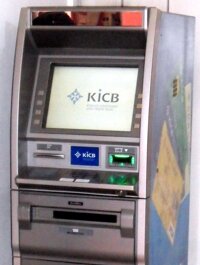
An ATM in Bishkek
When I was a schoolteacher and lived in North London, I wasn’t aware of a piece of history that had taken place in the neighbourhood.
It’s a pity because, as a teacher of Computing and Information Technology, I could have used it as a good example to quote in lessons.
I taught in a school in Southgate, and although the school itself was in the London Borough of Barnet, but most of Southgate was actually in the neighbouriong borough of Enfield … and it was a the branch of Barclays Bank in Enfield that the first ATM, (Automatic Teller Machine) was installed … well, in the UK , that is … on 27th June, 1967. Why they chose Enfield, I haven’t the faintest idea … but, actually, the ATM has a history that goes a long way back much further than 1967.
A Bankograph was installed in a New York bank; Wikipedia says in 1939, but other sources suggest it was in 1960(!). Whichever version is correct, it wasn’t really an ATM as we would recognize it today … it didn’t, for example dispense cash. It was, however, possible to make deposits into one’s account, (by putting coins, banknotes and/or cheques into an envelope with a deposit slip saying which account to credit). This may have speeded up the process of making a deposit but the customers didn’t seem to like it and apparently it was withdrawn after just sixth months.
The generally accepted view is that the Cash Dispenser in Enfield was the really the first automated teller machine … but, once again, although it dispensed cash, it wasn’t exactly an ATM as we would recognize today. In order to use it, the customer had to buy vouchers in advance and then in exchange for inserting the voucher, would receive the equivalent amount of cash.
Of course, there was a security issue … the vouchers could be lost or stolen in the same way that cash be, but the bank introduced the Personal Identification Number, (PIN), as an added safeguard. Originally these were going to be six digit numbers but that was reduced to a four digit number to make it easier to remember.
The following year a similar machine was introduced which worked with cards as opposed to vouchers, but these were swallowed by the machine and had to be retrieved from the bank at a later date.
The use of a magnetic stripe on card to hold encoded data which could be read by the ATM was introduced in 1969.
The first multi-purpose ATM seems to have been introduced in 1971.
It would be over thirty years before the first ATM would appear in Kyrgyzstan. I remember reading a news item about how one had been placed in TsUM, (the Central Universal Magazine), the main Department Store in Bishkek at that time. I went in search of my credit cards, (which at that time were not much use here in Bishkek as very few places accepted them), and, having found them, in search of this representative of another world to see if it really would work.
I was cautious and withdrew a small amount of US dollars … and I found it easy enough to operate. The transaction slip contained a small surprise, (the commission fee which hadn’t been mentioned anywhere else), but apart from that it was a relatively pleasant and painless experience. I felt that the twentieth century really had begun to arrive in Bishkek – even if we were on the cusp of the twenty first.
Since then, most of the banks have installed their own version of Bankomat. Some are located in branches, some in shops and department stores, some even on the street. One bank chose to build special huts for some of their ATM’s so customers don’t have to stand out on the street in all weathers when they want to use it, and no matter what time of day or night.
There is even a local version known as Elcart which is serviced by most of the banks.
There are some problems with the use of ATM’s … just as there are anywhere in the world … as some of our clients have discovered: power cuts can mean that the machines are down, (and not just for the period of the actual power outage but possibly longer if the data files get corrupted), under some circumstances the machines can retain the card (for example, in the event of three failed attempts to enter the pin code), it may not be possible to establish communications with the server of the bank that issued the card so access to the account, and hence the cash, may be possible.
History seems to have come full circle, because the latest form of ATM is a payment terminal, rather like the original Bankograph. Several companies have set up networks of terminals in lots of different locations and signed contracts with a wide variety of service providers: electricity, gas, heating, telephone, cable TV, internet providers and so on … so that people can use the terminals to pay their bills. You can even use it to pay your taxes.
The customer selects the service and provider from a menu, then key in their account number, before depositing the cash and collecting a receipt. Of course there is a commission for using the service, but it’s not large and people seem to find it commensurate with the ease and versatility of the system. It certainly beats having to wait in queues … only to get turned away because when it is eventually your turn at the cashiers’ window … the lunch hour has just started!
However, having said that, the National Bank has decided that these services need to be part of he banking system … either the companies operating the terminals need to become banks or they need to become agencies of one of the banks. They say it is to help combat money laundering and other financial crimes, to protect the consumer and ensure that the funds are properly separated and accounted for. Personally, I am not sure that I follow the logic.
It seems to me that, perhaps, someone has seen the “ATM with a heart of gold” episode of Eerie, Indiana where an ATM, (with a personality), befriended Simon started dispensing cash recklessly causing yet another banking crisis and needing to be taken under control. But … wasn’t that fiction?







 Bishkek
What I consider unusual is the User Interface of some of the ATMs and it is a danger to lose you card, so people should be aware of.
Some banks (e.g. Demir) have programmed their ATMs in a way that they do not give back the card immediately, which makes it easy to forget your card in the machine. They first dispense the money and then it takes at least 5 seconds till a question appears on the screen if you want to continue or end your interaction with the ATM. Only after you actively selected to end the session, the ATM returns your card.
This process made me forget my card more then once. The first time fortunately the person behind me in line, came after me to return my card. The 2nd time the card was swallowed by the machine when no one took it and could be retrieved at the bank’s headquarter the next day.
A very good observation … I have always been anxious about the use of ATMs – even back in the UK … but although the loss of card is a considerable inconvenience for those of us who live in Bishkek, it could be a minor disaster for a visitor.
Seen on facebook today:
“Whilst withdrawing money from a cash machine this morning I was given the option of receiving an “advice slip”. Imagine my disappointment when I realised that the slip contained no advice whatsoever–just details of how much money I had taken out. I think cash machines should be like high street agony aunts, dishing out advice on anything and everything from how to cook a good lasagne to combatting erectile distinction.”
Apart from the fact that I think that last word was meant to be “dysfunction” … well … an interesting play on words!