Reptiles
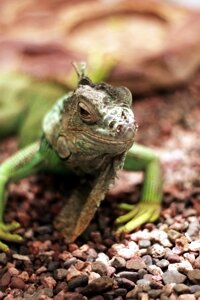
Maxim's Salamander
In Bishkek we don’t have a zoo, although there are plans afoot to introduce one. As it happens, a few weeks ago we had a travelling zoo here in Bishkek and Maxim picked up his camera and went off to have a look. Some of the photos he took are a bit depressing – large animals in small cages but he was particularly please3d with the one he took of a Salamander … at least I think it was a Salamander.
That was until he posted it on his website and Facebook page. The problem was that quite a few people liked the photograph – but didn’t believe that he had taken it. They said that he must have downloaded it off the internet.
I suppose part of that might be because he’s fairly new at this game and they were surprised at the quality of detail, etc., that he managed to achieve. Another point is that we don’t really have that many reptiles here in Kyrgyzstan.
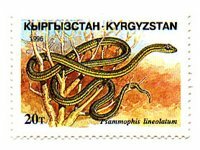
A snake on a stamp
On two different occasions, now, I have been riding in a car when the driver has slammed on the brakes and pulled over, even though I hadn’t seen any reason to do so: no accident; no GAI, (traffic policeman), indicating that we should pull over; we hadn’t burst a tyre … there was nothing as far as I could see. Andrei, my driver, obviously had better eyesight than I do because on both occasions he had seen a snake slithering across the tarmac and thought that I might want a closer look. ”Not too close, however,” he warned me, “as some of the snakes in Kyrgyzstan are poisonous, and it is better to be safe than sorry.”
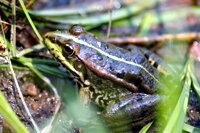
A Frog in Karagachovaya Rosha
In fact I have only seen a few other reptiles in all my seventeen years here in Kyrgyzstan – a few newts up by Lake Issyk Kul and a frog down by Komsomolskoe Lake in Karagachovaya Rosha.
In fact, there are something like 25 different species of reptiles registered in Kyrgyzstan, including tortoises, lizards, and snakes, and almost half of them are featured in the Red Data Book and this considered to be threatened with extinction.
There were three species of reptiles included in the original (1985) Red Data Book of the Kyrgyz SSR:
- Transcaspian Desert Monitor: A species of lizard, found in the south of the republic, in the foothills of the Turkestan range and in the arid gorges of the foothills of the Alai, Ferghana, Babash Ata and Atoivnovsky ranges. It is one of the widely spread monitor lizards in the world with a distribution from the Sahara to Central Asia. In spring they are active during the day, but as temperatures rise in the summer months they adopt a pattern of behaviour where they forage for food twice a day – in the cooler temperatures of the morning and evening. They hibernate over the winter from about October onwards.
- Spotted Desert Racer: (Coluber karelini Brandt). A rare species of snake - there is only one known occurrence of its existence in the territory of the Kyrgyz Republic recorded, which was obtained by V. V. Ozarovsky in the Kara Archa gorge of the Western foothills of the Kyrgyz range.Coluber snakes are thin fast moving reptiles – and commonly known as “racers”. In fact the term used to be used to designate snakes, but modern science has reclassified snakes so that the term is now restricted to a small subset of species. Most, but not all, are non-vemomous – or, at least, the venom is known not to be harmful to humans.
- Cliff Racer: (Coluber rhodorhachis). Another species of snake where only a single specimen has been found in the territory of the Kyrgyz Republic, collected in the Uzun Akmat valley of the Western Tien Shan. Cliff racers are found throughout North Africa, the Middle East and into Central Asia.
In 2005 the list was revised. The two species of snake were dropped from the list – and the following species joined the Monitor lizard:
- The European Green Toad;
- The Asian Frog; This is one of over 200 species of the Rana genus of frogs … which are found on all continents – except Antarctica. Like their relatives in the other two hundred related species, they typically have slim waists, long slender legs, webbed hind feet and smooth skin.
- The Russian Tortoise (otherwise known as Horsefield’s Tortoise or the Central Asian Tortoise); Growing to about 15-25 cm in length, females tend to be larger than males. They are coloured from ruddy brown or black fading to a yellow between the scutes on the shell. They hibernate during winter and are herbivores.
- The European Leggless Lizard (otherwise known as the Scheltopusik); These are large glass lizards which can grow upto 135 cm in length. Despite the name, they do have very small legs (just 2mm in length) which are sometimes visible. Tan in colour, it resembles a large earthworm and they can be distinguished from snakes by the ears and eyelids, as well as the presence of the diminutive legs. It lives in grassland and sparsley populated wooded areas - and feeds on arthropods and small mammals. It is particularly active in wet weather and can react to disturbance by hissing and biting.
- Said Aliev’s Toad;
- Schneider’s Skink (a form of lizard with a cylindrical body – named after the German zoologist Johann Gottlob Schneider); Although they can reach 34 cm most specimens are shorter, (about 20cm), with almost half of it’s length comprising the tail. Juveniles tend to have a brightly coloured tail – which, as a defence mechanism, can break off in an attack by a predator and then later regrows.
- Diadem Snake;
- The Steppe Viper – Ursini’s Viper: a venomous snake which is found over widespread areas, from the South of France to Xingjian in Western China. It usually grows to between 40 and 50cm in length – although some specimens have been reported which are twice as long.
- The Tartar Sand Boa; This is a large snake, and adults can measure anything from 50 to 120cm. The females tend to be larger than the male of the species. They are typically a sandy brown colour with brown and green “blotches”. It inhabits dry grassland and has been known to hide in the burrows vacated by rodents. There are some accounts of the snake being used as the basis for medicinal treatments.


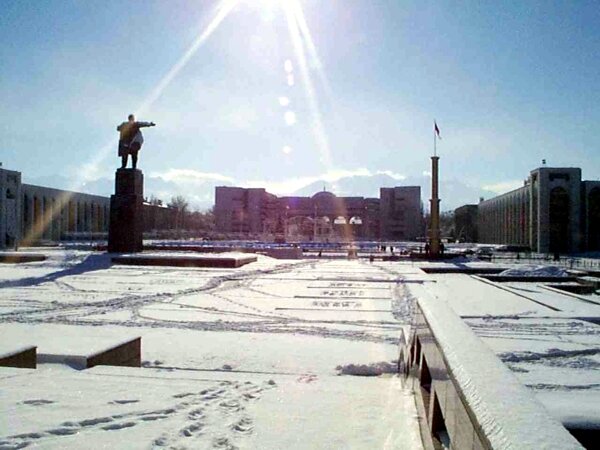



 Bishkek