Santa and Kyrgyzstan
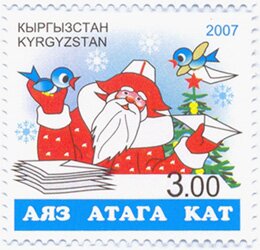
The decision of the Swedish scientists towards the end of 2007 to state that Kyrgyzstan would be an ideal starting point for “Santa” on his annual trip to deliver presents to the world’s children came as a surprise to everyone in Kyrgyzstan. It certainly generated a lot of interest in the country from around the world. Apparently there were a lot of questions directed to the State Agency for Tourism and they were quick to respond. My personal impression is that they did a very good job in meeting this onslaught of interest.
Not only were requests for information fielded but various events were organized. One of these was an expedition to the remote spot which the Swedish scholars had identified as the particular starting point in the remote mountains of Southern Kyrgyzstan.
Also, it was a fortunate coincidence that one of the country’s commemorative stamps in 2007 depicted Santa in a Ak Kalpak – the traditional headgear of the Nomadic Kyrgyz.
The story was picked up by the world’s media. The Google Alerts that arrive in my mailbox everyday cited a host of articles and blogs commenting on it with links from as far afield as Europe, Canada, America, India and China.
The interest generated by the news reports was very welcome … one of the problems the tourism industry of the country has faced for many years has been generating interest amongst potential clients who, sadly, know little or nothing about this region.
In the end the government decided to adopt the “Home of Santa” image as a promotional brand for the country, organizing annual “Santa Festivals”. These festivals have also received a fair amount of publicity and helped to spread news about Kyrgyzstan as a country and a tourist destination. They have served as a useful showcase, and I am still being asked questions and being interviewed, (as a foreigner, and as the Director of a Tour Company), on the subject.
I usually have to admit, however, that I, (personally), have a few doubts about the “brand”.
For example, I have some doubts about Kyrgyzstan as the “HOME” of Santa Clause. Simply because some scholars consider that this would be the best starting point for his yearly expedition, does not mean that it would be his home.
Then, it should be noted that there are already several contenders for this designation. Saint Nicholas – on whom Santa Clause is based – was in fact a Bishop whose diocese was in Southern Turkey – and it is still possible to see his tomb in the church there. In the West there are two main ideas about where Santa lives – one is the North Pole and the other is Lapland. Also, as I understand it, Russian tradition has him based in Velikiy Ustug. I am not sure about the Velikiy Ustug, but the identification of both the North Pole and Lapland are recently modern – if you delve far enough into the past the European image of Santa is associated with the pagan character, the “Green Man”, who lived in the “wild forests”.
As an aside – the identification of The Green Man is interesting because in Russia Ded Moroz (Grandfather Frost) is associated with a Blue robe and in the West we always associate him with a Red coat … the red coat is also a modern invention dating from an early twentieth century advertising campaign by Coca Cola. I mention this simply because it shows that traditions do change over the course of time … and so it may well be that Kyrgyzstan can supplant these other “homes of Santa” … but I doubt it.
Bearing in mind that there is no tradition associating Santa with Central Asia, then trying to create one will be an uphill struggle, even without having to combat the pre-existing associations with Lapland, the North Pole and Velikiy Ustug.
One advantage that Lapland has over its Central Asian rival is its proximity to the population centers of Europe … it is much easier for a family to treat their children to a visit to Santa’s workshop in Lapland than to one in Kyrgyzstan.
If I understand correctly, the Swedish scholars apparently based their conclusion on things like demographic patterns, and analysis of itineraries, distances, time and prevailing weather patterns. What happens when, in the
course of time, these factors (especially the demographics) change. Presumably Santa’s starting point will also change.
I think that even the Swedish scholars forgot the fact that “Santa” does not necessarily make a single journey – there are at least two “Christmases” – December 25th and January 7th and according to Russian tradition Ded Moroz is active at New Year.
Finally, there is the question of the likely reaction in the “west” … there has already been some comment on the internet about “who do they think they are?” and “it’s got to be a joke”. The question, it seems to me, is not the adoption of Santa by the Kyrgyz in itself, but rather the possible damage to the image of the country in the eyes of people who might be “offended” or think of it as a joke – after all, everyone is entitled to their own opinion … and when they voice that opinion, for example on a blog, then it will contribute to and feed a cycle of negative feelings and comments.
I have also had several people asking me what I think about a “Christian symbol” being “hijacked” by a “Muslim” country … please note that these are NOT my words – that is how the question was put to me by one person. To me, that’s not a problem … as I pointed out above and in reply to the question – Santa is not necessarily a “Christian” symbol, he is based as much on a pagan character as a saint in the early church and, anyway, the home and tomb of the original St. Nicholas are in Turkey which, although it may technically be a secular country, it has a history, tradition and culture which is Muslim.
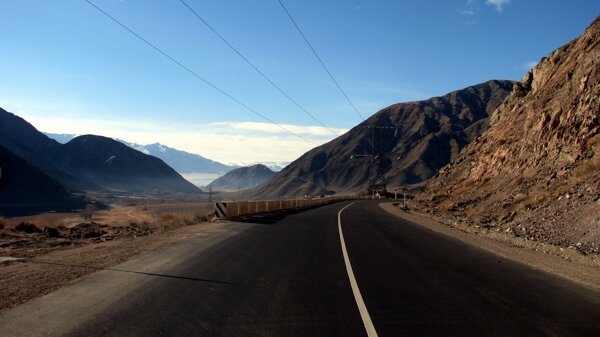
My biggest concern, however, is that, although the image of “Santa” has many positive aspects, it does not really reflect or concentrate on what are Kyrgyzstan’s attractions such as: the mountains, natural environment, the historical associations (for example with the Silk Road) and the traditional culture and lifestyle of the nomadic Kyrgyz.
In terms of the potential economic benefit and impact on potential tourism … my personal opinion is that it is likely to be marginal.
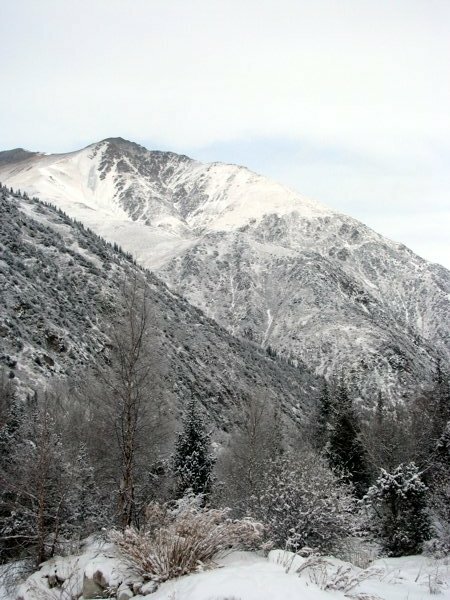
It would be nice if it led to an increase in “winter tourism” … after all, we usually have plenty of snow, so Santa should feel at home – even if the deer and yaks are not quite the reindeers with the stamina and abilities of Rudolf, Prancer, Dasher and the like.
As I have already said – I consider that the main contribution to the development of tourism is that it has presented us with an excellent platform on which raise awareness about the country … it was a “gift” in terms of marketing and for that we should be grateful. It was right to seize the opportunity that presented itself when the Swedish scholars announced their conclusions … and once again, as I said before, I think that the State Agency did a very laudable job in that respect. I can also see ways in which we could build upon this in years to come … for example: to “provodit”, (“see off”), Santa on his journey every 24th December (31st and 6th January …). However, I am not sure that this is the theme on which we should concentrate all of our efforts.
Only time will tell if this turns out to be a chapter in the story of tourism in Kyrgyzstan – or if it ends up as just an interesting footnote.


 Bishkek