After the Revolution
Amongst the many emails we receive are a huge number of spam and scam (spoof, “phishing”, variations on the so-called Nigerian scam) messages. There are are also newsletters, personal correspondence, … and, of course, requests for information.
Some requests are for information about the hotels, or potential tours. Quite a few, however, are for information about the country … and it is sometimes surprising the sort of detail we are asked for. On several occasions we have have stumped and had to write back and ask for the source of the enquiry – which map or guide book is the writer using - because in our research to find an answer, we have “drawn a blank”.
Anyway, just over a year after the Tulip Revolution we received a request from an academic who was doing some research into the effects of the revolution on tourism in the Republic – and he was asking for some background information. He had written to several companies – not just to us – so it would have been possible to write a very brief comment … but the situation is not that simple … so I eventually ended up with several pages. Here are some excerpts … Please note, however, that these comments are personal observations, based on my experiences and interpretation of events and activities.
Let me begin with some background information and by explaining that I am a British citizen, but I have been located in the Kyrgyz Republic since 1995 – and involved in tourism here since 1997. Along with two friends, (also British citizens), we established the Celestial Mountains Tour Company because we saw a great potential for the development of tourism in the country: The mountain landscapes; natural environment; nomadic culture; historical connections; the hospitality of the local population; the wide range of opportunities for activities; the fact that the country remained to be “discovered” (especially by “Westerners”, although there were already a number of visitors: mountaineers, trekkers and Silk Road travellers – we felt that we had identified a niche in the market relatively unnerved which we could exploit to advantage); and the general policy which accepted and welcomed entrepreneurial activity and investment.
Most, if not all, of those factors are still relevant today. The Tulip Revolution did not affect them to a great extent.
We established two companies to provide tourist services and targeted ourselves particularly towards providing quality accommodation, (we have two hotels – one in Bishkek and another in Naryn, on the road to China over the Torugart Pass), with a level of comfort and convenience that was not generally available at that time. Since then there have been a number of developments in the market that have meant that we have had to adapt. In particular the Community Based Tourism project (supported by the Swiss) has increased the number of homestays (B&B) and yurt camps in rural regions, coupled with a number of guesthouses providing accommodation approaching or achieving “European” standards of quality. There is still a problem of suitably qualified staff – but the people are adapting to meet the challenges of delivering services to tourists in the 21st century.
Since the beginning of 2005 I have also served as the President of the Kyrgyz Association of Tour Operators (KATO) and sit on the board of the Destination Marketing Association (DMA – a sort of Kyrgyz Tourism Promotion Board). I also sit on the Management Board of the International Business Council (IBC) which has a specialist Tourism Committee.
The main problems facing the development of tourism in the country have been: lack of information available, especially in the West, about the country and the opportunities (basically marketing); access to the country (the problems of getting visas, international transport connections, etc.); lack of, or poor, infrastructure – and service; problems of bureaucracy, crime and security – dealing with the demands of customs officials, traffic police, pickpockets and the like. (Generally speaking this affects CIS tourists mainly as although some Westerners have experienced difficulty, it is a feature reported mainly by Kazakhs, etc., travelling to Issyk Kul.)
It is worth noting that one of the first casualties of the Tulip Revolution was the First Bishkek International Tourism Fair. This was a “trade exhibition” organized by Itecca – who run a number of travel and tourism fairs – and was to be a showcase for the Kyrgyz Republic. It was planned to hold the exhibition in the middle of May – but was cancelled immediately after the events of March 24th. Instead the authorities organized an exhibition in Issyk Kul, based on one of the Sanatoria. It attracted a lot of local interest, and some Kazakh tour operators attended, but it was reported that very few firm contracts were concluded. The Bishkek exhibition was actually held in May 2006, and there are plans for it to be an annual event.
There were others …several tour firms reported a drop in bookings (more about this below) – and some said that they were facing bankruptcy … but as far as I am aware, only one actually closed. This wasn’t really due to a fall off in the number of tourists – but because their office was in one of the buildings looted in the riots on the night of March 24th – and everything was stolen, records, computers – and even the company stamp, (without which is virtually impossible to operate here).
Another “casualty” was the State Committee for Tourism, Sport and Youth Policy. Since the days of the Soviet Union this was the government organ (ministry) which administered these three areas of activity. Tourism was seen as a social service rather than as an economic activity. For several years, those working in the Tourism industry had been arguing that the department should be split up. The argument was that tourism should be seen as a revenue department and not a spending department as the other two, social, portfolios. Either a separate Ministry of Tourism established, or responsibility for it should be transferred to a Ministry of the Economy Youth policy being “hived off” to the Education Ministry, Sport to the Ministry of Culture, and. The new government did eventually decide upon a redistribution of portfolios, and tourism was transferred to a newly reorganized Ministry of Industry Trade and Tourism (MITT). This has in deed had a dramatic effect in that the new ministry has proved to be more dynamic and supportive that the former structure. It still has to be seen if this will be really effective, but after half a year there is more interest in tourism, more goodwill and the profile of the sector has improved. It was claimed that it was a priority area for the development of the economy, but now it feels as if it might actually, in fact, be one.
Turning to the statistics for the Industry: Below are some “official” statistics, which were provided by the government in November 2004 for the tourism sector, but there are a few points which need explanation beforehand. First of all, some specialist terms:
- Inbound tourism – the reception of foreign tourists into the country – providing an export of services
- Outbound tourism – the dispatch of (in this case) Kyrgyz citizens as tourists abroad – effectively an import of tourist service
- Domestic tourism– the provision of tourist services to citizens of the same country as where the services are provided
- Tourist – under a definition of the World Tourism Organization (WTO), a tourists is someone who spends a night away from their normal residence (… there is a slight problem with this – as it does not account for domestic tourists on an “excursion”, or day trip.)
- Tour Operator/Tour Agent – Under Kyrgyz law these are defined as selling tour services. In the case of the tour operator – they are responsible for providing the services themselves, whereas the Tour Agent sells the services which are provided by a third party … i.e. they act as a “middleman”. Two other terms which are now in common use, but are not defined in law, are “travel agent” and “service provider”.
Statistics tend to raise more questions than they answer. These proved to be controversial – mainly because of No. 11, which seemed to indicate a phenomenal rise in the number of “tourists”. The reason behind this was the change in the source – from the reports made to the National Statistics Committee by tour companies, (such as ours) and hotels, (such as ours), to the reports of the border services … which recorded every foreigner crossing the border – whether they were tourists, businessmen, people visiting their relatives, etc. One of the justifications for this was the definition of “tourist” by the World Tourism Organization – as, basically, someone who spends a night away from home.
The motivation for this change was, apparently, the widely held view that most of the tourism industry operates in the “shadow economy” and didn’t report their income, to avoid paying tax. There might be some justification in this … but, in fact, the Kyrgyz tax system is extremely complicated and many individual service providers operate on what is called a “patent system” which means that they do not have to report.
There are other interesting features or anomalies contained in these figures.
Basic indicators of the development of tourism in the Kirghiz Republic for the period of 2002-2004.
Based on data provided the National Statistics Committee
| № | Indicators | 2002 | 2003 | 2004 | 2005 |
| 1 | Number of registered enterprises rendering services in the area of Tourism | 3918 | 4261 | 4479 | 4771 |
| 2 | The total added value in the sphere of tourist activity (in millions of Som) | 3019.7 | 3010,9 | 3592.2 | 2288.1 |
| 3 | Percentage to gross national product (GNP) | 4.0 | 3,6 | 3.3 | 3.1 |
| 4 | Manufacture of the industrial output promoting the development of tourist business (in millions of Som) | 77.1 | 77,2 | 88.0 | |
| 5 | Investments in “fixed capital” in the sphere of tourism (in millions of Som) | 1357.1 | 739,5 | 988.8 | 584.9 |
| 6 | fixed capital (in millions of Som) | 1797.4 | 187,8 | 3243.5 | 1537.2 |
| 7 | Incomes received from the transportation of tourists (in millions of Som) | 1289.4 | 1368,2 | 1369.0 | 1298.3 |
| 8 | Turnover of retail trade in the sphere of tourism (in millions of Som) | 1691.3 | 1930,8 | 1566.9 | 1709.5 |
| 9 | Turnover of restaurants, bars, cafes, etc. (in millions of Som) | 1143.8 | 1469,9 | 1196.6 | 1457.7 |
| 10 | Export of tourist services - i.e. the income received for the reception of foreign citizens – Inbound tourism (in millions of US dollars) | 35.7 | 47,8 | 58.7 | 55.8 |
| 11 | The number of foreign citizens arriving into the country (thousands of people.) | 139.6 | 211,3 | 737.7 | 601.1 |
| 12 | Import of tourist services – i.e. expenditures made by Kyrgyz citizens travelling abroad (in millions of US dollars) | 9.9 | 16,6 | 38.8 | 37.0 |
| 13 | Paid services to the population (in millions of Som): | ||||
| Tour services – Excursions | 140.4 | 168.7 | 266.0 | 257.2 | |
| Sanatoria – Health Centers | 223.6 | 248.6 | 332.5 | 291.3 | |
| Services of hotels and other places of accommodation | 524.6 | 651.9 | 503.6 | 486.0 | |
| 14 | The number of “tourist establishments”: | 325 | 349 | 379 | n/a |
| Of which … | |||||
| 14.1 | Sanatoria | 37 | 46 | 44 | n/a |
| 14.2 | Boarding houses | 55 | 58 | 53 | n/a |
| 14.3 | Rest house | 11 | 11 | 11 | n/a |
| 14.4 | Camp sites | 11 | 7 | 9 | n/a |
| 14.5 | Children’s “improving complexes” | 45 | 39 | 38 | n/a |
| 14.6 | Hotels | 84 | 79 | 101 | n/a |
| 14.7 | Tourist agencies, tour operators and travel agencies | 80 | 103 | 115 | n/a |
| 14.8 | Natural parks and reserves | 2 | 6 | 8 | n/a |
For comparison purposes: USD1 = approx. 40 som or EUR1 = approx 55 som
These statistics are only indicative measures … but they do provide some useful information … and “food for thought” … provided we remember that, as is often the case with statistics, they seem to raise more questions than they answer.
For example: the increase in the number of visitors looks VERY impressive … but the basis has changed. The 2004 figure was provided by the Border Service and relates to the TOTAL number of foreigners that have crossed the state borders ,,, not just tourists ,,, whereas the figures for the previous years was provided by the National Statistics Committee and were based on reports submitted by tour companies, hotels, etc. Having said that, the figure for the first nine months of 2004 was 703,700, which – whilst being well short of the million and half visitors quoted in November 2004 when the figures were first issued, (they were later revised and it was claimed that the 1.5 million represented a mistake … the figures were counted twice) – anyway, it still represents an impressive improvement. However, it is not clear if this represents a real increase in numbers or simply that the government have been achieving greater success in moving tourism service providers out of the “shadow economy” and thus reporting to the authorities where they didn’t before. This might result in more accurate figures – but still leaves a huge question mark over the real size of the tourism sector in the economy.
What might be more serious concerns the figures in rows 10 and 12 – the earnings from tourism and the money spent by Kyrgyz travelling abroad. Whereas the income from foreign tourists shows impressive growth, so does the money spent abroad by Kyrgyz tourists … This could be a statistical anomaly if, for example, this figure does not distinguish between tourists and business travel, market traders etc. However, it could reflect a tendency that as people become more affluent, they prefer to travel abroad. It seems to be a real risk that soon the Kyrgyz Republic will spend more abroad than it earns from tourism.
The tourism market in the republic divides into a number of distinct sections: those tourists taking “rest and relaxations” – mainly in the resorts around Lake Issyk Kul – and comprises mainly of tourists from neighbouring Kazakhstan, Uzbekistan, and Siberia; Adventure tourists – mountaineers, trekkers, rafting, etc. … Hunters and skiers; Silk Road Travellers – transiting the country between the Orient (China) and the historical cities of Uzbekistan (mainly comprising “Western” travellers). I suppose this section also includes “ecotourism” and “cultural tourism”; Business tourism – comprising of people such as consultants, businessmen, traders, etc. who spend some time in the country.
The first section of the market, (rest and relaxation on Lake Issyk Kul) saw a dramatic drop in the number of tourists – to something like only 30% of the previous years’ figure. This was exacerbated by uncertainty of the situation in the country, concerns over crime and corruption by local officials (customs, police and traffic police) which was seen as directed towards Kazakhs and a series of “anti-reklama” articles (negative publicity) in the Kazakh press. There were also a strong advertising campaign by Kazakh resorts and other destinations (e.g. Turkey) to try and take advantage of the situation and attract Kazakh tourists and a number of adverse comments by Kazakh tour operators about the quality of facilities and service. The Kyrgyz authorities tried hard to campaign against this negative image … organizing the Issyk Kul Tourism Fair, attending the Kazak International Tourism Fair, (KITF), issuing Press Releases, and other activities. Many of the Sanatoria offered reduced prices. Even so, the figures were severely depressed.
Adventure tourism didn’t suffer to the same extent … mountaineering expeditions took place; trekkers, horse riders, etc. came and explored the mountains and didn’t seem too put off by the events. In terms of “Western” tourists, however, my impression is that quite a few cancelled very early on … but they were mainly those intending to travel at the beginning of the season. One firm reported losing 13 groups. Another reported that they lost all their bookings for April and May – although this is normally a quiet period, it created a sense of foreboding. Those tourists, however, who were planning to travel in the height of the season, (June, July and August) seem to have decided to adopt a “wait and see” attitude … and as the situation quickly returned to on of “calm” and normalcy … they later confirmed and arrived as planned. Not all of them, however, the vast majority of them. If the season started with a sense of “depression”, it ended up with almost the same level of results as in the previous year. There was some anxiousness amongst those who were planning to be here at the time of the Presidential elections in June – but they passed off peacefully and I am not aware of any problems that developed.
In our case – and remember that we concentrate on the “Western” market, being a native English Speaker and known as an “English owned and operated company, that’s natural – we actually had a slight increase in the number of tourists served throughout year. However, if it turned out to be a reasonable year, the prognosis before the events in March had promised an “excellent” one.
Having said that … there has been a “follow on” effect this year. Although everybody worked very hard during 2005 to protect their business … and were, on the whole relatively successful, it must be remembered that most of those tourists had already decided that they were coming to Central Asia before the March events. For 2006 and beyond, it was important to attract new potential clients. Some of course will be “repeat visitors” … our firm, for example, had one group which decided to play it safe and cancelled in 2005 – but they are booked again for 2006 … it’s a return group – they’ve been here before. Kyrgyzstan does that to people – many either want to extend their stay, or plan to return. Not all of them make it … there are too many other places in the world to visit … but quite a few do. One British consultant who works here calls it the “Boomerang Zone” … people may leave – but they have a habit of coming back. Such “repeat visitors” however, constitute only a small potion of the tourists who usually visit and it was important to attract new clients.
Several firms made special efforts to develop new “products” and new advertising material. We, for example, broke with the habit of many years and went to the World Travel Market (WTM) exhibition in London, after a gap of several years. It was important to meet with partners, renew contacts, confirm relationships and make new proposals for future cooperation. We developed new brochures and produced an information CD. We have supported press tours, and run two special “promotional” tours ourselves – and we have one more left planned for later this year. We even increased our staffing … slightly. All this meant a large increase in our marketing budget. But we felt that it was necessary to make the investment.
The Ministry (MITT), DMA, KATO, IBC and individual companies have all worked to try and improve the marketing of the country as a Tourist destination. These efforts were helped by the amount of press coverage given to the Revolution … if in the past people had never heard of the Kyrgyz Republic (or Kyrgyzstan),, or got it confused with Kurdistan, or simply grouped it together as “one of the stans” … (one of my friends in London could never get his tongue round the name and always referred to it as “Uncle Stan”) … Now, they knew it existed … unfortunately the publicity was dramatic and negative. However, the events not as bad as they could have been … riots happen in many places around the world – and here (thanks due, at least in some order, to some rather unseasonable inclement weather) they were quickly over and Kyrgyzstan dropped off the worldwide news radar … and if we consider the cliché that “there is no such thing as bad publicity” … then bad news can, at least, be turned to advantage in that it has helped to raise awareness about the country. “Bad news” does not necessarily have to mean a disaster from which recover is not possible … consider the situation in Paris … two sets of nightly riots – each of which seem to have lasted for several weeks … and the aftermath of the Madrid and London bombings … and the effect of SARS on Hong Kong … and … and … and …
Although there were some successes, (especially press tours – six group tours were organized as far as I am aware, and I know of four other “individual” tours), the results of the work of the DMA were, (for various reasons totally unrelated to the Revolution), somewhat disappointing and several activities were never actually completed. Under new management the DMA are planning a change in emphasis and an increase in media coverage to further improve awareness about the country.
What has been the result of all this promotional work? … it’s hard to say. There is certainly a lot of interest in the country … we are still getting enquiries – roughly one a day, even as late as this – the beginning of June. However, there is a change in the type of enquiry … there is increase in individual, independent travellers.
One company tells me that one of the European partners normally booked 12 groups of about 15 people – and about two thirds were usually full, with the rest about half full – this year they placed provisional bookings for only six groups and most of those were only half full. In our case, one company placed provisional bookings for groups of 11 (ten plus a company representative) and in the past they have been full – but this year they seems to be averaging between four and five tourists. Another company which specializes in small group travel – no more that six tourists per group have cancelled have of their tours due to lack of numbers … and the others seem to be running with just two people. Most of our planned groups this year are small … and, once again, there is increase in the number of individual, independent travellers.
The prognosis at the moment is for slightly fewer tourists to pass through our companies this year than last.
Following the “revolution” there was a burst of activity to try and “save” the season. I have mentioned the situation concerning marketing above … but I would like to comment on one or two other points.
Actually, it might be wrong to consider the Revolution in isolation … there has been a “rumbling volcano” in the republic. The events of March 24th represent the eruption of the volcano … there were rumblings before then – and the rumblings have continued. Despite a second attempt to seize the White House (Government House) and the events in Andijan (Uzbekistan), fortunately most of these other events have not been dramatic and “headline news” – and although they have received coverage in the world’s press, there seems to be little actual effect on the industry. Twice when press tours have been in the republic there have been high profile murders … it sometimes seems as if we are fated to have “bad luck”. However, even though there are continued “rumblings”, I am quite optimistic in that I don’t think the volcano will erupt again – at least in the short term. The Kyrgyz are usually very easy going people and very adept at compromise. Even they are aware that continuous revolution is not a good thing.
The response of foreign governments has also been interesting. Not every traveller reads Travel Warnings or Travel Advice … but most countries did respond to the March events by issuing such notices … and this, of course, has an impact on the question of travel insurance cover. It’s not just I am British, but I have to praise the British Foreign and Commonwealth Office … When Jack Straw was in the Foreign Office, he ordered a review of Travel Advice policy – and there were several changes to the system as a result of the final report (available on their website). Within hours of the revolution the advice was updated … and so was the advice issued by many other governments … BUT within a few days, when it clear that things were “calming down”, they revised the advice to say that they “not longer advised against non-essential travel” to the country. This suggests that they were talking to the British community on the ground – the Honorary Consul in particular and, incidentally, the British Ambassador who just happened to be in Bishkek on an official visit. I don’t have any real evidence to support this – but I am sure that this responsiveness was very helpful.
One suggestion which was put forward in the after of March 24th was to relax the visa regime – at least for certain countries. Kyrgyzstan has for a long time been a pioneer in this respect in Central Asia. In 2000 President Akaev announced that he wanted to move towards a position where there would be a visa free regime for member countries of the World Tourism Organization … but it never came to anything. The Japanese were afforded special “visa free” status – but for other countries the status was only granted for holders of diplomatic passports. However, for citizens of 28 countries, it was made possible to receive a one-month visa without the need for an invitation from any Kyrgyz embassy or consulate – including the one at Manas airport in Bishkek. It was suggested, amongst other steps that could be taken to liberalize the visa regime that these countries – and maybe some others – should be granted “visa free” status. Although there was initial support for this from many high ranking people, it has met some resistance and has not yet been implemented. There is some pressure to support the measure … but I think it is probably a “dead duck”. In other words, the Kyrgyz are not willing to adopt an “anything goes” approach.
I would like to make some final comments … people here tend to be fairly optimistic … “Vse budet horosho” – “Everything will be OK” – is a phrase that I hear several times a day. The year 2001 was designated by the then president, Askar Akaev, as the Year for the Support and Development of Tourism … or more simply: “The Year of Tourism”. Everyone expected lots of tourists … but no-one seemed to know where they were coming from. At the end of the season there were press reports of families who had taken credits to erect yurts to act as roadside cafes … but when the season came to an end many of them had not taken enough to pay off the loans … even so each year there are new guesthouses opening, more yurts offering the “Shepherds’ Life” experience, and more students enrolling on Tourism courses and training to be guides etc. As I said, this year tourism is the subject of a lot of attention – more so, probably, than in 2001 – and people are just as optimistic now as they were then … I hope that the results will be better …
On a personal note … I know that I have been a lot busier since March 2005 … interviews – with the press, with consultants; meetings; conferences; seminars; reports … all aimed at trying to secure the development of tourism in the republic. I sometimes joke that Bishkek must be the world’s “Meetings Capital” … in the next ten days there are at least four, high level government conferences on tourism … and several other related activities. I seem to be out of my office than I am in it. OK – so I am president of KATO and sit on a number of committees … but, as I said, it really feels as if Tourism has become a “priority area”. However, I have some misgivings … at the moment tourism represents only something like 4% of the GDP … if there is an increase in the number of tourists; the turnover in the industry; tax revenues from tourism; employment opportunities; and so forth … then it could still “all turn sour”. The winter was probably one the hardest we have faced in our Naryn hotel … and the Bishkek hotel did not do as well in the end of April and beginning of May compared to previous years. There are other problems in the republic other than those facing tourism and if the affairs of the republic do take a downturn … then we haven’t got “so far to fall” – but recovery will be even more difficult and the attitude of the authorities and the population in general may not be sympathetic or helpful to the industry.
I often say that I feel sorry for the Kyrgyz – they have been told several times that “Happy Days are Here Again” – “The Good Times Are Just Around The Corner” … first of all it was the introduction of the Free Market Economy which was going to be the instrument of improvement – but no-one told them that this meant factories would close and jobs would be lost; then it was Gold – but there have been problems there as well, even though the Kumtor mine helped to keep the economy afloat through the early days of independence; then came the introduction of the national currency, the som – swiftly followed by the rouble crisis; tourism then became the “great hope” – but I’ve told you what happened in 2001, (when we were trying to cope with the aftermath of the Batken incursions of 1999 and 2000), and which ended with the events of 9/11 which helped to depress the industry in 2002, followed by SARS (which killed the Silk Road business for the year), and so on; the number of projects funded by donors and international aid have pumped money into the economy – but many of them are about to come to an end and it is not clear what will happen in the future; the Ganci air base has provided a boost for the local economy since 2001 – and has certainly played havoc with the cost of housing in the capital – but this is under threat; and so on … . Tourism is carrying on its shoulders a great burden of expectation … and I am concerned that it might not live up to that expectation.
I am sorry to go on at some length – but as a former teacher, myself, I do tend to be somewhat verbose, outspoken and to suffer from a general desire to explain. The situation is never clear cut and simple. As I said above, these are personal comments … although I feel confident that I can stand by them, they are meant for background information and I am not sure to what extent I would want to be quoted directly. However, I hope you the comments useful. If you have any questions I will be happy to try and answer them – and promise to try and be brief.


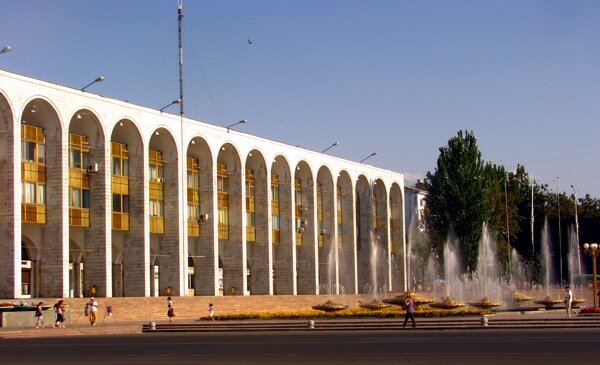


 Bishkek