Charity
One of the hardest parts of my job as Director of the company is dealing with the many requests that we get asking for charitable donations or sponsorship.
It seems to have been a feature of the Soviet system that enterprises accepted “social costs” — obligations to the community such as providing maintaining the local telephone system or the central heating system for the village. In the villages, especially, it seems to have been common practice for there to be one major enterprise providing employment for all the community, and responsible for all the local amenities. The enterprise may have on its balance sheet the local Social Club — or even the local police station. When it came to privatization, most of these “social costs” had to be divested from the enterprise to make it into a “going concern” — which seems to have left many communities without the financial wherewithal to support what might be thought of as valuable facilities for the community.
The local authorities, (town, village, region, province), already have considerable obligations and don’t have budgets large enough to accept responsibility for all the needy in their community. The system of local taxation is a problem all over the world — but here it is not very well developed, and to make things worse there is a tendency for people, naturally, to try and avoid paying taxes.
In the West, there is the tradition of tithing — giving one tenth of your income to “good causes” and I remember being told at school the story of the Scottish businessman who early in his career made a decision to donate half-a-crown of every pound (that’s one eighth — not one tenth) that he made to “charity”.
As a, (I hope), responsible businessman I appreciate that our business is part of a wider community and there is moral imperative on all of us to help those who are in need, and (again, I hope), we do our best to help those less well off members of the community. I have a small budget for this sort of expense — and it is regularly drawn on — if not overdrawn.
To be honest, however, we are in business — and our business is not “social work”. This is right and proper, in my opinion. The most important part of my job is to make sure that the business prospers — not just for the benefit of the investors, but also for the clients (our customers) and the local community. The business already contributes to the local community — it provides investment and jobs, we purchase goods and services locally and we pay our taxes. It helps no-one if the business is not a success, but it should benefit us all if it is.
Charitable donations, require a good solid economic base to sustain them.
It is all well and good to be altruistic — and donating to charity — assisting to “good causes” — helping the “poor and needy” — supporting “worthwhile projects” — helping to “improve the quality of life” …these are all admirable actions — but they need to be kept in their proper place.
“Pure charity” doesn’t always have to have a material side, and when it does, then it doesn’t need to cost a lot of money. Of course, there is always a cost of some sort — if only in terms of time talking to the lonely old lady sitting on the park bench, or maybe the emotional stress comforting a distressed person. Kindness, compassion, and sympathy are valuable “commodities” in themselves.
It is not possible to satisfy every request — and deciding which ones to support and which ones to turn down is, as I said, one of the hardest aspects of my job. Most of the requests that land up on my desk are very worthy. Some are heartbreaking. For some, however, I have little or no sympathy.
Here are just a few examples. They are in no particular order, and you can ask yourselves which ones deserve support:
- The beggar who walks into the office and says: “Give me some money.”
- The child that knocks at the door and asks for bread.
- The letter from a government official asking for sponsorship to buy an air ticket for another, high ranking, government official so that he can attend meetings in Moscow and Berlin.
- The letter from a government department asking for sponsorship to renovate their office — because it wasn’t included as an item in the budget. — This seems to occur quite regularly, we have received such requests from a Ministry, a registration office, a school, even the military … Sometimes they don’t ask for a cash donation — but ask if we can provide materials — some wood, cement, paint
- The mother whose child needs an operation — but she can’t afford the fees and so she is going around all the offices and shops in town asking for a donation. You might be surprised how often this happens.
- The young sportsman who is a national champion in Kyrgyzstan, and won medals in competition in Asia and even in world competitions, who needs to raise funds to travel abroad and represent his country — or the local youth organization which wants to organize a sports competition amongst the youth of the region, or the local football team which wants to take part in a National competition.
- A letter from a government official requesting any soft furnishings which are about to be written off, to be donated to a hospital for those suffering from TB.
- A request for sponsorship for the police, or other officials, so that they can “celebrate” their national holiday (“Police Day”), or so that the Colonel can entertain some important visitor. Sometimes the request is for cash — but sometimes it is if can they use the facilities in one of our hotels, (for free — or at a very large discount).
- Office supplies (paper, files, printer cartridges…) for a government department”h A request from a very important government body, so that they conduct an international conference — hosting representatives from all the other CIS countries
- A derelict Social Club in a small village outside Bishkek which needs renovation — can we help provide the wood for the windows and the doors
- A request to provide a computer for a local school — sometimes we get asked for basic supplies — paper so that the children have something to write on, and pencils.
- A Music school — we actually sponsor two — so that they can provide a party for the children, put on a concert, buy new musical instruments, or issue a CD, or …
- A Veteran’s and Pensioner’s Association which tries to distribute food parcels to old people in the capital on the various national holidays
- The local military authority which can’t afford to buy petrol to transport Veterans to a memorial ceremony.
- The non-government organization which provides legal help and education to the poor
- An Association for disabled people which provides a range of services.
- The international organization which wants to publish a calendar.
- The organizers of an international Art Exhibition in support of young artists.
- Various capital projects such as renovating the centre of Bishkek for the 125th celebrations of the city’s founding, or the construction of a railroad.
- A statue to be erected in honour of some great Kyrgyz personality
- Support for students in Higher education who come from poor families — the monthly stipend (grant) is about 100 som — i.e. a little over two US dollars.
And believe me, that’s by no means an exhaustive list.
Many of these examples could be found in the West — but some would not. Others would be handled in different ways. Some of the cases might bring advertising — although I came from a generation and tradition which says “Don’t boast about your good deeds” — and so donations can be considered as marketing budget.
We prefer to donate to “good causes” which directly help poor and needy people — of which there are many — and who will always be with us. I ask for definite projects — I don’t want to give a donation to an organization but want to be able to show my investors where the money has gone. This helps me to decide which projects to support and which to decline.
There is a great tendency to want to help children … they have their whole lives ion front of them and need a good start. On the other hand, I feel a great sympathy for the elderly who were promised so much and have “lost” so much by the collapse of the former Soviet system. Occasionally, I meet people who really don’t want to ask us for help — they seem to be embarrassed that part of a once great nation has fallen on hard times — but they have no other options available to them. I also prefer “Self-help” schemes — as the old Chinese proverb puts it …“if give a man a fish and you feed him for a day — but teach him how to fish and you feed him for a lifetime”.


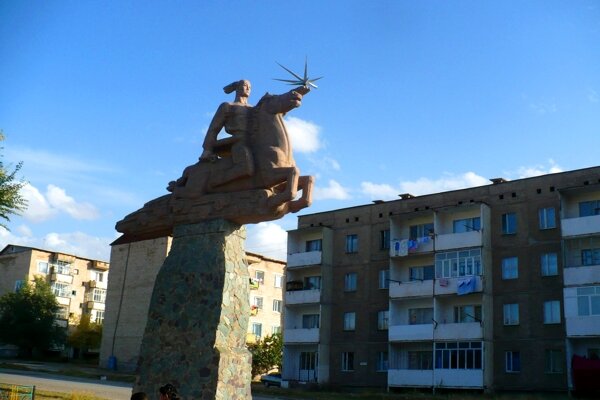



 Bishkek