Bread
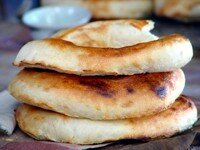
Lepioshka - typical flat breads of Central Asia
A few years ago a client gave me an anthology of writings on the subject of Food. Although I don’t think I would have picked it up in a bookshop back in the UK, it proved to be quite an interesting read with a variety of stories and anecdotes: buying a goat in Africa, meeting a cannibal in the south seas, the American visiting a Japanese restaurant for the first time and mistaking the finger bowl for a bowl of soup … and so on.
As with any anthology, the quality and interest of the different pieces varied and there was one that I found particularly disturbing … it was written by an itinerant, (a tramp), about how to survive on scraps. He described how he would search dustbins and often find good food – tasty tidbits which had been thrown out even though they were still perfectly edible; possibly simply because they had passed the “Best before” date printed on the packaging … ignoring the fact that the products had not actually spoiled or ”gone off”.
Now the idea was not particularly appealing, although I well remember being intrigued coming across a recipe for “Garbage Soup” when looking for something to cook for a vegetarian friend who was coming to dinner. Despite the name, the ingredients weren’t necessarily plucked out of the garbage can … although most people, including me, would have thrown them there without a second thought. The Chef recommended making a soup from the peelings from potatoes, carrots and other vegetables. The one proviso was that the vegetables should have been thoroughly washed beforehand, nut as they are perfectly edible and contain considerable nutrients, he said, there was no reason to throw them away. Despite being intrigued at the time, I have to admit that chickened out and settled for something far more mundane.
Anyway, I came across an interesting article on the BBC over the weekend: Why is bread Britain’s most wasted food? The author, Anna-Louise Taylor, pointed out that Britons tend to throw out an incredible 4.4 million tonnes, (that’s metric tons), of edible food each year, and that includes about a third of all bread purchased in the UK, about 80% of it from loaves of bread that have been started but not finished.
Speculating on the reasons for this wastefulness, she suggested that people simply bought too much bread, afraid of running out: “It’s a reasonably low-priced commodity and rather than run out, they prefer to have too much than too little.” The main reason, however, was that people have lost touch with the bread making process: “If you make something yourself, you’ve spent half an hour kneading the bread and then baking it, you don’t waste that bread because you know how much energy you’ve put into it.” These days, however, people are used to picking up a loaf at the supermarket and so don’t have the same respect for what they are consuming.
I think there is a lot of truth in that. Certainly, as I reflected on the article, it occurred to me that this just wouldn’t happen here … or, at least, wouldn’t have happened here until quite recently. People have a different approach to bread.
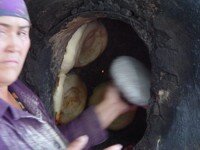
Baking Bread
In the villages, many people bake their own, thus maintaining the emotional link, the “respect” with the final product. I have stayed with many different families around the country and have been amazed at the different textures and flavours of the home baked bread; often the flat breads known as lepioshka. These may be laid out in a pile on the table at the start of the meal and in due course someone picks one up and tears it into pieces – they don’t cut it with a knife but tear it with their hands. It’s distributed to the company seated around the table but always placed “face up” – never upside down.
In the cities, however, people will buy their bread from shops or in the market. Whereas, back in the UK, I would do a “weekly shop”, a habit learned from my mother, here people often purchase what they need on a day to day basis, (although some things are purchased in bulk). Bread, in particular, is usually purchased every day. Although some of the supermarkets now carry “sliced bread”, The baton, loaves, tend to be much smaller than we would buy in the UK.
Even with “shop bought” bread, as a rule, stale bread is not thrown away. Instead, it may be cut up into cubes and toasted in an oven to make Kirieshki, (croutons), or soaked and fed to the dogs. A couple of years ago I astounded people by producing my father’s favourite standby of “bread and milk” and a friend serving up some “Bread and Butter Pudding”, both of which were praised as excellent ways of using stale bread.
The main reason for this attitude, as it was explained to me, dates back to the “Great Hunger” of the 1930’s. Although there is some difference of opinion, most scholars agree that the famine was caused by the policies of the government rather than by natural causes. Poor harvests in 1931 and 1932 may well have been caused by a variety of natural disasters, but; the move to collectivization, (which was ruthlessly pursued in the face of opposition amongst the peasant farmers), and inefficiencies in the planned productions aggravated the scale of the disaster. To make matters worse, Stalin refused to release large grain reserves that could have alleviated the famine, while continuing to export grain; he was convinced that the peasants had hidden grain away. The successful harvest of 1933 ended the famine.
There’s a very good account of this period, The Silent Steppe written by a Mukhamet Shayakmetov, a Kazakh who was a young boy at the time. His family ostracized because his father was considered a Kulak, a “class enemy” of the socialist revolution. It’s an excellent book, well worth reading and I thoroughly recommend it.





 Bishkek