Vino

Red or White?
One of the problems of being known as one of Kyrgyzstan’s long standing ex-pats is that I get asked all sorts of questions. Sometimes they are easy to answer, but sometimes they prove rather challenging.
A few days ago I received one such challenge:
Is it true to that wine is produced locally in Kyrgyzstan? And if so, where are the grapes grown and who makes it?
Have you ever tried Kyrgyz wine? Or know where I can get some?
It’s a very good question … and one that has vexed me for a very long time. (I have often thought about it as a topic for a page on the blog … but have had trouble tracking down reliable information.)
Obviously Vodka is the main tipple here amd there are several firms which distill the liqueur from various bases such as grain, potatoes and beet. I have seen fruit liqueurs, including a very passable chasis produced in Issyk Kul, but only occasionally.
In terms of Kyrgyz wine, apparently during the Soviet period there was quite a bit made locally. There was a winery, for example, in the village of Kunduu, just outside Bishkek, and their product was shipped all over the former former Soviet Union. I am told a story of a young man from the village who was sent to some remote posting when he was doing his military service and was delighted to discover bottles of Kunduu wines in the local shop.
I’m not sure that any is made commercially these days … although according to the Association of Fruit and Vegetable producers there is some made in the Batken oblast … we tried to find some details but have, unfortunately drawn a blank. (If anyone out there has any information about this, I would be grateful to hear of it!)
The grapes were both local and imported, (from Uzbekistan, I believe).
I can’t say that I have seen any vineyards in Kyrgyzstan, although I am told there were some on the southern outskirts of Bishkek, some in Kunduu and others out by Kant. The ones outside the city, (by the GorGAI building), were grubbed up some time ago, as were the ones in Kunduu which were replaced by apple orchards. I am not sure about the ones near Kant.
Grapes are, however, grown in Kyrgyzstan, but the vines I have seen tend to be isolated, (at a dacha or someone’s back yard), and the grapes seem to be used as fruit rather than for making wine.
According to the Food and Agriculture Organization there seems to be a steady 6000-7000 hectares under cultivation, (which isn’t all that surprising because a vineyard is a vineyard … and remains fixed from year to year, unlike a field which can be used to grow potatoes one year, onions or garlic the next and carrots or beans the following year).
The yields have varied considerably from year to year with anywhere between 10000 and 30000 tonnes of grapes being harvested a year. Again, that’s not all that surprising … last year for example, some friends of mine who live in a village to the West of Bishkek and have have six different types of vine in their garden, lost virtually all their crop as the result of a severe hail storm at a critical moment in the growing season. Although they were able to rescue most of their other crops, the grapes were all ruined and the plants never recovered during what remained of the season. Sometimes late frosts can also play havoc with the harvest, but usually only limiting the size of the crop; last year was the only time that they tell me they lost the whole crop,
Some time ago I came across an article about a serious fungal disease affecting vines in Kyrgyzstan, a sort of mildew, however my impression from talking to people is that things like early frosts may have had more of an effect on the amount of grapes produced.
Apparently, there used to be a lot of grapes that went for export … although the FAO figures suggest that this was mainly in the period 2002-2004, but I have seen some other statistics for other years and when the Kazakh border was closed in 2010, there was a lot of fruit, (including grapes), released onto the local market because they couldn’t be sent to their traditional markets.
Although wine may not be part of traditional Kyrgyz culture, vineculture certainly seems to have been a part of the local agricultural scene for some time. For example, there is a scene the group of people harvesting grapes, (complete with a turkey!), on a frieze on the building of the Constitutional Court on Prospect Erkindik, a typical sort of Soviet image about the “joy of labour”.
There is a fair amount of wine available in Kyrgyzstan, especially in Bishkek where it can in most supermarkets and up-market specialist shops, but most of it is imported. The shop next door to my office, for example, sells a very wide selection including Georgian, Moldavian, French, Italian … even, occasionally, Australian, South African and Soputh American wines. The only Kyrgyz wine they seem to stock, however, is Sovietskoye Champagne, from the Champagne Kombinat which I believe used to produce wine as well, (but I haven’t seen any evidence of this for some years). They certainly produce Kyrgyz Cognac which, by all rights, should also be made from grapes, and grapes are a constituent ingredient in their other major product, Arashan Balsam.
There are a number of specialist importers, the largest of which is Foresters, who cover the whole republic have been working in the country since 1997 and also import beer, spirits, chocolate and cosmetics. There’s also a Frenchman, (a sommelier), who specializes in French wines and holds wine tastings at his wine bar, U Franzutsza, here in Bishkek.
I am told that there is currently quite a market in re-bottling wine, (imported – I am not sure it is local production), and relabeling it to pass it off as French or some other nationality …
I have only ever tasted one Kyrgyz wine … a long time ago – it was a red called Kagar, and was both very cheap and very sweet … not something I would feel confident in recommending and the name seems to be a generic one.
As an aside: Here’s a link that might be interesting; it is about Kazakh wine … but refers to Issyk which is just outside Almaty, on the Kazakh side of the Kungey Ala Too.
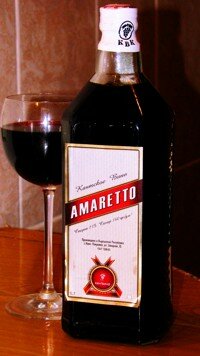
Amaretto from Kantvino - Photo Maxim
UPDATE
I asked around and a friend told me that the Kant winery closed some time after the collapse of the Soviet Union, but has since reopened and is producing wine. Just outside Kant there is apparently a large billboard advertising their existence and production. They produce a sweet red wine, (although the label says it is made from white grapes), called Armaretto which is sold both in bottles and on draught. I asked him to get me a bottle and he brought it to me on Sunday evening. It was interesting but I can’t say that it is to my personal taste, (being rather sweet).
However, I think it is obviously worth more investigation. Maybe, the next time I go up to Naryn I will stop off in Kant and see if I can find out anything more or, maybe it calls calls for a special visit.


 Bishkek