Dungans in Kyrgyzstan
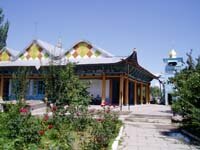
Dungan Mosque in Karakol
At the moment there is an exhibition in the Frunze Museum about the ”The Dungans of Kyrgyzstan” – a photo-documentary exhibition of the history of the Dungans beginning with their transfer to Central Asia in the late 19th century.
I have mentioned the Dungans in some previous postcards, (notably in Nationalities, the DunganMosque in Karakol and Dungan cuisine), but it seemed to take a closer look at who they are.
Dungans are ethnic Chinese Muslims, from the Kansu and Shensi provinces of northwestern China. In China they are known as Hui. They refer to themselves as Hui-Zu, (or “Chinese Muslims), and have their own newspaper, Huiming Bo, (or “Muslim People”), although the Russians, and hence the Kyrgyz, referred to them as Dungans.
The name Dungan is of obscure origin. It is mostly used to describe the Turkic- and Tajik-speaking neighbors, both in Xinjiang and in the former Soviet republics, and has been presumably borrowed from the Turkic languages into Russian, (dunganin (sing.) and dungane (pl.); ), Chinese (Donggan zu), and also English (Dungan, and also earlier, Tungan). One theory suggests that this was derived from the Turkic döñän, (“one who turns”), which can be compared to Chinese (huí), which has a similar meaning. There is another theory that suggests it is derived from the Chinese Dong Gan, (“Eastern Gansu”), which is the region to which many of the Dungan can trace their ancestry, (however the character gan used in the name of the ethnic group is apparently different from that used in the name of the province).
Although technically Muslim, it seems that the young, in particular, tend to adopt a more relaxed attitude to religion and, according to one source, become more committed or devout at about the age of 40.
Like the Uighurs – the original Dungan community arrived in Central Asia, (predominantly Kazakhstan – where there were over 35,000 according to the 1999 census – and Kyrgyzstan – where there were were over 50,000 in the 1999 census), as refugees from persecution after a series of failed Muslim rebellions between 1862 and 1877 and the especially severe winter of 1877.
One group of refugees, about 1000 people, from the area around Turfan in Xinjiang, arrived in Osh. Another group, of over 1100, arrived and settled in the region around Karakol. A third group, of over 3000, settled in the village of Karakunuz, (which means “camp” or “encampment”), just North of Tokmok in what is now part of Kazakhstan. (In 1965 the village was renamed Masanchi after a local Dungan leader, a participant in the Communist Revolution and a Kazakh statesman.)
Another wave of immigration followed in the early 1880s. The Treaty of Saint Petersburg, (1881), required the withdrawal of the Russian troops from the Upper Ili Basin, (the Kulja area of Xinjiang), and the Hui and Uighur people of the region were allowed to opt for moving to the Russian side of the border. Most choose that option, and according to the Russian statistics, 4,682 Hui moved to Russian Empire under the treaty. They migrated in many small groups between 1881-83, settling in the village of Sokuluk some 30 km west of Bishkek, as well as in a number of points between the Chinese border and Sokuluk, in south-eastern Kazakhstan and northern Kyrgyzstan.
Today, there are over 110,000 Dungans in Kazakhstan, Kyrgyzstan and Uzbekistan. In particular, people from Kansu settled in the mountains and valleys of Kyrgyzstan, and people from Shensi living in Kazakhstan, mainly concentrated in the river valleys.
Although they have, on the whole, assimilated into the local community, (for example, many of the Dungan in Kyrgyzstan adopt contemporary Western style clothes), they have maintained certain features of their traditional culture and identity.
Many Dungan, for example, speak Kyrgyz, and the young people also speak Russian, in addition to their own, native, Dungani language, (a form of Mandarin Chinese which is heavily influenced by Arabic, Perian and Turkish), and they write using the Cyrillic script. Although children in school are taught most subjects in Russian, they may also receive instruction in Dungani for a couple of hours a week
The Dungan are primarily farmers, growing rice and vegetables such as sugar beets. Many also raise dairy cattle. Many live on kolkhoz, or “collective farms,” with Dungan chairmen, doctors, and teachers. A few live in the cities, but those few have found jobs as writers, linguists, historians, poets, and newspaper editors.
As well as being farmers, Dungans taking great pride in their gardens. Generally, Dungans are wealthy, wealthier than their Kyrgyz counterparts. This has sometimes led to problems between the two communities but, on the whole, the two communities get on well.
The Dungan tend to marry within their own community, (that is, they are “endogamous“). The Dungan in Kyrgyzstan are less conservative than are those in Kazakhstan, permitting their girls to marry another Dungan from any other place. Practices such as having multiple wives, (polygamy), and the payment of a bride-price, (a dowry), were abolished in 1921. They believe in having as many children as possible and apparently, according to one source, the average number of children in a family is eight.
The Dungan are famous for their hospitality and they hold many ceremonies and banquets which help to preserve their former culture. These include elaborate and colorful observances for birthdays, weddings, and funerals. In addition, some schools have special museums which help to preserve other parts of their culture, (such as embroidery, traditional clothing, silver jewelry, paper cuts of animals and flowers, and old traditional tools).
Their cuisine remains a striking feature of their culture and Dungan restaurants and cafes are popular. It involves of plenty of meat, (especially lamb and chicken), vegetables, (which are mainly fired) and noodles, all lavishly seasoned with garlic and vinegar. Most Dungans still eat with chopsticks.




 Bishkek