Visa logic?
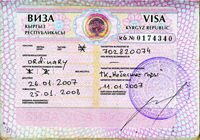
The all important visa
Some people seem to have the opinion that I am an argumentative sort of person. Although I can understand why they might come to this conclusion, personally, I don’t think it is so, (but I would say that, wouldn’t I?).
The trouble is that although I don’t like arguments and will try to seek a compromise, if I possibly can, by ”putting myself into the other person’s shoes”, (trying to see things from their point of view and understand their position). Although this can help me prepare my argument to counter their position, it also has the problem that I can sometimes see the justice in their point of view which may weaken my resolve.
Sometimes, however, it is simply frustrating because, although I understand their stated position, I cannot see the logic in their argument, (I have mentioned before in another postcard how I sometimes have difficulty in following the logic of some arguments). I am in that position now over the proposal to extend the visa free regime to the citizens of another forty one countries.
For the record: Like every other country in the world, Kyrgyzstan operates a visa policy. A visa is permission to cross the border to enter the country. It doesn’t guarantee that entry will be permitted; that decision is delegated to the officials at the border at the time of entry and they can deny entry even to someone who has a visa, usually that is on the basis that their name is on a list of proscribed persons.
There are different types of visa, (for example: Transit, Tourist, Ordinary, Study, Diplomatic, Investment, and so on), each with their own rules. Visas are further classified according to their length, (a few days, a month, or a year, for example), and the number of entries they permit, (one, two or multiple); and again there are special rules governing each. In addition there are three different visa regimes: “Visa Free“, “Simplified” and “Ordinary“, but more about that below.
A visa is issued by a consular official, usually assigned to a diplomatic mission abroad, (but in some cases in the country itself – such as at Manas Airport in Bishkek or an office of the Ministry of Foreign Affairs).
In order to obtain a visa, the traveler has to make an application, (filling in an application form and other required supporting documentation – such a passport photograph), and pay the appropriate fee.
Some countries ask for considerable amounts of supporting documentation. Police certificates to show that the applicant doesn’t have a criminal record or health records which may require a medical examination, (both of which take time to obtain and may involve additional fees). In some cases (but not for Kyrgyzstan – although the consul does have discretion to request this), they may ask for evidence of travel insurance or proof of income to ensure that the traveler can afford to meet any expenses such as medical fees if they have an accident or fall in whilst they are in the country. In some cases they may ask for proof of travel plans like air tickets or a visa for the next country to be visited, (but, once again, not for Kyrgyzstan, except in the particular case of a transit visa).
The main supporting document required by Kyrgyzstan in most circumstances, that is, is an invitation from someone in the country, as proof that the journey is genuine and someone takes responsibility for you whilst in the country. This invitation has to be registered with the authorities who scrutinize it and, if approval is granted, informs the consular department where the application for a visa is to be submitted by the traveler. In Kyrgyzstan, this approval process takes at least a week, (two weeks for some countries – “countries of risk” – and can sometimes take longer … much longer; the record as far as our company is concerned was 70 days(!)), and, of course, there is another fee for it.
The time taken for the consul to actually issue the visa can vary from a few minutes to several days.
Now, let me be frank. Kyrgyzstan has one of the most liberal visa policies in Central Asia and the former Soviet Union.
Citizens of most countries are required to obtain a visa in order to cross the border and enter the country. In most cases, (that is, for most countries but not necessarily most people), the “ordinary” visa regime applies which means that they have to obtain an invitation which is registered with the Consular Department at the Ministry of Foreign Affairs here in Bishkek, which scrutinizes the application and, if approval is granted, informs the consular department where the visa application itself is to be submitted.
Visas can be issued at at any Kyrgyz Consular post abroad, or on arrival at the airport here in Bishkek. Because there are so few Kyrgyz diplomatic representative offices around the world, an agreement with the Kazakh government allows a Kazakh consul to issue visas for Kyrgyzstan in countries where there is no Kyrgyz diplomatic representation, (in Paris, Rome, Madrid or Bangkok, for example).
In some cases, however, it is possible for travelers from about fifty different countries to obtain a visa which is valid for entry on a visit to the country for up to one month from any Kyrgyz consul, just on the basis of a personal application; (that is, without an invitation.) There are rules about what they can do in the country and if they want to apply for a visa which will last for longer than a month, or for a special type of visa, (for example in order to study or work in the country), or if they want to take advantage of the facility to apply at a Kazakh embassy in a country where there is Kyrgyz embassy, then they still have to obtain an invitation. (Also, provided they are in the country for less than a month, then they don’t have to register with the authorities but, if they are in the country for more than a month then they do have to do so.) For many potential tourists, however, this “simplified” regime offers a fairly easy way to obtain a visa in order to visit the country.
I don’t know of anyone who falls into this category that has had an application for a visa refused, (although I suppose that it is possible that consular officials may check a “black list” to see if the applicant is on it before issuing the visa). In other words, it is just a formality and a visa is automatically issued … in return for a fee. It seems to me that in this case the fee it has nothing to do with the need for the country exercising an element of control over who is allowed to cross its borders. It is simply an “entry tax”, just like when you pay an entry fee to go to Disney World. The main difference, of course, is that at Disney World, everybody pays the entrance fee.
There is also an agreement with the Kazakh government for the mutual recognition of each others tourist visas in the oblasts, (administrative regions), which border the other country. So, someone with a Kazakh visa can fly into Almaty, cross the border into Kyrgyzstan, visit Lake Issyk Kul and then fly out out from Bishkek. Although that sounds good, there have been some problems because the regulations are quite restrictive. It only applies, for example, to a certain limited region in both countries. Also, the agreement does not apply to all tourist visas – only to those issued to citizens of certain countries, (and the list of countries is different for both Kyrgyzstan and Kazakhstan). It’s is also important to note that crossing the border invalidates the original visa, so a double entry visa is needed and it’s and not possible to return unless you have a multiple entry visa.
Citizens of about ten countries which belong to the list of countries in the “visa free” regime are not required to have a visa at all in order to enter the country. There are still rules that govern how long they can stay, when they have to register their presence with the authorities, and what they can do in the country … but the don’t need a visa to cross the border. Most of these are former socialist countries, like Cuba and North Korea, but the list also includes Japan.
For the record: The visa free regime also extends to holders of diplomatic passports from some other additional countries.
These fortunate travelers are spared the time and expense involved in applying for a visa.
Kyrgyz citizens, of course, don’t need a visa in order to enter the country.
If that all sounds like a procedural nightmare – it is … and, obviously, the country’s tour operators want to simplify the system as much as possible. Discussions about this have been taking place over many years – all the time I have been involved in tourism. Over the years we’ve put forward our arguments about:
- the signal sent by the requirement of having to apply for a visa – we don’t trust or don’t want visitors from those countries as they represent some form of danger to the country and need to be “controlled”. Relaxing the visa requirements will be an advantage – sending a hospitable, inviting signal to potential tourists;
- the time taken in the process, especially an invitation is required;
- not to mention the inconvenience of making a journey to visit the consul, (or post the passport … or … in one case I know of, a tour operator in New Zealand collected the passports of everyone in the group and took them to the Kazakh embassy in Thailand in order to apply for their visas … and there were sometimes problems with faxes informing the embassy that approval had been granted, or someone had made a mistake on the application form.) Not every visitor to the country can avail themselves of the consular services of a Kazakh Embassy, (for example in New Zealand), or at Manas airport, (those, for example, arriving from China at Torugart or Irkeshtam, from Kazakhstan at Kordai or from Uzbekistan at Doslik);
- the fees, which may well be lower than those charged by other countries, but still constitutes an additional expense which can be considerable in some cases – e.g. for a family of four;
- the economic benefits gained from an increased number of tourists visiting the country; from direct expenditure in the country (providing a source of foreign currency income, as a form of “export of services”); an increase in the number of workplaces created in order to provide the additional services; the increase in taxes collected for the budget;
- the experience of Georgia and the Ukraine which have relaxed their visa policies and seen significant increases in the number of visitors; not to mention the fact that many other countries are looking to relax their visa policies – including Russia which is considering introducing a special visa free regime for countries of the European Union.
- … and so on.
Now I confess that some of these arguments are stronger than others. Some of them are of minor importance and can be addressed by introducing refinements to the process … in fact, that’s how we got the consular post at Manas airport, the simplified regime and the limited mutual recognition of Kazakh tourist visas. It also led to the suggestion of the introduction of an electronic visa, although that measure was never implemented. Some, however, are much more important … and not just to the tour operators.
In actual fact, we tour operators stand to lose a source of income, (albeit a minor one), if a visa free regime is introduced as we will not be charging our clients a fee for arranging an invitation for them.
Seven years ago there was outright opposition to the suggestion from certain government departments. I sat in one meeting and heard a barrage of “reasons” why the measure could not be implemented. I said that it reminded me of a blunderbuss approach, (korotkostvolnoye roozhe): fire as much buckshot as possible in the direction of the target and hope that some of it hits the target. At the very least it means that the opponents, (i.e. me and my colleagues), will have to spend time and effort answering them all.
At that time, the main argument seemed to be the need to collect visa fees. As one official put it in an unguarded moment, “How will our embassies abroad live without the fees they collect?” Although that may be important for embassies like the one in Britain, it can’t be the case for the embassies in Belorus or Japan, where the citizens don’t have to apply for visas. How do they survive?, I wonder.
Last year, however, the government made a decision to extend the visa free regime to 41 countries. The Ministry of Economic Regulation, (as it was then), had proposed a list of almost sixty countries, but this finally pared down to just forty one. (The selection criteria for the countries to be included in the list was supposedly based on the fact that they should have a GDP in excess of USD7000.) It is a decision line with the Kyrgyz government’s policy to remove regulations which are not necessary and which provide barriers to development.
Since then the Ministries have all come on board. Even the Ministry of Foreign Affairs and the Security Services have said publicly that they are not opposed in to the measure in principle. They do, however, raise some issues which they feel need to be addressed before it can be implemented … which, I take to mean, they are opposed to it. Rather than showing that visas are necessary, however, they try try to show why abolishing them is not the right course of action.
The main argument for a visa is that of security and the question of security has always been raised as an argument for retaining the visa as a control over who can come into the country. A visa requirement provides a chance to vet an application for a visa in advance of the person arriving at the border. If, for some reason, it is undesirable that a person be allowed access to a country then permission to enter can be withheld. Such reasons might be if they were a threat in some way, a criminal or terrorist, or if it was felt that they would outstay their welcome, undertake employment in the place of a local person or become a burden on the host state.
In fact, two of the Parliamentary committees, when considering the current proposal have refused to back the measure, sending it back for further consideration on grounds of security.
Now, we obviously want to don’t want to allow certain elements, (criminals and potential terrorists) into the country. I am not convinced however that a obtaining visa will be a barrier that they won’t be able to overcome if they really want to. More telling, it seems to me, is that murderers of Beslan, (being Russian citizens), were free to enter the country without needing a visa whereas a tourist from France, (hardly a hotbed of terrorism – or am I wrong?), has to obtain one – even if they would be able to get one fairly automatically from the embassy in Brussels or on arrival at Manas airport … in exchange for a visa fee.
Oddly enough, in a radio interview, when the question of security was brought up, a representative of the Ministry of Foreign Affairs, in response to a question, could only say that “we do not ensure the safety of tourists in Kyrgyzstan.” Although that does that not sound particularly good … I suspect it is true everywhere at the best of times, not just in Kyrgyzstan … it also begs the question of how the possession of a visa would be beneficial in ensuring their safety.
The most recent argument from the security services in favour of retaining the visa requirement seems to be that Kyrgyzstan would lose control over migration. When asked which of the 41 countries posed a potential problem in respect of uncontrolled immigration, the Ministry spokesman is reported to have said: “I can’t name a certain country as the illegal migration issue must be considered holistically.” I am sorry, but I am not sure that there are large numbers of Brits, Americans or South Africans that are looking to migrate to Kyrgyzstan.
What’s more the current proposal would only allow someone to stay in the country for a limited time, (90 days – but I suppose that could be “up for grabs”), and anyone staying over that period without a visa would be liable to deportation in the same that someone is if they overstay their visa now. As it happens, in Europe, the Schengen region allows people from one member state to stay in the territory of another member state for up to 90 days in any half year without a visa … and that seems to work.
Apparently, in one radio programme, (and I have to admit that I didn’t hear this myself, I only have reports of the incident to go on) one of the callers who was opposed to the measure apparently spoke about “an invasion of the Chinese and Uighurs”, but China is not in the list under consideration. That’s probably something to do with traditional Kyrgyz antipathy towards the Chinese … despite the good relations that exists between the two governments: Manas goes on a long march to fight outside the gates of Peking, (Beijing), in the epic saga; the Kyrgyz Khanate replaced the Uighur Khanate in the eighth century; the Oirots (from China) ruled the region for a while; even Kokand in the eighteenth century sent tribute to the Chinese Emperor; and there is a deep fear and distrust amongst the devoutly patriotic Kyrgyz of economic and political dominance from our giant neighbour.
In fact Chinese citizens, for some reason, seem to face particularly strict scrutiny when it comes to obtaining a visa. That extends to those passport holders of Taiwan and Hong Kong as well as citizens of the People’s Republic.
If it was felt necessary to ensure that visitors had insurance to cover medical expenses, then I could see the importance of a visa; it would give a chance for this to be checked. Not only is it a requirement of Kyrgyz law that the foreigner has insurance, (although it is not checked, either at the border or when a visa application is being processed), and the party issuing the invitation accepts certain obligations and responsibilities for their visitor, including an obligation to ensure that they are not a burden to the state by giving an indemnity against such expenses. This is probably, in my opinion, the strongest reason in favour of a visa requirement, but nobody has ever mentioned it, (at least, not as far as I am aware). What’s more, the fact that so many can enter the country without a visa, whilst others can obtain a visa on the basis of a personal application as an apparent formality suggests to me that it is not considered to be a real issue.
Instead we get treated to a range of what seem to be spurious arguments about the difficulties that would arise by introducing such a policy, begging the question that if they do indeed present such “insurmountable” problems, (and I dispute that they are insurmountable), then why aren’t there similar problems when if comes to dealing with Kazakhs, Russians and Japanese?, with Cubans, Vietnamese and North Koreans?
We are told, for example, that there aren’t the facilities at the border for processing entry into the country. I was astounded, for example, to hear a representative of the Security Services say that we have no reliable knowledge about who comes into the country … or if they actually leave. I was under the impression that foreigners are registered when they cross the border. I remember, for example, my name and passport details being written into a register when my passport was stamped at the border when I first came here back in the mid 90′s. So, in theory, we should know they are here … and when they leave. There might be a problem with matching up the records in different registers, but if the current system doesn’t work, then we need to find a way to fix it. My problem is that I don’t see how the presence of a visa helps to do this.
Following the line argument to it’s logical conclusion, if we assume that the presence of a visa really does help, then perhaps it should be applied to all foreigners – Kazakhs, Russians and Japanese, for Cubans, Vietnamese and North Koreans as well.
One (simpler) solution to the problem might be to introduce an Immigration Card to be filled in by all foreigners crossing the border. Completion could be required of all foreigners entering or leaving the country, not just those who need a visa. This could provide not just a record of the person, but also be used for collating more reliable statistics. For some reason, however, there seems to be some resistance to this idea.
If it really is a case that the equipment at the border post is insufficient or inadequate, then, it seems to me, that is an argument for improving the facilities at the border, not retaining the requirements for a visa. What’s more, I have seen the figure of thirty something border posts being mentioned, but actually there are only a few border posts which are actually available for use by foreigners: Kordai, Chaldovar, Doslik, Kyzyl Art, Torugart and Irkestam, as well the designated international airports in Bishkek, Osh, Tamchi and Karakol. The others, (there are almost 80 border crossing points in all), are all local crossing points – open only to Kyrgzystan and the neighbouring country. Citizens from third countries are regularly turned back at these posts if they attempt to cross the border at them. So, if the designated international border crossing points don’t have adequate equipment, perhaps the authorities should be looking to see that they are properly equipped. That’s what happened last year when the airport in Karakol was re-opened and designated an international airport so that it could accept flights from Almaty in Kazakhstan and suitable facilities for the border service had to be provided where there hadn’t been any before.
We are also being told that there needs to be a system of registration of foreigners when they arrive in the country. Under the Soviet system, of course, foreigners had to register at every point on their journey, (unless they were on a “cruise” – and that wasn’t necessarily on a cruise ship), so that the authorities knew where they were at all times. The system persists in some countries of the former Soviet Union even today. Now I can understand that for someone resident in the country – even in Britain foreigners have to register their presence with the police if they are living there for more than six months unless they have a residence permit – but for tourists and people staying for a short period it seems a step backwards … at a time when there is a move, (backed, incidentally, by some nationalist politicians), to abolish the propiska – registration of Kyrgz citizens.
I don’t see how the absence of a visa makes this necessary. Following the line argument to it’s logical conclusion, if we assume that the absence of a visa really does present a problem, then perhaps we should require one of all foreigners – Kazakhs, Russians and Japanese, for Cubans, Vietnamese and North Koreans as well.
It is said that if you can’t win the debate by positive arguments, then move onto the attack, and that seems to be the next tactic adopted by the opponents of extending the visa free regime.
One of the phrases I keep hearing in the debate is that a visa free regime “is not a panacea” for all of the problems facing the development of tourism in Kyrgyzstan. In fact no-one has suggested that it is … at least no-one who is arguing for the extension of a visa free regime. The people who are saying this are the only people who seem to be using the word. We acknowledge that there are a host of other problems: the lack of marketting of the country as a potential tourist desitnation, the lack of infrastructure, levels of service, high prices, a lack of qualified personnel and so forth. We acknowledge that these problems have to be addressed as well. These are, however, all long term problems that require long term solutions, whereas the introduction of a visa free regime can be introduced quickly and easily, if the political will is there.
We are also being told that the introduction of a visa free regime will not automatically increase the number of tourists to the country. The case of Japan is often cited as an example. Kyrgyzstan introduced a visa free regime for Japanese citizens in 2000, but the number of arrivals from Japan has stayed relatively low, and comparable to earlier figures, ever since. That is true but it is also a special case and there are important factors to bear in mind when considering it: few Kyrgyz tour operators were working in the Japanese market trying to attract tourists to the country and there were few Japanese tour operators offering Kyrgyzstan as a destination at that time. Also, it is difficult for Japanese citizens to get to Kyrgyzstan as there are no direct flights, and then the Batken events when four Japanese geologists were kidnapped by Islamic militants in the remote South of Kyrgyzstan worked to discourage the Japanese from considering Kyrgyzstan as a destination. It is true that a visa free regime is not a panacea which will solve all of the problems of tourism in the Republic; it is not simply a case of “if you build it he will come” as in Field of Dreams, but requires work, (time, effort and money have to be invested to develop a market.
There has also been some interesting analysis of the phenomenal growth in international arrivals experienced by Georgia after they abolished the visa requirement for citizens of the European Union, which suggests that the growth was not entirely a result of the measure. In fact a large number of the arrivals seem to have come from Turkey and other neighbouring countries. There may well be some truth in this … just as there is in the fact that Georgia is nearer to Europe and easy to get to from there than Kyrgyzstan is.
Amongst the other arguments I have heard, is that Kyrgyzstan cannot simply introduce a visa free regime unilaterally as it needs to consult with its allies and partners in various international organizations. There may well be some treaty obligation to do this and even, possibly, requiring their approval before doing so … but I haven’t been able to find it. What’s more, I can’t follow the logic. It seems to me that it only becomes an issue if the borders are open for the free passage of people. It’s a question of sovereignty. Kyrgyzstan has the right to decide who it allows into the country just as Kazakhstan, Russia and Britain have the same right.
On that front. some people have suggested that Kyrgyzstan could, (or should), use the possibility of a introducing a visa free regime as a bargaining ploy to try and gain some advantage from the countries that would benefit from such a move. For example, if Kyrgyzstan will grant a visa free regime for British citizens, will Britain reciprocate? Although, I have some sympathy with this argument, it doesn’t seem realistic. One of the responsibilities of the Kyrgyz government is to care for its citizens, at home and abroad, and if it could obtain some benefit such as this, then it seems reasonable that it should try to do so. The trouble is, I can’t see it happening. Whereas I don’t see a lot of Brits queuing up to migrate to Kyrgyzstan in the event of there being a visa free regime, I can see the possibility of a lot of Kyrgyz taking the opportunity to emigrate to the UK given the possibility. So, following the logic of this argument to its obvious conclusion, Kyrgyzstan won’t offer a visa free regime in order to spite the Brits for their “intransigence” in refusing to reciprocate. The trouble with this is that it will hurt the Kyrgyz far more than it will hurt the Brits. Kyrgyzstan has far more to gain from the implementing the measure than Britain has.
That’s the whole point of our argument in supporting the proposal for extending a visa free regime: the requirement for a visa is counterproductive. It provides a barrier which discourages people who might be interested in visiting Kyrgyzstan whilst adding little or nothing in terms of safety, jobs for the people, income for the country or money for the budget.
Of course, we could sit back and do nothing, keep the current visa regime and hope for the best, or we could take a real step that would send a signal, remove a barrier making it easier for people to come to the country … and even encourage them to decide “This Year: Kyrgyzstan”. It would be a vitally important plank in an active and aggressive marketing plan to help raise awareness of Kyrgyzstan as a destination and achieve name recognition. The rest would be down to us who work in the industry to sell our own “tour products” … which is, of course, how it should be.






 Bishkek