Leilak Pile Carpets
A few years ago, atourist left a book for me that he had finished reading: The Carpet Wars by Christopher Kremmer.
Although I was grateful, books in English are quite rare and so are like gold dust here, I wasn’t too sure if I was going to enjoy it. It’s quite a tome, over 450 pages, and the topic seemed a little esoteric. The rubric on the back cover was intriguing but seemed to covey mixed messages, telling me that it was:
A writer’s true-life odyssey of war, turmoil and friendship in Islam’s heartlands. Following the historical and cultural threads of the oriental carpet, The Carpet Wars plunges us into a world where even the simplest motif on a rug can be filled with religious, tribal and political significance.
The subtitle, ” From Kabul to Baghdad: A Ten-Year Journey Along Ancient Trade Routes ”, seemed to be a bit more promising, especially with its hinted reference to the Great Silk Road, but I wasn’t sure about the mention of Baghdad and “Islam’s heartland” . Although I met several afficianados of carpets, there is no way that I could or would claim to be one of their number. I am far too prosaic: to me, a carpet is a carpet … is a carpet. I do know, however, that carpets are an important part of traditional life in the Islamic world and especially in Central Asia, and the reference in the blurb to the motifs in the design and their potential significance was interesting. Anyway, I was intrigued enough to pack the book into my bags to take with me on one of my monthly treks up to Naryn.
Kremmer is an Australian journalist – and a collector of carpets. The book covers a ten year period when he was in the region, (Pakistan, Kashmir – yes, I do know that Pakistan claims that Kashmir is part of Pakistan, Afghanistan, Iran, Iraq, and the former Soviet Central Asian Republics), covering a variety of stories … as it turned out, of course, many of those stories were tied up with the political and social upheaval, conflicts and wars. As he was in the region, of course, in addition to looking for newsworthy stories, he also took the opportunity to look for carpets.
He gives many interesting character sketches and describes many fascinating scenes, anecdotes recounting incidents and encounters. I wouldn’t say that it was a natural “page-turner”, but I did actually enjoy it and found it quite satisfying in many ways and on different levels.
I would have welcomed more on those motifs and their significance, and could have done with some photographs to illustrate the point, but that wasn’t the point of the book – and there are others that do this.
I know how important they are in Kyrgyz handicrafts. Swirls this way and that can have different meanings and represent different things whether on a shyrdak or ala kiyiz , embossed on leather, carved in wood or embroidered: a pair of rams horns, an eagle, waves on the lake, a range of mountains, a dog’s tail, a sheaf of wheat, a tulip … a circle representing the universe, often divided into four to symbolize the four elements, and so on. Sometimes, as in the case of kurak, (patchwork), or terme, (woven bands), the swirls are translated into straight line equivalents and even the geometric patterns and the seeming random ones that you see in the kurak have meanings and often combine to tell a story.
Unlike many of their Central Asian neighbours, the Kyrgyz are not really renowned for their carpets, being more famous for their felt work especially shyrdaks and ala kiyiz, their equivalent floor coverings made of felt and that served as carpets in the yurt. However, their are indeed Kyrgyz who create pile carpets which, although they may not be well known or sought after as their Afghan and Turkmen counterparts, they are sought after by some collectors if only for their rarity.
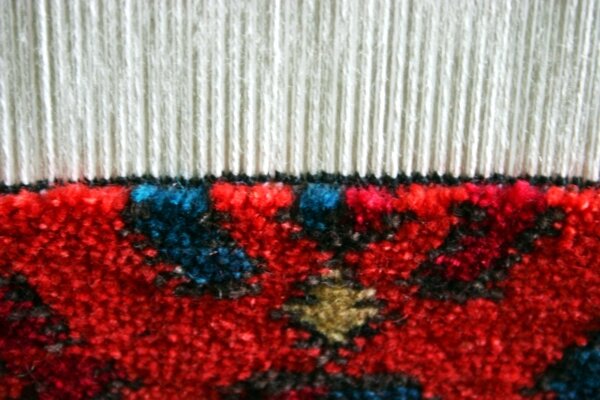
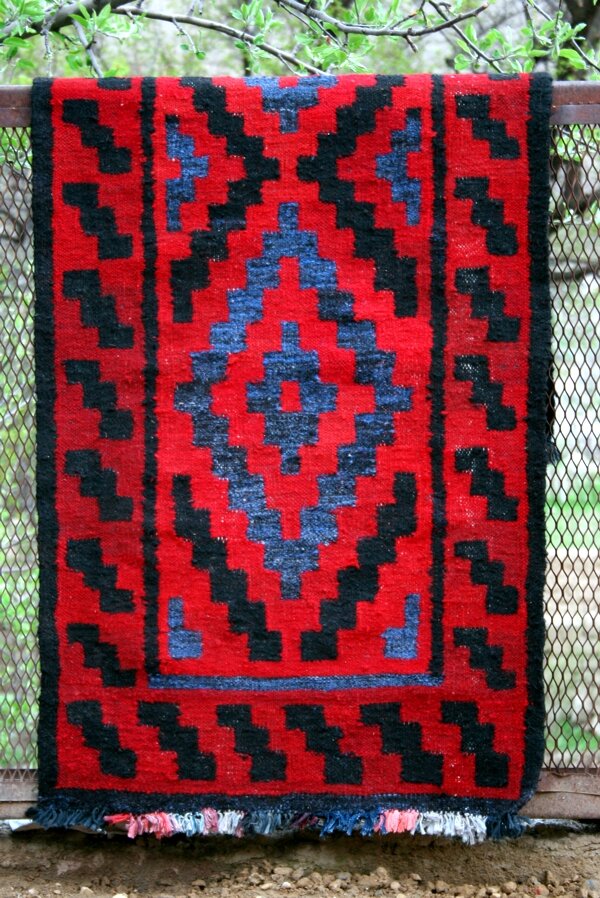
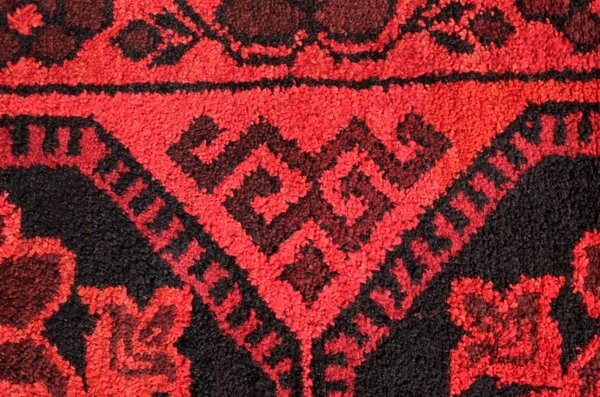
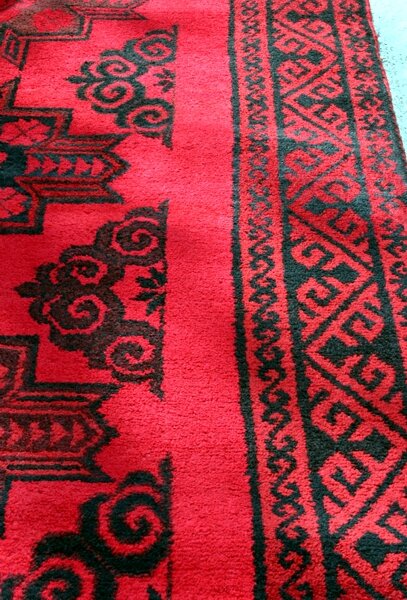
Pile carpets are mainly produced in the south of Kyrgyzstan in the Leilak region of Batken oblast – which lies in the extreme south westerly corner of the country. They are usually quite recognizable, with their deep Red and Black colours.
It is known that the Kyrgyz were making pile carpets in the Middle Ages – although only small rugs seem to have been the main object of manufacture. Early Russian travelers considered Kyrgyz pile carpets to be of exceptional high quality. Having said this, however, the craft was not highly developed until towards the end of the 19th century. Production was mainly for use in the family and it was only later that carpets were sold in markets (and even exported).
Small examples would be used for making bags, saddle cloths and other items. Larger carpets, called kilem, measure about 150 cm by 300 cm and are usually edged with a long fringe of plaited threads. They were used to cover the load on a camel when moving from jailoo to jailoo, or placed over felt carpets (ala kiyiz and shyrdaks) inside the yurt. Most of these carpets are made from wool – but cotton was also sometimes used. Camel hair (wool) was often preferred because of its strength and durability.
Making pile carpets is a team effort involving several women, (according to one source six women were typically needed), working together.





 Bishkek