Bruegel

Peasant Wedding
Today, January 13th, as well as being Stariy Noviy God, (“Old New Year”), marks the anniversary of the death in 1625, of Jan Brueghel the Elder. He was one of a whole dynasty of artists called Brueghel, (including Peter the Younger, Jan the Elder and Jan the Younger), and he was the son of Peter Bruegel the elder.
If someone simply refers to Bruegel, however, it’s almost certainly Peter the Elder that they mean. He dropped the ‘h’ and simply signed his works Bruegel.
It’s not often these days that I come face to face with the rendition of a Bruegel painting, but some time ago, a friend of mine who happens to run a restaurant, brought me his wine list to show me. For the front cover he had chosen a detail from a Bruegel painting, the Peasant Wedding feast which hangs in the Kusthistorisches Museum in Vienna.
He was really proud of it. They had recently started to stock French wines and so he had had the wine list drawn up anew and as well as including the latest additions, they had completely redesigned it.
He made the mistake of asking me what I thought about his masterpiece … and maybe I was being a little unkind, or at least mischievous, as I hesitated before saying, “It’s fine … very nice, in fact, except …”. “Except what?”, he asked perturbed. “Well,…”, I said, “you do know, don’t you, that Bruegel wasn’t French – He was Flemish … that is, Belgian.”
He started to look a little crestfallen and I could see that he really liked this painting, (and I don’t blame him because I quite like it, too), but he was coming round to the opinion that it wasn’t that much of a problem because most people wouldn’t know the difference – unless, of course, they were either French or Belgian.
It was then that I dropped the second bombshell and pointed out that of all the paintings he could have chosen, this was, perhaps, not quite the most appropriate for a wine list … as the “waiters” are not serving wine but delivering plates of food. “Yes, but we serve food as well, (it is a restaurant after all), and the picture does show a banquet in progress.” “True, but why did you have to use the one picture with Bruegel’s most famous ‘mistake’ in it?”
“Mistake?!”

Three feet
“Yes, look, the waiter at the front has three feet.” Bruegel was famous for the detail of his work, so how could he make such a complete “Fail!”? If the picture had been generated today, then it could easily have qualified for one of those “Ooops, Photoshop Bloopers” competitions. The two most famous examples of his paintings with exquisite detail are probably Children’s Games and The Harvesters. These two are often used to illustrate the finer detail of his canvases. You can stand back and take in the overall scene and even marvel faces and so on, but if you can get up close and look at the minute detail, then you see exactly how much care and attention he paid to every square centimeter of the picture.
I once saw, for example, a TEDTalk, by Amit Sood, about “building a museum of museums on the web”. He used the Harvesters to show how a new on-line resource, (Google Art), gives surfers access to images with 10 billion pixels. “What do you get for 10 billion pixels?”, he asked and then zoomed around the picture giving some examples … and then as a supreme salesman he makes his pitch and says: “The Best is yet to come”.
My friend looked distraught. “I never noticed”, he said. Oddly enough, most people don’t … until it is pointed out to them, that is.
He reached for his phone and said he was going to try and reach to printers to see if he could stop the printing, but I persuaded him not to bother … it was a good painting, and most people wouldn’t know about him being Flemish or wouldn’t spot the additional foot.

The Icarus Landscape
Anyway, that got us talking about how I knew so much about Peter Bruegel the Elder. I admitted that he is one of my heroes. The first time I came across him was in Primary school … when we were shown his picture, Landscape with the fall of Icarus. We were doing some project about the history of flight and I remember searching the sky in the picture asking the teacher, “But, where’s Icarus?), only for her to point – not at the sky, but at the pair of legs splashing in the water.
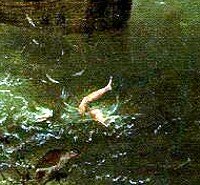
Detail
Indeed, my main interest in this particular picture was Icarus. You see, as my initials are IC, that has meant that over the years many people have given me nicknames like Ai-See, Ik, Icky, Ichabod, (a character in a popular Children’s TV serial), or even Icarus.
It was also whilst at school that I met his painting of the Tower of Babel, an iconic image which is remarkably close to the zigguratof ancient Mesopotamia which modern scholars think well have been the origin of this little known Bible story.
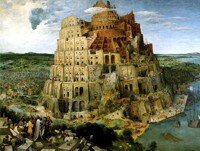
Tower of Babel
My next encounter with him was as a student in Oxford. A friend of mine got a job managing a shop selling posters and gave me part-time job as a sales assistant. They carried a lot of pictures by Bruegel and he sold me a few of them, which had been damaged in transit, cheap to decorate my room … I suppose it was a form of marketing, as it would be a form of showcase and I would be sure to tell all my fellow student where I had got them.
The highlight, however, came later on when I went to Vienna and visited the Kusthistorisches Museum, where something like a third of the surviving forty odd paintings are kept. By this time I had taken an Open University Associate Student Self Study Course called “Looking at Paintings” which meant that I was able to look at the pictures with a fresh eye and appreciate them much more clearly for their brilliance of execution.





 Bishkek