Air Crash Investigation
One of the popular shows on the National Geographic TV Channel is Air Crash Investigation. Personally, I loved it … and hated it.
There was, I felt, something masochistic about it. Although the account of the twists and turns of the investigation was always interesting, there seemed to be something unsavoury about watching a disaster, (quite often one that involved loss of life), for “entertainment”. It made me wonder how people felt about boarding an airplane after having a few episodes.
Yet, they say that air travel is, statistically, still the safest form of travel.
On the other hand, the travel advice issued by the British Foreign and Commonwealth Office for Kyrgyzstan states:
Safety and Security - Local Travel - Air Travel All Kyrgyz airlines are currently banned from operating services to the EU because they do not meet international safety standards. You should avoid travelling with any Kyrgyz airline. If you have a flight booked with a Kyrgyz airline and it is part of a journey which commenced in the EU you should consult your travel agent. In August 2008 a Boeing 737 belonging to ITEK Air crashed in Kyrgyzstan shortly after take-off killing 68 passengers and crew.
(Oddly enough, they haven’t yet updated the advice to include last week’s incident where a plane skidded on the runway on landing and flipped over. Maybe that’s because no-one was killed, or maybe it is due to the extended holiday period.)
In fact, when it says “You should avoid travelling with any Kyrgyz airline” it is a lot stronger than these statements usually are. It’s not exactly an instruction as such, but is pretty close; about as close as the diplomatic language used in such statements can get. It’s a lot stronger, for example, than the standard formula used in the opening summary: “we … advise against all but essential travel to …“. So why did the British diplomats decide to abandon the usual, carefully gauged comments, designed to convey information about relevant concerns but remain at the level of “advice”, leaving the final decision of what action to take in the hands of the traveller?
After all, the American State Department are a little more cautious, saying simply:
As there is no direct commercial air service to the United States by carriers registered in the Kyrgyz Republic, the U.S. Federal Aviation Administration (FAA) has not assessed the government of the Kyrgyz Republic’s Civil Aviation Authority for compliance with International Civil Aviation Organization (ICAO) aviation safety standards.
Surely, if the ultra cautious State Department felt that there was an issue they would say a lot more.
Well, the ban on Kyrgyz Airlines in European airspace says a lot – although as a Ministry spokesman here put it, “it is easy to be blacklisted, but very difficult to be get off the blacklist”.
That accident in 2008 was also a pretty telling event. The fleet of aircraft registered in Kyrgyzstan numbers about 70 planes, but according to some reports, only 26 of them are actually airworthy. Some aircraft that were made in the 1970′s have now been banned from flying in Kyrgyz airspace.
Since the first recorded airplane accident on 17 September,1908, in which the pilot Orville Wright was injured and his passenger was killed, there have been thousands of incidents, many of which have resulted in fatalities. In the first decAde of this century, (2001-2010 – sorry, but I am being pedantic; 2000 was the last year of the twentieth century), there were apparently 1662 air accidents which resulted in 14380 fatalities.
Even so, air travel is still often said to be the safest form of travel. So what is the record of Kyrgystan’s airlines in regard to such accidents?
An interesting blog post during the week which listed what the author claimed to be the record of air accidents or incidents in the country since 2000, together with photos and videoclips. It’s in Russian, so I thought it would be an idea to post the information in English.
To be honest, I am not sure why he started his list in 2000 … after independence in 1991 the country inherited the local branch of the Soviet airline, Aeroflot, and created Kyrgyzstan Airlines. One could reasonably assume therefore that it started with a “clean sheet” and start the collection of statistics from that point. I think that there were some accidents in the 1990′s involving helicopters, but they don’t appear in this list:
- March 15, 2000: In the At-Bashy district of the Naryn oblast. An Mi-8 helicopter crashed on a rock. The helicopter had picked up a group of people and during the flight, in bad weather conditions, the helicopter’s tail touched the rock. As a result, 3 people were killed, (including a deputy in the Jogorku Kenesh), and four more were wounded . The helicopter was burned out.
- October 23, 2002: At Manas airport just outside Bishkek, a cargo plane crashed during landing after a flight from Moscow, overshot the runway and collided with a fence, before catching fire. There were 8 crew members on board and all of them survived, although two of them were wounded. The plane was completely burned out.
- December 17, 2002 : Also at Manas airport, a Norwegian fighter plane crashed crash landed. After a hard landing, which made him fall off the rear chassis, and was dragged several meters on its belly. The pilot was not injured.
- January 4, 2004: Again at Manas, a Dutch fighter also crashed on landing. The hydraulics on the landing gear failed, after which the plane rolled off the runway and stuck its nose into the ground. The pilot was not injured.
- March 15, 2004: In the At-Bashy district, a helicopter crashed during the evacuation of a group of hunters. who found themselves in a snowdrift. Loaded aboard were about 20 people, including three U.S. citizens and a Canadian. It took to the air but could not sustain the flight, falling to the ground, killing two people. The helicopter was burned out.
-
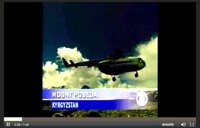
A screenshot of the video
August 6, 2005: At the climbing base camp at “South Enilchek”, in the Issyk-Kul region, a helicopter crashed on take off. It had arrived at camp, at the foot of the peaks Pobeda and Khan Tengri, to pick up a group of climbers. On take-off, it could not gather the necessary height and crashed. There were no fatalities, but the seventeen tourists and four crew members on board had to be evacuated. The helicopter was burned out completely. The whole thing was caught on video and you still see it on the internet.
- September 26, 2006: At Manas airport once again, a passenger plane operated by Kyrgyzstan Airline on a flight to Moscow, collided with an airforce Tanker plane. The plane had been given clearance to take off, but the right wing clipped the tanker and although damaged was able to complete the take off, circle and make an emergency landing. The 52 passengers on the civilian flight and the crew members of both planes survived. The Kyrgyz aircraft was sent for repair, but I am not sure what happened to the Tanker plane. There is a clip of it on fire on youtube and it looks as if it was destroyed.
- June 23, 2007 : In Kara Kuzhur tract in the Naryn oblast, a Yak-40 airplane, (which used to be used for the President on official flights), made an emergency landing on the ground. Ironically, on this flight it was carrying a group of leaders of the country’s airlines, (including the then head of Manas airport and the Director of Aviation Emergency in Kyrgyzstan), when, during the flight, two engines failed and the pilots decided to make an emergency landing on the runway in the tract Kara Kuzhur, which was used collective farm. However, the landing gear did not drop, and the plane “dropped down” and burst into flames. Everyone on board, 9 passengers and 5 crew members, survived, but the plane was completely burned out.
- August 24, 2008 : At Jany-Jer, near Manas airport a Boeing 737-200 operated by the Kyrgy airline “Itek Air” on a flight from Bishkek to Tehran crashed while trying to make an emergency landing shortly after take-off. The plane was burned out burned killing 65 people; 25 survived.
- December 28, 2011 : At the airport in Osh, a passenger plane crashed during landing in conditions of poor visibility. After a hard landing, (according to preliminary data), the right wing of the plane broke with its landing gear. The plane slid along the runway and rolled over. After that, the plane began to burn. Everyone on board survived, (82 passengers : 69 adults, 4 children and 9 infants – and 6 crew members), although 26 people were given medical treatment after the crash. The plane was burned and cannot be restored.
If that wasn’t bad enough, a report in September 2009 sad that in the first eight months of that year, there had been some 15 air traffic incidents and one accident. The report explained the difference as such: an incident does not involve casualties or injuries, for example a violation of airspace or equipment malfunction, whereas and accident involves the destruction of the aircraft or loss of life.
In 2008, by contrast, there were 12 incidents, and two accidents – including the crash of the Boeing referred to above.
I could, but I won’t go through all of those reported incidents. I will say, however, that, as usual with statistics, these two lists raise more questions than they answer. Not only are there discrepancies between them, I wonder what the situation is when it comes to other airlines and other countries: British Airways, for example. It seems to me that there has been an awful lot of incidents and accidents, however, you want to define them, and I wonder how we can make a comparison.
I don’t think these figures, bad as they are, would deter me from flying down to Osh or Batken. But maybe I am just being blasé, after all I have been through a fire on board ship; faced, (and outrun a hurricane); been on a plane which aborted a take off because a light failed to come on, (but then as we turned around it started working again so the pilot decided to continue the journey anyway); not to mention several riots in the UK and two revolutions here.
This latest incident is currently under investigation, and the local authorities are receiving help from specialists from Russia. Let’s hope that the investigation will be as thorough as those on the TV programme.
At least the incident had two good outcomes. First, everyone survived, although, let’s face it, being involved in such an incident must have been harrowing. Secondly, as Prime Minister Babanov put it, “this case should be a wake-up call , and we have to seriously reconsider the system to ensure passenger safety,” and he has ordered to conduct a comprehensive review of all airports, aircraft and crews in Kyrgyzstan.




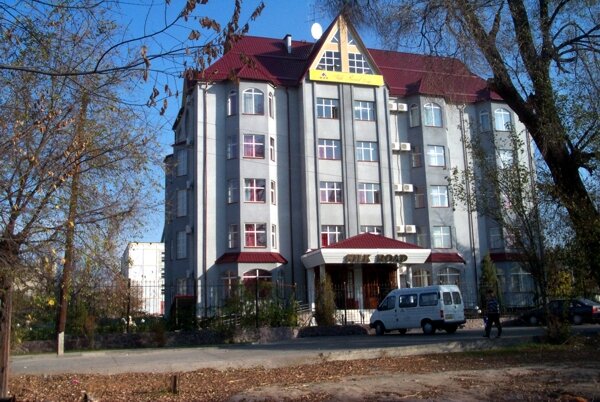



 Bishkek
Saturday, I came across two more articles about air safety.
As usual, the statistics are confusing. One, (which carried the headline: “Aviation experts: 2011 was safest year since World War II”), says “Just 498 people died worldwide in civil aviation accidents during 2011″.
The other, (citing a report from the International Civil Aviation Organization, or ICAO, called “2011 State of Global Aviation Safety” – which was apparently issued in December 2011?!), reports ” that global commercial air transport experienced a total of 121 accidents of which 19 were fatal, involving 707 fatalities.”
So I went and had a look at the website of the Geneva based Aircraft Crashes Record Office, or ACRO, (http://www.baaa-acro.com/), and see that they say that there aer 113 accidents and 824 deaths.
You can find the two articles at:
http://www.monstersandcritics.com/science/news/article_1684267.php/Aviation-experts-2011-was-safest-year-since-World-War-II
and
http://www.travel-impact-newswire.com/2012/01/public-safety-aviation-remains-well-ahead-of-road-transport/
You might also want to look at the ACRO statistics which you can find on their site and figures for the last 10 ten years are quoted on Wikipedia at: http://en.wikipedia.org/wiki/Aviation_accidents_and_incidents