Wildlife of Kyrgyzstan
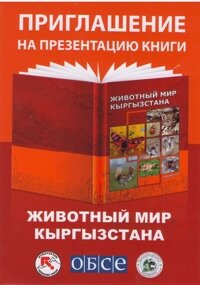
An invitation
I was invited to a presentation during the week. It was for a new book, “Wildlife of Kyrgyzstan“, which has just been published by the Trekking Union of Kyrgyzstan with financial support from OSCE.
It was to take place in a school, which was quite appropriate as it was supposed to be a textbook or reference book for use in schools and colleges. Anyway, the school is not far from my office so as the hour for the event drew close, I wrapped up warm and trotted off. It was pretty cold out and I walked briskly.
The school looked like a school, albeit somewhat smaller than I am used to from my time as a teacher back in Britain, and I felt “at home” in the familiar surroundings almost as soon as I walked in through the gates. The security guards sitting in their little hut at the gate seemed to have no idea of the event was happening and pointed me off in the general direction of the main building.
Once there I managed to find the room where the presentation was being held. The poster on the door helped and once inside the building I just followed the sound of voices and sure enough I came to the classroom which had been set aside for the event.
It was a nice, bright, clean room, that looked as if it had been recently decorated. Just inside the door there was a large rubber tree and I was really impressed by that, until I noticed that it was plastic – not rubber. Still, it looked good and helped make for a pleasant atmosphere. Although it was a large room, it felt quite cramped because there were ten rows of seats, each with eight chairs, which meant that it was either it was used as an auditorium or else they have very big classes in that school!
For the record: Back in the far distant past, in the days when I was at school, I spent one year in a class of forty, but that was very much an exception. When my turn came as a classroom teacher, the largest class I ever had to teach had fifty four pupils, but that was only for a few weeks, whilst someone was away, and for most of my career I rarely faced a class of more than thirty.
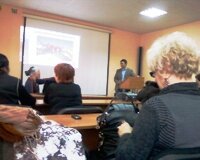
The presentation
I looked around and did a quick count of heads. I am not sure how many people had been invited, but the room was only about half full, and the men in the room were outnumbered by the women by six to one. Even though there were so few of us, it felt tight as we adults squeezed into seats normally occupied by those much younger and smaller than ourselves.
The bell rang, bringing back memories of days gone by and giving the signal for the start of the event. Speeches began and the speakers explained how the project had come into being, competing all the time with the sound of running feet in what was apparently a very active class in the room above.
The book had been compiled by experts from the Academy of sciences. It was, in fact the second edition. The Trekking Union had already published a first edition with text and illustrations of 120 different species of wildlife that are found in Kyrgyzstan, and it had proved to be so successful that had sought sponsorship for an enlarged second edition.
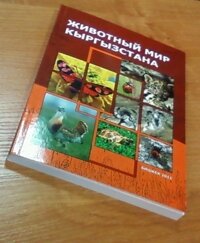
The book
A grant from the OSCE had come to their aid and made the current edition possible and there were 240 species listed, each with a full page spread, with a colour photograph, the names of the animal in Russian Kyrgyz and Latin and a description, (only in Russian, unfortunately), giving details of the appearance, habitat, life cycle, location in Kyrgyzstan and background information about their appearance in legends where appropriate. The glossy paper looked to me like “overkill, but gave the colour photographs a particular vibrancy which would probably have been lacking if other paper had been used.
There are plans for further editions, for example in English and Kyrgyz. English for tourists, (we often get asked for such books – especially by ornithologists), and Kyrgyz so that it can be used in schools in parts of the country where Russian is definitely a second language.
Another book is planned on the Plant life of Kyrgyzstan, and although much of the work is ready, they are still looking for sponsors.
It struck me as an excellent project and well worth doing … but I did have one complaint. The print run was only 2000 copies. That strikes me as very few, not enough for one per school, not for a class set for each of the schools in the capital. The book is already being distributed and several of the people present were cramming to find out how they could get copies for their schools. It is a start however, and the nice part about it is that they are being distributed to schools “free of charge” as part of the sponsorship deal from OSCE.
OSCE is, of course, a “political” organization, concerned with the security and international cooperation, so it is very good to see that they have been able to find funds to support a project like this from one of their budget headings – for environmental protection.
The principal of the school where we were meeting made a nice, short, speech pointing out that too many books were simply placed on a bookshelf and rarely opened whilst had nice covers but only “yellow pages” between them not worth reading, this volume was likely to be taken down and perused again and again and was a delight to hold. It was like a mini encyclopaedia.
I think she is right. Already, skimming through it, I found many fascinating facts. Maxim looked at it and, pointing at a picture of a Bear asked me, “We don’t have those in Kyrgyzstan, do we?” Yes, but they are very rare and usually found only in the highest mountain or very remote regions. He then pointed to one of the “cats” and asked, “and those?”. ”Yes,” I said. ”Where?” ”Somewhere in Issyk Kul,” although to be honest, I have never seen one and only knew because I had read about it only moments before. ”When can we go and see it?” he said. ”Unfortunately, it’s not that simple … most of these animals are “wildlife” which means they tend to shun humans and are difficult to find.”
However, it was good to see that the book has already served part of its purpose in raising awareness amongst st least some of the young people in the country.
Congratulations go to The Trekking Union of Kyrgyzstan, OSCE and the Academy of Sciences for implementing this project – I hope it is just the first of many and that we will soon see a second printing of this second edition … with a larger, (much larger), print run, as well translations … and, of course, the book about the Plants of Kyrgyzstan.




 Bishkek