The symbolism of statues
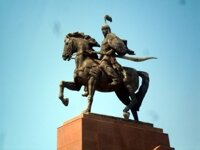
The new statue of Manas
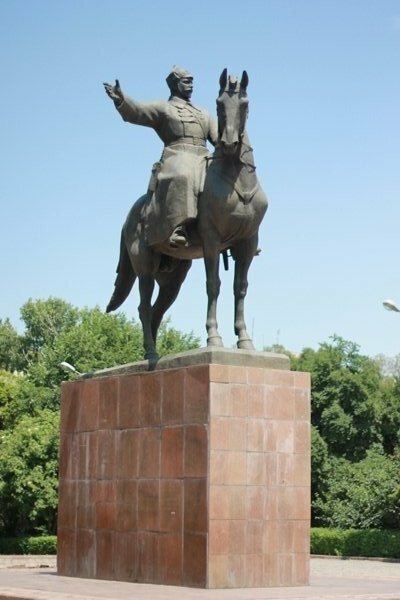
So, Bishkek now has two new statues to grace the main square: to the south of the square is on of Chinghis Aimatov, the famous twentieth century Kyrgyz author and diplomat, whist facing him on the northern side of the square, in front of the Historical Museum, is a new rendition of the legendary hero of the Kyrgyz national epic, Manas.
Aitmatov’s statue probably raises few eyebrows given the fact that Aitmatov is held in high regard and that the only statue to him in the country was up in Issyk Kul. The decision to erect a new statue to Manas, however, did come as a surprise … especially as there is a statue dedicated to him just a few blocks away, outside the Philharmonia at the intersection of Prospects Chui and Manas.
So, why create a new statue when already exists? The answer, so I am told, lies in some small, (one might say, hidden) significance details.
It’s easy to jump to conclusions and take things at face value, without considering the hidden symbolism that lies behind the effigy. Take the Michelangelo’s statue of David, for example. I chose that example simply because today (September 8th marks the anniversary of its unveiling in Florence in 1504).
.
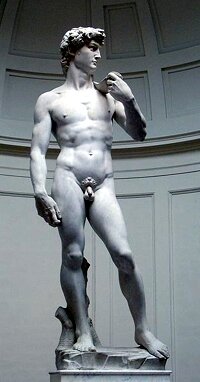
Michelangelo's David
Plans for a statue of David were actually older than Michaelangelo himself. Work on it had actually been started by other sculptors since 1463, but was abandoned and the huge block of marble stood idle and neglected in a store yard for something like twenbty five years before the twenty six year old artist received the commission to complete the work in 1501, and he was to spend two years of his life working on it.
Michaelangelo’s David is a classic masterpiece of monumental sculpture, recognized around the world and often copied. Some people seem to use it as a pictorial synonym for “culture”. It hasn’t always been that way though. The statue was originally commissioned as one of a series of statues of Old Testament prophets for the roof of Florence cathedral, but was placed instead in a square outside the seat of civil government.
It may have been due to the fact that David appears naked, that it was thought unsuitable for the church, or simply a matter of logistics – the sheer size of the figure which stands at over 5 meters tall, (that’s 17 feet).
The statue soon came to symbolize the spirit of little Florence, an independent city state which was surrounded by larger more powerful states. David is not portrayed, as was common at the time, after having dispatched his gigantic opponent, Goliath, but in the state of preparing for battle. Although his body appears to be a relaxed pose, carrying his sling casually over his left shoulder, the veins of his right hand bulge, his the tendons in his neck standing out, his brow is furrowed and his eyes cast a warning glare at his opponent instead.
In some ways it seems to me that this image of David might be appropriate for Kyrgyzstan as well, but the statue would not be welcome here, portraying him, as it does, in the nude.
The nudity has, in fact, caused some adverse comment over the years. It was apparently, the subject of much adverse comment at the time it was unveiled even though it was in keeping with the traditions of Renaissance art and the classic Greek tradition of the standing nude hero. (A fact which is often used to explain, or excuse, the fact that the hero is uncircumcised, contrary to Jewish practice, both then and now). Incidentally, the copy of the statue in the British Museum had a fig leaf fashioned that could be attached to hide the figures masculine appendage in order to save the sensitivities of Queen Victoria when she visited.
.
Oddly enough, there are several copies of the statue in Florence. The original was removed from its place in the square in order to protect it from damage and was placed in the cities Academia gallery. There is another one in the foothills overlooking the city. In 2010, a fiberglass replica was installed on the roof of the cathedral, (albeit for just one day), so that it possible to see how the cathedral skyline might have looked if it had erected as original planned.
So, the idea of having two sculptural interpretations of one subject in a single city is not unknown. Indeed, in Bishkek there is both a statue to, and also a bust of General Ivan Panfilov. Also, of course, in Soviet times there were effigies of Vladimir Illych Lenin practically everywhere.
Even so, the idea of having two statues of Manas has still caused considerable debate.
One reason may well be that, (unlike the case of David, which had been in the works, off and on, for something like forty years), the decision seemed to be quite sudden and to have come out of the blue. The discussion and decision seemed to have been taken by the government behind closed doors without any formal announcement or competition before Bazarbai Sadykov received the commission to start work.
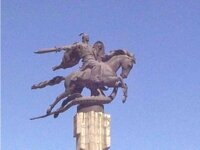
The Original Manas Statue
More to the point, however, the existing statue of Manas by the well known Kyrgyz monumental sculptor, Sadykov, does have its critics. He is riding his horse with his sword drawn as if going into battle with the snake that winds itself around the hero and his horse, Ak-Kula. Some people that I have spoke to, however, have suggested that it might be better if he held a kamchi, (a horsewhip), as it is a symbol of power, rather than a sword which is a weapon.
Sadykov partrays Manas, instead of holding his sword high in front of him, ready for battle, ready to strike a blow, holding it so that it hangs down behind him. This is seen as a bad sign as there is much implied by the way that objects are held, for example, the way that the kamchi is held. When someone is approaching with news then, if the kamchi is held pointing downwards towards the ground, then is a sign that the person approaching brings bad news, whereas one that holds it upwards is bringing good news.
Now although Manas was definitely a warrior, (one of the favourite excerpt from the epic which is recited by manaschi for almost any occasion describes a battle between the Kyrgyz and their Chinese enemies, whom Manas has united the forty tribes to face), the emphasis these days is placed more on his being a peacemaker, and uniting the rival factions.
As a result, many Kyrgyz feel that he should not have been depicted going into battle, but in a more peaceful role, approaching with his hand held high or his arm outstretched in greeting, He may well be armed that he can, if necessary draw his sword to defend the people, but the sword should clearly be in its scabbard.
(It’s a bit like the police patrolman who is equipped with a pistol but not expected to use it, except as a last resort, in order to protect life and limb, and who is told not to draw his weapon unless he is prepared to fire it.)



 Bishkek