Breathe-in experience, breathe-out poetry.
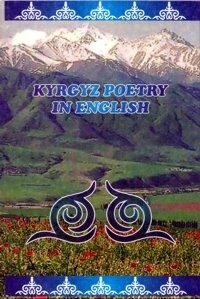
Mukan's Antholgy of Kyrgyz Poetry in English
Earlier this week, I had an interesting visitor drop into the office: Mukan Asanaliev. He is a businessman that I have known for several years, but this time he wasn’t coming to tell me about his yurts by Son Kul Lake, his café in Boom Gorge or any of his other business projects. He had brought me a book.
As an English speaker, he also works sometimes as an interpreter. The book he brought me was one that he had written and had published privately last year (albeit with some sponsorship from the State Patent Service): “Kyrgyz Poetry in English”.
Murkan is himself a poet and he has collected together over 15o poems from more than 80 different Kyrgyz poets, (both male and female), which he has translated in English. The Kyrgyz and English versions are printed side by side. Obviously for some of the poets there is only one single representative piece, although some have four or five examples in the anthology.
This isn’t his first venture into such an enterprise, before this book he published a collection of verse by famous English poets such as Byron, Shelley and Coleridge which he had translated into Kyrgyz.
Like many of the books published here, the opening pages included some salutatory comments, (Retzenzia in Russian, reviews rather like an Imprimatur – a declaration authorizing the publication of a book, but also more loosely applied to any mark of approval or endorsement). This particular tome included two, one from the Honorary British Consul in Bishkek and the other from the Chair of the English Language Department of the Foreign Languages Institute.
Then we proceed to the poems themselves. Most are quite short, and in some cases they seem to be excerpts with “*****” indicated where he abridged the original.
They seem to have a number of notable themes, such as patriotic love for the Fatherland, (I keep trying to explain to people that we prefer to use the word Motherland in English, but never mind), and the landscape; expressions of emotion, such as love poems addressed to an individual and contemplations on the nature of mortality and impending death. One seems to be an actual epitaph.
They are all fairly modern verses, (many of the featured poets are still alive and writing), and not of the more traditional compositions of Akyns, for example, composed for an aitish competition, and none of the longer traditional epics.
I have said elsewhere that I consider translation to be a difficult skill, but when it comes to poetry it doubly, if not triply … or even more difficult. It is one thing to translate a text word for word, and another to convey the meaning properly and effectively. Often there are idioms or ways of expressing oneself in one language which simply cannot be translated word for word … the resulting words and phrases can not only be misleading, in some cases they can be unintelligible. When it come to poetry, there is far more involved that helps to convey the meaning that the poet wants to pass on to their audience: the meter, the rhythm, the rhyme, … the emotion …
Indeed, Mukan told me that the book represented two years of hard slog, burning the midnight oil as he searched for the right combination of words to best convey the meaning and emotion behind each verse – but I got the feeling that it was a labour of love.
To be honest, I am not a great one for poetry – even in English. When I was at school, we weren’t really taught to learn verses by heart like the children are here. Here, almost anyone can burst into quoting the great Russian poets like Pushkin at the drop of a hat … albeit short quotations, just a line or two, but sometimes into quite extensive excerpts.
What’s more poetry has quite a long tradition amongst the Kyrgyz, as the akyn, travelling from jailoo to jailoo would both entertain their nomadic hosts and also provide a means of passing news, messages and gossip, much of which would be incorporated in song and poetry.
So, poetry has long been a notable element of the literary tradition and was highly prized during the Soviet period. A number of early collections of Kyrgyz poetry were published as early as in the 1920’s. Of course, under the Soviets, many of these had a political character – such as the collection of Tokombaev’s poems, “About Lenin”, published in 1927. Tokombaev also went on to write “Bloody Years” – a “novel in verse”.
I asked Murkan if I could present a few poems here in a postcard and he graciously agreed. This is a random sample and not in any way meant to be representative of the book as a whole, but I hope will give, at least, an impression of the range of works in the book:
.
I don’t Understand – by Baidylda Sarnogoev, (b. 1932)
Whenever we meet your speech is smooth,
and to please me, yes you try your best.
If you were mercury you would be playful,
dancing in my palm, heeding not the rest.
Who knows who you are – a friend or an enemy,
I don’t understand your mysterious smile.
I would thump your head to test your ripeness,
if you were a watermelon for a little while.
Though life’s load be heavy … – by Esenbek Abdrasulov (b. 1397)
Though life’s load be heavy
as a mountain to bear,
and the journey I take
filled with mortal despair,
my path will not sway
for the flight is at hand!
Pressing on all the day
for the beloved Fatherland.
To You – by Tologon Mameev (b. 1938)
I don’t know how it can be like this …
I yearn for you all the more to hold
close to my bosom, and to kiss
your eyes, even though I am old.
What’s the reason today for my love so clear?
Of course it is due to the fullness of time.
For now we’ve completed our fortieth year
of being together in love sublime.
Don’t be late – by Tynchtykbek Nurmanbetov (b. 1953)
Don’t be late my love, don’t be late,
moments without you are a dark miserable fate.
I feel as if time has stopped forever,
waiting is a thing that I unbearably hate
Come quickly and open the door,
come in smiling as you did before.
I wait, long suffering in the same old place,
don’t be late, and don’t make me implore.
I’m living only for you – by Aidarova Jusubaly (b. 1955)
I looked for you, where we used to be,
and asked the people who knew you and me.
You asked me to renounce you my dear,
but I cannot live without you and be free.
You know that my love for you is so deep,
I am trying my feelings untouched to keep.
Love is something that torments pitilessly,
thinking of you I cannot rest and sleep.
Don’t laugh at me and don’t make me sad,
that’s the deed of the one who is ill-bred.
You may not love, but show respect to whom,
who loves you and is suffering bad.
The Mountain and I – by Baias Tural (b. 1956)
I was born in the mountains.
As the mountains I am honoured
serious and elevated!
They say that the mountains
are but sand and some clay.
But the summits, for me,
are of honour and stature.
These peaks filled with beauties,
and grace and delight.
Vales of enchanting Juniper smell,
hills full of wonder,
where mysteries dwell.
Thought I wander afar, my heart
pounds for my home.
In my dream, in my verse,
are the echoes of the mountains.
And my thoughts only whirring
say and night round the peaks!
.
For the record: the title of this postcard is from Muriel Rukeyser - an American poet and political activist, best known for her poems about equality, feminism, social justice … and Judaism.




 Bishkek