Buddhism in Kyrgyzstan
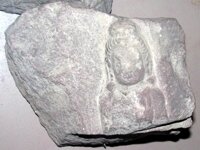
A stone carving of the Buddha in the Historical Museum in Bishkek
During the week, I noticed an article on the AkiPress news service announcing that a large statue of the Buddha had been found outside Bishkek during archaeological excavations. Interestingly, it was quoting a report from a Russian news agency, RIA Novosti.
The joint Kyrgyz-Russian archaeological expedition has been working since 2007 in the area of the village of the Krasnaya Rechka settlement, in the eastern part of the Chui Valley, just 30 km away of Bishkek. I’ve already written a postcard about the ancient Silk Road city of Nevkat, situated near Krasnaya Rechka, the walls of which were as long as those around Rome and which has revealed Buiddist, Nestorian and Manichean temples.
The report quoted Asan Torgoev, (a researcher at the State Hermitage Museum and head of the Russian side of the expedition), as saying: “this year, a unique discovery was made on one of the hills hiding the remnants of the Buddhist temple of the 8-10th centuries in the Medieval complex – the clay Buddha statue almost 2 human heights tall in (the) Lotus position. It was colored,”
The statue was in the altar niche of the temple with smaller statues of bodhisattva in upright position on both sides. Unfortunately, they are not complete. Only one third of the torso of the Buddha statue and smaller parts of the bohisattvas have survived.
Restorers are currently cleaning the statue and expedition members are preparing the excavated part of the temple for conservation. There are plans for the archaeologists to extract the remnants of the sculpture composition, assemble and restore it. This will all take some time as it is not a simple task, but eventually the finds will become exhibits in one of the Museums in Kyrgyzstan.
For the record:
Buddhism is a system of beliefs and practices based on the life and teachings of an Indian Prince, Siddhartha Gautama, (more commonly known as “The Buddha” – “the Awakened One”), who lived in the north-eastern region of the Indian subcontinent and probably died sometime around 400 BC. Accounts of his life are found in various Buddhist scriptures – such as the Tipitaka and the Lalitavistara Sutra. There are discrepancies between the different versions and so historians are not sure about the accuracy or detailed facts of his life, but it is generally accepted that he lived, taught and founded a monastic order.
After his death, Buddhism spread slowly through his native India, until adopted by the ruler Ashoka – who sent missionaries throughout his own realm and also abroad to places like China, Malaysia and even to the Hellenistic kingdoms in the West.
The Buddhist monks Fa-hsien and Hsuan Tsang travelled through Central Asia in search of sacred texts to take back with them to China. Hsuan Tsang on his way to Tashkent, Samarkand and Bactria before turning South to India crossed over the Bedel Pass from Ak Suu in present day China, skirting Lake Issyk Kul before visiting Tokmok and then through the Talas valley. The crossing over the Bedel Pass was a traumatic experience … heavy snows had delayed his departure from Ak Suu, a portent of worse to come, in a 40 mile stretch, (about 65km), he lost a third of his companions and animals.
Archaeologists have discovered the remains of a Buddhist temple at Ak Beshim, near Tokmok. The ancient town of Ak Beshim, near to Tokmak, was referred to by the Buddhist monk, Tripitaka (602-644), in his account of his travels.
Bishkek, used to be known as Jul during the 6th to 12th centuries and archeologists have discovered the remains of Buddhist temples in the surrounding environs.
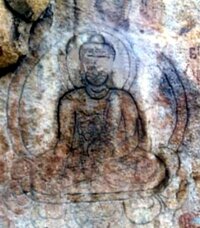
The waters of Issyk Ata have attracted visitors for many centuries for their medicinal values – and this used to be a place of pilgrimage and in the nineteenth century villagers expressed their gratitude for the healing properties of the water by smearing onto a large rock which has an inscription on the Buddha on it which dates from the tenth century, (although there is some controversy about this). The Tibetan inscription is on the face of a boulder with an eagle sculpture on top. Unfortunately, contemporary, modern, graffiti now joins it.
To the North of Kyzyl Suu, in the Issyk Kul region is to the North is the site of a medieval settlement of Torktol, and to the West in the village of Saru there are some ancient barrows (burial mounds). In the hills above the village there is a Tibetan Buddhist inscription on a stone.
Also in Issyk Kul, above the village of Tamga is Tamga Tash (= “letter stone”) – a stone inscribed with ancient Tibetan runes. The rock is high above the water – quite difficult to find – and nobody knows how or why the inscription (some of which has worn away) comes to be here. Apparently it is an ancient mantra – still chanted by Buddhist monks today.
During the Battle of Talas, which occurred in 751AD on the banks of the river Talas nearer the city of Taraz (Djambul) in Kazakhstan, a combined Arab, Kyrgyz and Tibetan force met and defeated the massed armies of the Chinese empire. The battle marked the greatest extent of the Chinese empire – and it was more than just a military defeat for the Chinese, because amongst the prisoners rounded up after the battle were many experts in the manufacture of paper and silk – two closely guarded secrets by the Chinese – and their secrets soon found their way Westward to Europe.
.
According to the US “International Religious Freedom Report”, there is one Buddhist temple serving the small Buddhist community in the country but, to be honest, I’ve never found it.
__________________
Update:
In the following week I came across a couple of news articles about the discovery of the statue and one, from New Tang Dynasty Television, included this video clip:
.




 Bishkek
Here’s a news article about the discovery, with a small photo:
http://www.3news.co.nz/Kyrgyz-archaeologists-unearth-Buddha-statue/tabid/1160/articleID/219180/Default.aspx