Mind Your Language
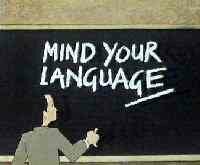
Many years ago there was a sitcom on British television called “Mind You Language”. It was set in a night school English as a Second Language class for foreign students. It ran for three seasons between 1977 and 1979, and was revived in 1986.
The class consisted of a variety of foreigners with varying degrees of proficiency in English: an Italian Chef, three Au Pairs – one French, another German and the third from Sweden, a Chinese secretary, the representative of a Japanese electronics company, an Indian housewife and another Indian working on the London Underground, A Greek who works in a shipping office, a Spanish barman, an unemployed Pakistani and a Hungarian student.
The humour of the show was based on situations in which the students show their misunderstanding of English words or terminology. It relied heavily on the cultural stereotype of their individual nation of origin.
It seems funny looking back on it, and I wonder if a proposal for such a series would receive a favourable hearing nowadays, in our climate of political correctness, given the potential for racist comments. Indeed the first run of the series was cancelled precisely because some people had complained that the programmme was racist. Despite that, it sold well in the international market, being bought and shown in places as diverse as Australia and New Zealand, but also India, Pakistan, Sri Lanka, Malaysia, Kenya, Nigeria, Ghana and Singapore, and when it was revived in 1986, it was mainly for the export market. It also served as the model for other series in the US, India, Pakistan and Nigeria.
The programme sprung into my mind last week when I was having dinner with some other ex-pats in a restaurant. Someone made a comment using a B* word to describe a woman who, so the speaker considered, had done something unwise. Although it was clearly meant to be a derogatory comment expressing the speaker’s point of view, which was far from complimentary, I don’t think he meant it in a demeaning way. I think that he was just using it in a “light hearted” manner to add some sort of emphasis to the view he was expressing. However, one of the party took great offence and asked, (quietly and calmly), that he not use that word in future, because she found it offence to refer to a woman as a if she were a “female dog”.
To be fair, he did apologise, withdrew the comment, (although it had been said and you can’t go back in time and undo things), and promised not to use the word again to describe a women in front of her, (presumably he may continue to do so when she isn’t present). That seemed to calm things down, but it also led to quite an interesting discussion about the words we use to describe people in everyday language and the connotations that they carry with them.
Obviously, for example, the N-word cannot be used to refer to black or people of African origin without causing offence and Prince Harry discovered that he shouldn’t be using P*** to describe people from the Indian Sub-continent. There are similar words referring to the Jews, Italians, Germans, white settlers and Native in Southern Africa, communists, homosexuals, and many other groups.
Sometimes, however, the people belonging to those groups take over the word and use it in a self-deprecating way, sometimes turning it into a badge of honour. There is a film, for example, where Danny De Vito plays a detective who is hauled over the coals for using the N-word. His captain, who was an African American, repeatedly used the word in the dressing down, saying that he could do so with impunity, but that the De Vito character couldn’t, and that he should never let it utter forth from his mouth.
In Russian there are several words that are used to refer to homosexuals: Homosexual – used for formal occasions, Goloboi – which was the colour of the cover of the first book published on the topic in the Russian Empire, and has been adopted and accepted as the equivalent of Gay; and Pedarast, or Pedic – which carries with it connotations of antipathy and can be associated with Queer, Fag or many of the other derogatory terms which have been employed over the years. Unlike many of those, however, some of the Gay community have, at least to a certain extent, taken over the words Queer and Fag and use them in a more positive sense, to identify themselves and emphasizing that they are both embracing and rejecting the negative implications contained in the word.
On the other hand, certain words that were once widely used and could be said to have been commonplace, have not been rehabilitated and are deemed unacceptable. When reading books or watching films set in Colonial Africa, we often come across the words Bw* and K*, for example, although we wouldn’t dream of using them in the context of today’s world. There is always a question as to how much Bowdlerization of literature should take place and if these words should be removed from modern editions or left as an example of the culture and morays of the times being depicted.
I was surprised to learn that the word Sq*, used in cowboy novels and Westerns to refer to female Native Americans, (“Red Indians”), may come from an Algonquian word to refer to a part of the female anatomy, and is hence considered offensive by many. The English equivalent would definitely be considered offensive, so I can well understand why many Native Americans take offence at this, seemingly innocuous word with which we (at least those of my generation) have all grown up.
Here, we have another little problem. In English there is a “space filler” that is widely employed in conversation as someone takes a moment to form their thoughts: “Um”. After I had been here a short while, I was taken to task by a young Kyrgyz woman who asked me not to use that word as in Kyrgyz, it was a rude word that referred to a part of the female anatomy.
I was somewhat taken aback, but like the gentleman over dinner, I apologized, and promised to try to avoid using it in future. I try not to do so, but it is not that easy. As I said, it is not a word, it is an exclamation or space filler. According to one source I have seen, such fillers make account for something like 20% of spoken English. Other examples of such fillers might uh, er, well and like.
I hope and trust that my efforts in trying to avoid the offensive filler are appreciated. After all, the Kyrgyz also employ many wordless sounds to express meanings, in particular, as they listen to somebody else they make sounds like “un hun”, “aah” or “mmm”. Other example include:
- … to indicate No, they may utter “uh uh” and shake their heads
- … “oy” is used like “oops” in English to indicate a mistake
- … “ahyee” or “oy voy yuy” is used to express surprise or amazement, equivalent to “really” or “wow” in English
- … “erah” is used to show disappointment,
- … “hunh” indicates pain,
- … “oof” suggests that they are tired, and
- … “erf” that something is terrible or disgusting.







 Bishkek