Who’s Who on the Som Banknotes
The National Currency is sometimes said to be “the face that the country presents to the world”. It is hardly surprising, therefore, that considerable thought goes into who and/or what is depicted on banknotes.
When the Euro was being designed, for example, it was felt important that the symbolism on the money (notes and coins) should be generic and represent the idea of a united Europe and so no person or actual place was depicted.
The British, on the other hand follow an ages old tradition of placing a portrait of the monarch on their money. This means, of course, a new series of notes and coins have to be minted every time a new monarch ascends the throne. Edward VIII ruled for only 10 months and coins, banknotes (and stamps) with his likeness are very rare and collectors items.
The United States has chosen to depict a number of former presidents on the Dollar banknotes (and Benjamin Franklin – one of the Founding Fathers of the republic who never actually became President) …
The Kyrgyz Republic has chosen to depict a number of historical characters on the Som banknotes. (The Tiyin notes are similar to the European in that they depict simply symbols). The choice of characters is mainly modern – marking the period from the end of the 19th century to the late 20th century. The chief exception to this is Jusup Balasugin, who appears on the 1000 som banknote
1 som
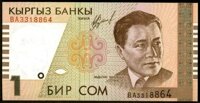
ABDILAS MALDIBAEV – Composer – (1906-1978)
Born in Kara Bulak, in the Chui oblast, Maldibaev was one of the first Kyrgyz composers and a singer (tenor).
He began composing music at the age of 16 and some of his early songs were popular in the Soviet era. He experimented with music forms which were not a part of the Kyrgyz traditions, (such as hymns, marches, opera and a symphony). In 1954 he became the director of one of the prestigious musical colleges in Frunze (now Bishkek). He wrote musical dramas and what was the first Kyrgyz opera – “Aichurek”, which is still occasionally performed in the Bishkek Theatre of Opera and Ballet. Other works include “Ajal orduna”, “Altyn-Kyz”, “Toktogul” and “Manas”. In total, he composed some 400 songs and arranged 200 traditional melodies.
5 som
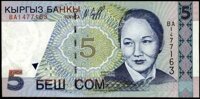
BUBUSARA – Ballerina – (1926-1973)
Bubusara – was a famous ballerina who in her later years trained several generations of dancers and was one of the founders of the Kyrgyz ballet school.
Born into a peasant family in the village of Tash-Tube (not far from Bishkek) on 17May, 1926, Bibisara Beishenalieva went to study in the Leningrad School of Choreography at the age of 10. She made her debut on the stage of the Bolshoi Theater in Moscow just three years later. Over the next thirty years she became an eminent ballerina performing in such classics as Swan Lake, Don Quixote, Romeo and Juliet as well as a number of Russian and Kyrgyz national ballets. Staring in the Lenin Film Studios version of a Kyrgyz ballet – Cholpon in 1958. She married the composer Akmat Amanbaev in 1944 and they had a son, Ermek, and later a granddaughter – Cholpon.
Elected as a member of the Supreme Soviet of the USSR and the Kyrgyz SSR – she was awarded the title “National Artist of the USSR” in 1958 as well as several other prestigious prizes and titles. Teaching in the Kurenkeev school of choreography – her talent, charm, kindness, understanding and sense of responsibility made her popular with adults and children alike.
Apparently she had a shy, reserved, character – fond of simple pastimes such as sewing, knitting, playing draughts and cooking traditional dishes such as beshbarmak, plov, lagman, borsok and chakchak. She also sang and played the piano.
She died six days before her 47th birthday in 1973.
10 som
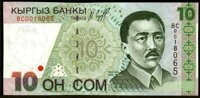
TYNYSTANOV KASYM – Linguist – (1901-1938)
Tynystanov was a linguistics scholar, cultural worker, professor and poet. Born in a village in the Issyk Kul region, he was taught to read and write by his father before attending a religious school. He later went to Tashkent to study and began to work on newspapers and writing for magazines.
He is probably best known for his work on the development of the Kyrgyz language, and, in particular, the Kyrgyz alphabet. At first this based on Arabic (as is Uighur – still to this day), then into Latin characters and finally in Cyrillic. His report, “The Main Principles of creating a new alphabet” was given at the first congress of Turkologists in Baku in 1926 – and became the main document in the formulation of the new written form of Kyrgyz. In 1933 he published a dictionary of linguistic terms and his “Spellings of Kyrgyz Literary Language” appeared in 1934. He wrote some of the first books to be published in the Kyrgyz language.
His career as a poet began with the composition “Ala Too” and the only collection of his poems was published in Moscow in 1925. He was also a scholar of , and expert on, the Manas epic.
Although a member of the communist party he never really held any high office within the party, however he was the first People’s Commissar of the National Committee for Education. He translated revolutionary songs (such as the “Internationale”) into Kyrgyz.
He fell into disfavour with the authorities, was “repressed” (executed) in 1937 and executed in 1938. It is not clear why – one story is that it was the result of having written one particular song, another that it was a result of his scholarly work on the Manas epic.
20 som
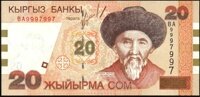
TOGOLOK MOLDO – Akyn – (1860-1942)
Togolok Moldo, (his real name was Bayymbet Abdyrakhmanov), was born in the Ak Talaa district in the Naryn region, into a musical family. After his father’s death, he was brought up by an uncle, who was a well-known Komuz player. He was given the name Togolok Moldo by his audiences – “togolok” means round-faced, “moldo” means an educated person.
He was a poet and one of the better known twentieth century manaschi – a special class of itinerant minstrel (akyn) who give recitals of the Manas epic. Unlike the other great akyns, he could write and so many of his verses were written down. He recorded and wrote down many national folk songs as well as his own verses, and many of the texts are now kept in the Manuscript Library of the National Academy of Sciences.
50 som
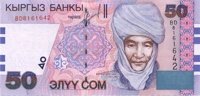
KURMANJAN DATKA – Stateswoman – (1811-1907)
Kurmanjan Datka was an outstanding stateswoman of the Kyrgyz Republic. She is sometimes known as “The Tsarina of Alai”, and “Queen of the South”. The word Datka means “General” and she was awarded the title twice.
Born into a simple nomad family of the Mongush clan in the Alai Mountains, at the age of 18 she was supposed to marry a much older man whom she didn’t see until her wedding day. Breaking with tradition, she ran away, back to her father’s yurt in the Alai. In 1832, the feudal lord, Alimbek – who had taken the title Datka and ruled all the Kyrgyz of the Alai, freed her from the “marriage contract” and married her. Alimbek died after a palace coup in 1862, and Kurmanjan gathered around her the faithful “batyrs” – heroes. It is said that she commanded an army of 10,000 “djigits” – all devoted to her.
She went on to govern the Alai, (she is thought to be the only women to have been granted the role of ruler in the Muslim world), and became regarded as the ‘mother of the nation’. There are many colourful legends about her that attest to the high regard in which she was held by all Kyrgyz – not just those from the South.
In 1876 the Alai region joined the Russian Empire and she established good relationships with many of the governors and Russian officials. She even received two British emissaries on their journey from India to Bukhara who had been rescued from a snowstorm by some of her ‘djigits’.
When she was at the height of her power, two of her sons and two grandsons were accused of “contraband” and of murdering customs officials – and even her status could not help to save them. When her favourite son was executed, (hung in the main square of Osh), she refused the urging of some of her followers to effect a rescue, saying that she would not her private hopes and ambitions be the cause of suffering for her people. Her lament has been preserved in the form of a poem. The others were then exiled to penal servitude in Siberia
Kurmanjan, (suffering from insult and shame), retired from public life – giving away all her property and leading a hermit like existence in a village, refusing all visitors. She died on 1st February in the village of Mady, near to Osh – gripping the dressing gown of her favourite son. She was survived by 2 sons, 2 daughters, 31 grandsons, 57 great grandsons and 6 great-great-grandsons. She is also thought to have been a poetess.
100 som
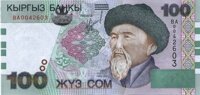
TOKTOGUL – Akyn – (1864-1933)
Toktogul Satylgan uulu was a Kyrgyz poet – regarded as a democrat, a thinker, an outstanding komuzist (a performer of komuz music and improviser). He was born into a poor family in a village near to where the Toktogul reservoir now lies. His mother was a good singer and he began singing at the age of eight. Later, as a shepherd, he made up songs about the hardships of his life – a theme recurrent throughout all his life. He remained poor throughout his life – even losing his beloved to a richer man – and he always performed at gatherings of poor people – not for the rich, about whom he composed derogatory verses describing how they exploited the masses. (He seems to have had a talent for this – he turned “professional” at the age of eighteen after winning a traditional competition in which two contestants made up derogatory verses about each other.) The manaps (aristocracy) were unhappy about his and he was accused of participating in an uprising against the Russians – and sentenced to exile in Siberia. He escaped once – but was recaptured – and a second attempt was also unsuccessful. On a third attempt, in 1910, he was successful, aided by rum ours spread by his friends that he had drowned. His later songs have many references to his Russian friends – Semen and Hariton – who helped him escape from his penal servitude. At first, praised by the Soviets as a socialist – it is said that democratic ideas in Kyrgyz history began with him, and that Kyrgyz poetry dates from 1919 when he sang a eulogy of Lenin for the local Commissar – he later fell into disfavour with the authorities.
His life and work are usually divided into four periods: the first “Before Siberia” period is characterized by traditional folk songs and lyrical love songs; the second by songs of advice and admonition; the third marks his return from Siberia and the before the Soviet Union – and includes the tragic song, “I have no son” – composed as a lamentation for his son, Topchybay, who died whilst Toktogul was in Siberia; the final period is known as the “Soviet” period when he composed songs such as “Long live Soviet Power” and “What a mother could give birth to such a son as Lenin”.
200 som
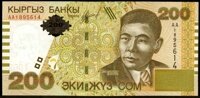
ALYKUL OSMONOV – Poet – (1915-1950)
A Kyrgyz poet and writer, born in the village of Kaptal Aryk in the Chui oblast. He began writing poems early in life, his first published poems appearing when he was only 20. Two years later his first collection of poems was published, and in 1945 the collection which is regarded as his masterpiece, “Mahabat” (=”Love”). Between 1943 and 1948 he wrote several plays – and he translated many literary works into Kyrgyz – including Pushkin’s “Evgeny Onegin”; Shakespeare’s “Othello” and “Twelfth Night”. (He was called the “Kyrgyz Pushkin”). He wrote in both Kyrgyz and Russian and he also translated many poems, stories, legends and fairy tales from Kyrgyz into Russian.
He was very fond of Lake Issyk Kul and lived in Chalpon Ata – many of his works describe the lake in its different seasons and moods.
He was revered in the Soviet time as an important Soviet writer, and his poems were published in Russian and Estonian as well as his native Kyrgyz. He died at the age of 35 of Pulmonary Pneumonia.
500 som
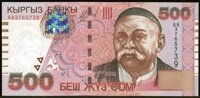
SAYAKBAI KARALAEV – Manaschi – (1894-1971)
One of the great Manashi of the twentieth century – according to the Kazakh author Muhtar Auezov called him the “Homer of the 20th Century”. (Another source suggests that it was Chinghiz Aitmatov that awarded him this title).
Born into a poor family in a small village, Akele, on the shores of Lake Issyk Kul. His mother was out collecting wild berries in the mountains, stepped on a snake and gave birth to him prematurely. According to his own account, he grew up as an ordinary “village lad”, without showing any interest in Manas – and showed only modest talents as a composer.
As a manaschi he had to master half a million lines of epic poetry. His versatile performances veered between tragedies, to lyricism, to dramatic. At times crying, at others laughing, and at others sighing. At first he was greatly influenced by Chouke Omur, a well-known manaschi from Issyk Kul, but about 1925 started to develop his own style. Between 1932 and 1947 he wrote down the entire Manas epos – ‘Manas’, ‘Semetey’ and Seitek’ – totalling over half a million lines of poetry. He performed in Finland and in Moscow as well as in Kyrgyzstan, and received several awards.
1000 som
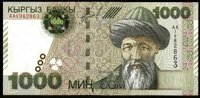
DJUSUP BALASAGIN – Writer and Philosopher
Djusup Balasugin was a writer and thinker born in the ancient city of Balasagin – where the Burana Tower stands, near the site of the present day Tokmok, possibly around 1016.
From a young age, he supposed to have shown his many talents, and after receiving a basic education in his home town he was then sent to the best schools of that era – in Farah, Kashgar and Bukhara. He mastered Arabic and Persian to his native Turkic language – and showed himself a master at philosophy, poetry, politics and science.
He is best known for his work Kutagdu Bilig – which is sometimes translated as ‘The theory of knowledge’, or ‘The Knowledge that Brings Happiness’ – an English translation by Walter May has been published under the title ‘Beneficent Knowledge’. Written in couplets, in the Uighur language, sometime around 1070, it gained for the author a renowned place in the history of Central Asian Literature – and a place at court in Kashgar. One interesting feature, amongst others, which marked it out was that it wasn’t written in either Persian or Arabic – the lingua franca of the period, The Kyrgyz have adopted him as one of their own – largely, perhaps, because his birthplace is located in the territory of the modern republic – but it is not clear if he was himself Kyrgyz. Most of what we know about him is drawn from little snippets of information contained in the poem. The work suggests that he was a highly educated person, skilled in poetic forms, with a wide knowledge of astronomy, mathematics and medicine. It forms a sort of moral code – one of the central themes is the value and supremacy of laws.
5000 som
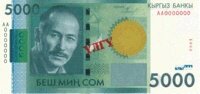
SUIMONKUL CHOKMOROV – Actor and Artist – (1939-1992)
Suimonkul Chokmorov was a Kyrgyz film actor and artist.
Born in the village of Chon Tash, just outside Bishkek, on November 9th, 1939, he was one of seven children with three brothers and three sisters. He fell sick as a child child and was almost crippled, but he went on to play volleyball in an attempt to overcome his illnesses – later playing for both the Kyrgyz and Leningrad teams and being awarded the title Master of Sports. During his illness he stayed with his brother, an teacher of drawing, in the city rather than at home in the village, and it was at this time that he developed a love for painting
He studied at the Frunze Art School and later at the Leningrad Academy of Arts, graduating in 1964 and then taught painting and composition at the Frunze Art School for three years, and became a member of the Union of Artists.
As an artist he worked in several genres: portrait; still life; landscape – Portraits being his favourite
His film career began in 1969, when he landed the major role of Baktygul in the film Shot in the Karash Pass – the first feature film by the, now, famous Kyrgyz Director, Bogs Shamshieva. His film won him four festival awards, (the Soviet Union’s equivalent of an Oscar), and was the only actor to be achieve such a record. His credits included a wide range of roles: historic, dramatic; adventure; contemporary – and he starred in several dramatizations of Chinghiz Aitmatov’s novels.
He died on September 26th, 1992, after a long illness


 Bishkek