NOTW
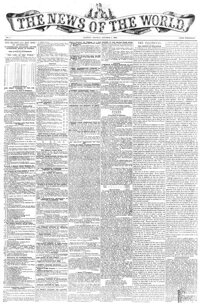
A British institution is about to close. That probably doesn’t mean much to many people who read these postcards; whether they be American, Australian, French, German, Russian, Kyrgyz … or whatever, (although the news has received pretty wide coverage worldwide, for example on CNN). For many of the Brits, even, the news will not necessarily come as a big shock, nor elicit strong feelings of regret and remorse.
The “News of the World”, a British weekly tabloid newspaper is to cease publication after almost 168 years, in the wake of a scandal about journalists’ illegal “hacking” into people’s mobile telephone conversations. Tomorrow’s edition will the last one. Despite statements from the owners, (News Group Newspapers, part of News International, which is in turn a subsidiary of Rupert Murdoch’s News Corporation), about the “shocking” allegations and condemning the activities outlined in them as “inhuman”, and issuing an “unreserved” apology for the actions, according to some pundits, it is a move taken for purely commercial reasons as most of the advertisers have announced that they are cancelling their connection with the paper and the company has made a controversial bid for one of Britain’s major television broadcasters, BSkyB.
Whatever, the newspaper is not unused to controversy. Over the years it has concentrated on celebrity-based scoops, populist news and sex scandals which led to the satirical magazine “Private Eye” giving it the nickname “News of the Screws”. Although, this approach led to several high profile libel actions and considerable payouts in compensation, it also resulted in the newspaper having a huge circulation, (approaching 3 million copies each week), so that its owners could claim that it was read by more people than any other English language newspaper in the world.
Journalists don’t have a particularly good reputation, and this won’t help to improve it. They are often listed as untrustworthy, interested only in “getting the story”, at whatever cost. Lois Lane, (of “Superman”, “Lois and Clark” and “Smallville” fame), may have been ruthless and relentless in search of the byline and willing to stretch, if not break the rules, but, (at least, according to the comic book writers), her heart was always in the right place. I’m not sure that many people would say the same about the current crop of journalists at the NOTW given this scandal.
Despite that, there always seems to be lot of students signing up for Journalism courses.
.
Journalists here in Kyrgyzstan don’t seem to be having any better a time of it. There are often statements about the need to provide better training journalists, and the Press Complaints Commission has received some 20 complaints so far this year. Most of them seem to be directed against certain NGOs and independent journalists, (freelance).
Several journalists have found that it can be quite a dangerous occupation, (as their “victims” seem to take a leaf out of the comic books and try to exercise influence or extract “justice” and “retribution”). The most recent examples are the investigation into the death of a journalist, supposedly thrown from a hotel window in Almaty, and the film crew attacked in Osh.
There was a round table during the week to discuss the safety of journalists, organized by the Organization for Security and Cooperation in Europe, (OSCE). Issues discussed included the general level of respect for different journalism institutions; the extent to which media workers respect ethical and other norms, and “the boundaries of respect and responsibility”. It was hoped that the event would result in a better understanding of the reasons behind the current trend of attacks on, and pressure being brought to bear upon journalists and a common understanding of the roles of the different players, or stakeholders, in the industry.
The particular scandal that led to the demise of the NotW is not exactly new to us. We discovered that the authorities purchased and installed equipment so that they could record all mobile telephone conversations, and it seems to be generally accepted that phone conversations cannot be assumed to be “private” and on several occasions I have heard the phrase, “it’s not for a telephone conversation”, but, to be honest, that often simply means the subject is a little too complicated to explain over the phone rather than a case of “you don’t know who might be listening in”. Although the system was apparently switched off after the revolution, some politicians have said that they think the security services should have the right to listen in … where properly authorized by the prosecutors’ office.
There have also been cases where some telephone conversations have been leaked on sites like youtube, most notably the alleged conversations between Maxim and Janysh Bakiev which seemed to presage the events in Osh last June. It has to be admitted, however, that some of the conversations have declared to be crude forgeries.
It’s not just telephone conversations that are leaked ion social networking sites like youtube. There seems to have been a spate of videos showing officials doing things which raise more than a few questions. There is, for example, a trend to broadcast clips where people have been stopped by the GAI, the traffic police. There was one particular clip which purportedly showed members of the security services raiding bank vaults and private safe deposit boxes shortly after the revolution. This week there was another clip which showed a GSNB, (the local security services, formerly the KGB), recording of a meeting between civil servants and private foreign businessmen.
.
Arrangements for the Presidential election are progressing, but not without a certain amount of controversy. The Central Election Commission has begun its work, but there are some people who are questioning if it has been properly constituted, according to the law. In the meantime, they are establishing the polling stations, local election commissions and making voter lists, as well as preparing for handling nominations and supervising the campaigns such as approving the necessary documentation: regulations and forms..
It looks like being a strange campaign, at least to those of us from a Western Background. Although nominations have yet to be submitted, some people have already expressed an intention to stand: a former regional governor, for example, and it looks as if there may well be three candidates from just one party. Although the President has to give up their party allegiance, it is hard to see how the candidates are going to muster enough support to get the majority vote in the plebiscite, especially if they split their own parties vote.
Whoever gets the job is not going to have an easy time, especially when it comes to economic development. Forbes have announced that the country has the 7th “worst economy” in the world, thanks to its high inflation rate, (estimated to be at 12.6 percent by the International Monetary Fund), its low GDP per capita, (at $943 per year) and 11% unemployment rate, (mind you, I’m not sure that particular figure can be relied upon). It didn’t appear in this notorious “top ten” in last year survey, so let’s hope that it can bounce back again next year.
The budget deficit amounts to something like 21% of GDP according to the Finance Ministry, (around 2 billion som, or about 45 million dollars). Mind you, the government says says that they received something like 250 million dollars from donors during the course of the year, (with something like 71 million already having been received). The government are looking to reduce this through “optimization of expenditures”, which will involve some cuts, (which may not be well received), as well as raising some additional funds from the sale of nationalized assets.
One thing that might help, could be an increase in tax and other revenues from the mining industry. Apparently, as a result of recent prospecting, something like 47 additional tons of gold have been discovered. All that needs to be done now, is to find a way to extract the mineral from the goldfields.
.
The Customs Union between Russia, Kazakhstan and Belarus is now operational and this involve new tariffs and tightening of controls and checks on the borders. According to the Freight Forwarders Association, this is causing considerable delays – whereas lorries might be held for 2 hours whilst completing formalities, they can now be held for up to 2 days. One other interesting comment in the press conference was “unofficial fees” charged by customs officials have increased by 400% – from USD100 to USD400. These unofficial fees “activates the single window mechanism: you give one bribe for all to them, they quickly process documents and let you go. This is illegal, but if you do not give it, they will protract the process. You will lose time and will have to pay more in the end”.
This will all have a big impact on the two largest markets in the country, (Dordoi, just outside Bishkek and Kara Suu, down near Osh and Djalal Abad in the south). These two markets are important as a lot of Kyrgyzstan’s international trade passes through them and, as a result, the government are preparing a program for the development of these two markets in the new circumstances.
Apparently, so am I told, the new customs regime on the border means that Russian customs officers have appeared on the Kazakh-Kyrgyz border. Of the 12 existing border crossings, only half are actually operating at the moment and the main crossing point, just outside Bishkek, is vastly over worked. Something like 32,000 people crossing every day, although it was originally designed to handle just 7-8,000 people a day … hence the massive queues. To try and ease the situation, some other border crossings are planned to re-open and it is hoped that this should make life easier for the Kazakh tourists coming to take a vacation on Lake Issyk Kul.
Another thing that should help, is the establishment of regular flights from Almaty to the newly renovated airport at Tamchi on the northern share of the lake.
Although there are tourists arriving to Issyk Kul, the number is expected to decline once more after an incident in one of the resorts, a quarrel between some police officers and holiday makers turned into an affray and actually into a “firefight”. It was worse than a “normal” holiday “brawl”, (“drunken” or otherwise), in that five people were injured and treated in hospitals in Bishkek. Some of the local residents, upset at heavy handed approach of the police officers, then staged a protest rally outside the local police headquarters. Although everything is, apparently, now peaceful, the publicity given to the event, especially in neighbouring countries, is unlikely to encourage potential holiday makers to consider Issyk Kul as an ideal destination for rest and relaxation.
Mind you, even if they decide that they want to come to Kyrgyzstan, visitors from Britain might face another difficulty. Apparently the Kyrgyz Embassy in London has run out of Visa stickers to stick in passports, and won’t be able to resume issuing visas for another week.
Some of the resort owners on Lake Issyk Kul are up in arms because, they say, some local officials are “forcing” them to sign contracts involving commitments to help in the “fight against poverty” … the contract obliges the resorts to hire a proportion of their workforce from residents of the district; to buy a proportion of products local farms; to build new buildings on the territory of the holiday hotel only with the sanction of the head of the district, (which I thought was a legal requirement, anyway); to use local resources during the construction; to provide financial aid to veterans of the Great Patriotic War, (the Second World War), Chernobyl and Afghanistan, low-income families, children with disabilities and orphans. In return, the authorities promise to control the quality of farm produce, (how?); to find a sanctioned place for a garbage dump, (I thought that was their responsibility, anyway) and to help in organization of cultural leisure for guests in the resort, (it’s not clear what is meant by this). Now, although some of these may be sensible, “good business practice”, (employing local people and buying local goods), are others are admirable examples of CSR, (Commercial Social Responsibility), it’s hard to see how such a “contract” can be “forced” onto a business, yet alone enforced. We’ve come across similar suggestions, before, in both Bishkek and Naryn, but they have been just that – suggestions – and there has never been mention of a “contract”, or being forced to do anything. I wonder if we’ll hear any more about this in the future or if it will simply sink into the quagmire of other news.
.
As an aside, I came across this comment on one of the social networking sites, (from a Kyrgyz member), which I thought was worth sharing:
Six Miracles of Socialism:
-There is no unemployment, but no one works.
-No one works, but everyone gets paid.
-Everyone gets paid, but there is nothing to buy with the money.
-No one can buy anything, but everyone owns everything.
-Everyone owns everything, but no one is satisfied.
-No one is satisfied, but 99 percent of the people vote for the system.





 Bishkek