Ella Maillart – Riding Solo through Soviet Turkestan
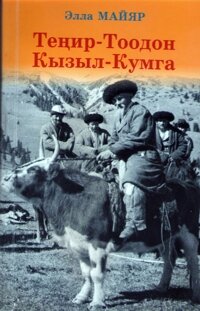
The name of Ella Maillart may not be one of those that immediately springs to mind either when thinking of Kyrgyzstan, explorers or travellers. Her story, however, is quite extraordinary.
In the 1930′s she undertook a journey through Soviet Turkestan, (though parts of present day Kyrgyzstan and Uzbekistan), writing a book about her experiences: “Turkestan Solo“. It has just been translated into Kyrgyz and published by the Swiss charity Pamir Bridges, with the support of the Swiss Cooperation Office in Kyrgyzstan. It has a print run of 2000 copies, (which is actually quite good for Kyrgyzstan), many of which will be donated to libraries in rural schools.
What’s more, it is planned to open a “Maillart Museum” in Karakol, in August.
So … just who was this Ella Maillart?
Born in Geneva, Switzerland in February 1903, Ella Maillart’s father was a Swiss fur-trader and her mother was Danish. As a young girl she was interested in sports as well as maps and reading adventure books.
An active person, she learned to sail on Lake Geneva, (representing her native Switzerland in sailing at the 1924 Olympics), and was an avid skier (she was a four-times member of the Swiss Nation Skiing team). She also played hockey and rowed.
During a restless youth she tries her luck at various occupations – as a typist, a teacher of French, a commercial traveller, a model for a sculptor, an actress, and even as a stunt woman in the German film industry.
It was whilst she was in Berlin, in 1929, that she met some Russian émigrés and was inspired to visit Moscow with the aim of writing some newspaper articles. On her visit to Russia she travelled into remote regions of the Caucasus Mountains and thus began a lifelong “love-affair” with travel to the far corners of the world and experiencing lifestyles and traditions from a bygone age – which were under threat of disappearing as the twentieth century encroached upon them.
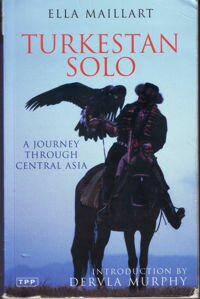
She wrote a book about her journey and this enabled her to undertake a second trip, in 1932, which she describes in her book “Turkestan Solo”. This was a difficult time for the peoples of Central Asia. In 1930 Stalin had begun to enforce a policy of collectivization throughout the Soviet Union and this created many hardships for the traditional nomadic peoples such as the Kyrgyz and Kazakhs who were dependent on their livestock to support themselves and for their livelihoods. Although it would not have been obvious to her at the time, the results were catastrophic. Within two years, for example, the Kazakhs were to lose more than half their population – dying from starvation whilst another 15% were to emigrate.
In the first part of the book, from Moscow she travels by train south to Frunze (now Bishkek) and then through the Celestial Tien Shan Mountains to the edge of the Chinese border, then back to Almaty. In the second part she describes how she travelled to Tashkent, explored the ancient cities of Tashkent, Samarkand, Bukhara and Khiva. She describes her concerns for the future of the traditional lifestyles of the people as the Soviet attempt to bring the twentieth century to them, her encounters with locals, with bureaucracy, with nature. All this at a time when the region was still agitated by the recent Basmachi uprising, and when there was a prevailing suspicion of foreigners.
“Turkestan Solo”, (originally published in French in 1932 and now also available in German, Dutch – and the second part, dealing with Uzbekistan, in Italian), offers an insight into the life and times of the early Soviet Union. Although some of the scenes which she recounts might still be encountered in some of the more remote regions, most belong well in the past and, as one of the characters remarks, “You won’t find that any more”, and it is full of interesting vignettes, (all the more interesting because of their contemporary nature and graphic detail – in some cases very graphic detail), such as:
- visits to a political exiles recording their comments on the Soviet treatment of the “natives” amongst other topics;
- a camel train passing in the night;
- descriptions of toilet facilities – a problem then as now – and the modernizing “improvements” being introduced;
- how she ascended a 5000 meter mountain;
- a chance meeting with one of the negro specialists helping the Soviet authorities develop the cotton industry in Uzbekistan;
- the trial of a group of Basmachi rebels;
- riding across a desert in subzero temperatures on a camel to the eastern shores of the Aral Sea.
The book was a great success and led her being commissioned to undertake yet further adventures. Perhaps her most famous journey was from Peking to Kashgar, accompanied by the Times journalist, Peter Fleming. Two contrasting and complementary accounts of the journey have been published, “His” – News from Tartary, and “Hers” – Forbidden Journey.
As impressive as her achievement in this completing this journey might have been, however, according to Dervala Murphy in her introduction to Turkestan Solo, Ella Maillart, herself, thought that her trek through the Tien Shan was a “far more difficult” undertaking.
Further journeys followed one on the other: to Lebanon, Turkey, India, Iran, Afghanistan, Nepal and Tibet – always travelling, taking photographs, writing and giving lectures.
Throughout her eventful life many the names of many notable historical characters make an appearance, including: Jack London’s wife, Countess Tolstoy, the Russian film producer Pudovkin, the philosopher Teilhard de Chardin, Sven Hedin, and Paul Morand.
She died at home in Switzerland in March 1997. The Saint-Barbe chapel in Chandolin, (her “home base” for over half a century), is now dedicated as a museum to her life and work with a permanent display of photographs, documents, drawings, articles, posters and objects connected with her travels.
_____
29/10/11
I have just met Ishen Obolbekov, who has been involved with this project and he gave me a copy of the book and told me a little about the translation process from the original French text. It’s a handy pocket sized book, smaller than the English edition that sits on my bookshelf.
I just wish that I could read Kyrgyz so that I could reread it … but I already have a queue of people who want to borrow it.
He also told me about his visit to the Ella Maillart museum which he highly recommends as worthy of a visit for anyone who is interested in this fascinating woman or her travels through this part of the world.


 Bishkek